 Add to Chrome
 Add to Firefox
 Add to Edge
Scalable Long-Horizon Planning with Staggered Updates for Lifelong MAPF
Aug 07, 2026
Lifelong Multi-Agent Path Finding (LMAPF) requires generating collision-free paths for large agent fleets under strict real-time constraints. Reactive frameworks such as PIBT and Enhanced PIBT (EPIBT) scale effortlessly to thousands of agents through rule-based, step-by-step coordination but suffer from severe temporal myopia, making them ineffective in scenarios where long-horizon reasoning is essential. RHCR plans windowed paths over multi-step horizons but incurs substantial planning overheads that hinder scalability. TP tackles both challenges by planning only subsets of agents at each timestep, yet its applicability is restricted to highly structured maps. To achieve long-horizon planning at scale across general maps, we propose Path Updates over Staggered Horizons (PUSH), a LMAPF planner capable of coordinating thousands of agents in under a second while planning over multi-step horizons. PUSH combines the key advantages of PIBT, RHCR, and TP. Like TP, PUSH reduces computational complexity by planning only a subset of agents at each timestep using staggered planning windows. Unlike TP, however, PUSH plans RHCR-style windowed paths in general maps without relying on restrictive map assumptions. To maintain high throughput in congested environments, PUSH further integrates EPIBT-inspired priority inheritance, backtracking, and anytime improvements into its windowed planning. Empirical evaluations across two realistic MAPF scenarios requiring long-horizon reasoning show that PUSH scales to the same massive agent loads as EPIBT (e.g., 10k agents) while achieving significantly higher system throughput than all baselines.

Diffusion for Long-Horizon Multi-Robot Path Planning in Human-Shared Environments
Jul 10, 2026Multi-robot path planning in human-shared environments requires a delicate balance between robust inter-robot coordination and socially aware behavior. While diffusion models excel at generating predictable, human-like paths, existing generative planners are often restricted to paths of fixed duration and high computational latency, limiting their adaptability to varying goal distances and hindering real-time deployment. We present Multi-Robot Rolling Diffusion (MRRD), a novel framework that enables real-time, long-horizon navigation for large robot teams through dense crowds. MRRD combines a rolling-horizon scheme to accommodate the limited prediction horizon of human motion, parallelized diffusion inference for scalable generation of human-like paths, and a conflict-based-search mechanism for resolving inter-robot collisions. It further incorporates urgency-based temporal conditioning to generate paths with varying speeds and employs differentiated guidance terms to maximize both social awareness around humans and efficient coordination between robots. Experimental results in crowded environments demonstrate that MRRD successfully scales to 15 robots in real-time, significantly outperforming existing baselines in both safety and mission success rates.
Illusion3D: 3D Multiview Illusion with 2D Diffusion Priors
Dec 12, 2024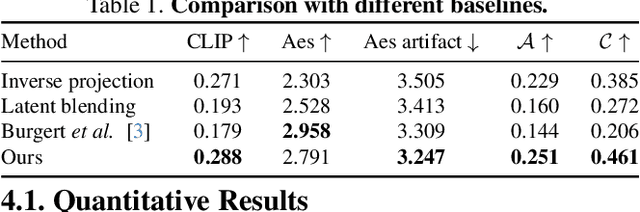

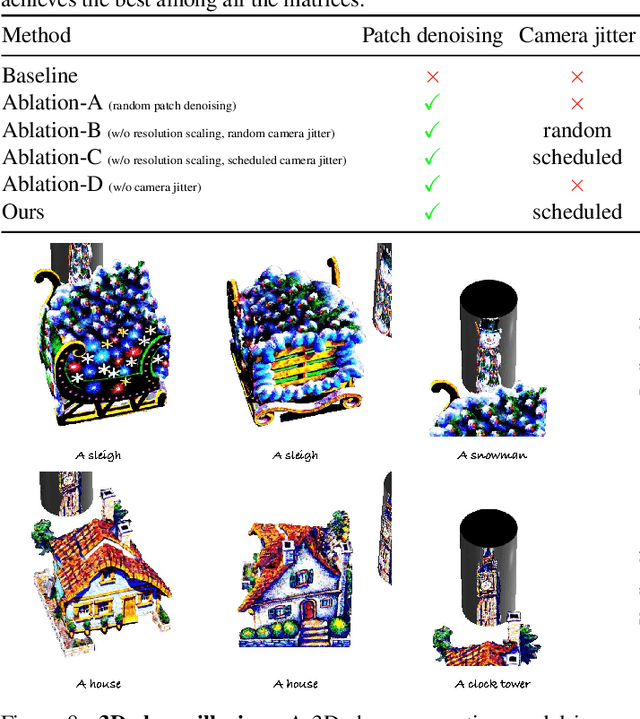
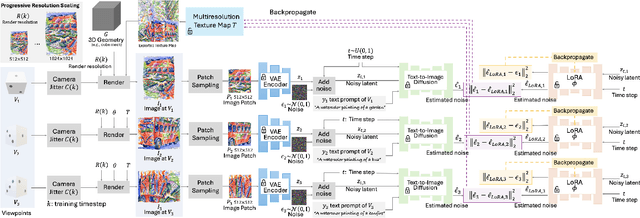
Automatically generating multiview illusions is a compelling challenge, where a single piece of visual content offers distinct interpretations from different viewing perspectives. Traditional methods, such as shadow art and wire art, create interesting 3D illusions but are limited to simple visual outputs (i.e., figure-ground or line drawing), restricting their artistic expressiveness and practical versatility. Recent diffusion-based illusion generation methods can generate more intricate designs but are confined to 2D images. In this work, we present a simple yet effective approach for creating 3D multiview illusions based on user-provided text prompts or images. Our method leverages a pre-trained text-to-image diffusion model to optimize the textures and geometry of neural 3D representations through differentiable rendering. When viewed from multiple angles, this produces different interpretations. We develop several techniques to improve the quality of the generated 3D multiview illusions. We demonstrate the effectiveness of our approach through extensive experiments and showcase illusion generation with diverse 3D forms.
Dynamically Finding Optimal Observer States to Minimize Localization Error with Complex State-Dependent Noise
Nov 30, 2022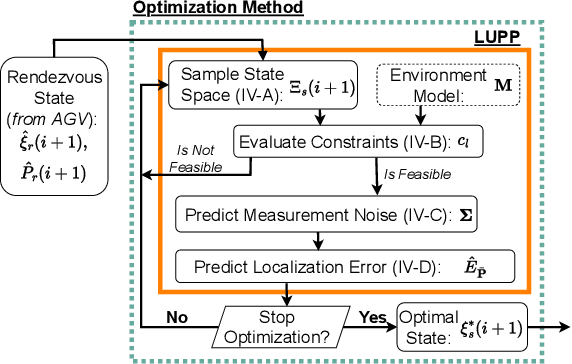
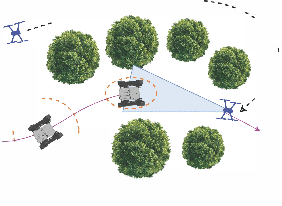
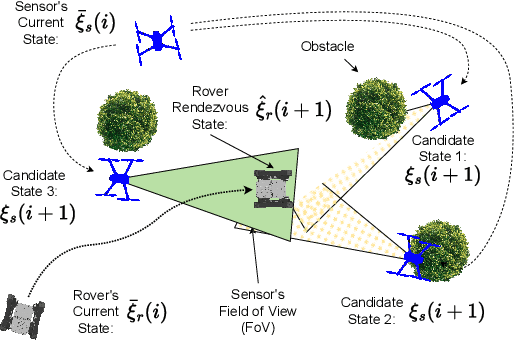
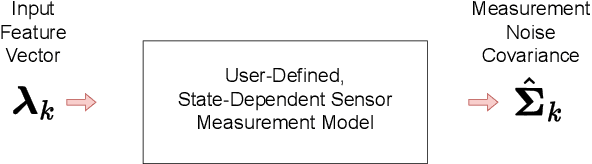
We present DyFOS, an active perception method that Dynamically Finds Optimal States to minimize localization error while avoiding obstacles and occlusions. We consider the scenario where a ground target without any exteroceptive sensors must rely on an aerial observer for pose and uncertainty estimates to localize itself along an obstacle-filled path. The observer uses a downward-facing camera to estimate the target's pose and uncertainty. However, the pose uncertainty is a function of the states of the observer, target, and surrounding environment. To find an optimal state that minimizes the target's localization uncertainty, DyFOS uses a localization error prediction pipeline in an optimization search. Given the states mentioned above, the pipeline predicts the target's localization uncertainty with the help of a trained, complex state-dependent sensor measurement model (which is a probabilistic neural network in our case). Our pipeline also predicts target occlusion and obstacle collision to remove undesirable observer states. The output of the optimization search is an optimal observer state that minimizes target localization uncertainty while avoiding occlusion and collision. We evaluate the proposed method using numerical and simulated (Gazebo) experiments. Our results show that DyFOS is almost 100x faster than yet as good as brute force. Furthermore, DyFOS yielded lower localization errors than random and heuristic searches.