 Add to Chrome
 Add to Firefox
 Add to Edge
An AI-Based Decision-Support Pipeline for Day-Ahead Photovoltaic Forecasting
Aug 03, 2026
Reliable photovoltaic (PV) forecasts are needed for low-carbon energy systems, but newly deployed sites often have short, imperfect records. This makes standard day-ahead forecasting difficult: persistence and physical baselines can be sensitive to calibration and timestamp alignment, while single machine-learning models may capture only one structure in the data and overstate skill under non-temporal validation. We study this problem at a United Kingdom charging-station site, where PV forecast errors affect charging availability, storage scheduling, and downstream control. Using measured inverter output and publicly available meteorological inputs, we develop a deployment-oriented environmental-AI pipeline for day-ahead hourly PV forecasting. The pipeline corrects timestamp conventions, constructs leakage-safe solar-geometry and clearness-index features, adds short-term atmospheric context, and combines complementary predictors through validation-learned stacking. Against smart persistence, a clear-sky baseline that adjusts recent PV output using expected clear-sky irradiance, the best ensemble reduces daylight normalised RMSE by about 32% under random day-blocked evaluation and 9% under the stricter rolling-origin protocol. It also reduces daylight RMSE relative to the strongest individual machine-learning baseline by 6.6% and 6.4%, respectively. The results show that physics-aware stacking can support PV forecasts from limited site data, but its value depends on model class, evaluation protocol, and deployment context.

Instruction-Conditioned Exploration with Asymmetric Reinforcement Learning and Self-Distillation
Aug 03, 2026Post-training Large Language Models (LLMs) with Reinforcement Learning (RL) has become an important tool for improving model capabilities, but the LLM action-space structure introduces challenges distinct from classical RL, with implications for inducing exploration. New methods are required that leverage the broad knowledge and flexibility of pre-trained LLMs to deliberately generate diverse experience at training time. We propose Instruction-Conditioned Exploration (ICE), which supplements task prompts during training with one of several distinct instructions, increasing the coverage of behaviours attempted. To facilitate ICE, we propose Asymmetric-RL/SD, a combined Reinforcement Learning and Self-Distillation training objective, to transfer explored behaviours to the unconditioned test-time policy. ICE with the Asymmetric-RL/SD objective improves Qwen3-1.7B held-out pass@1 performance at $4$K response length on mathematical reasoning tasks by $5.0\%$ relative to training with DAPO, with improvement persisting at a longer 8K context.
Facilitating Automated Online Consensus Building through Parallel Thinking
Mar 16, 2025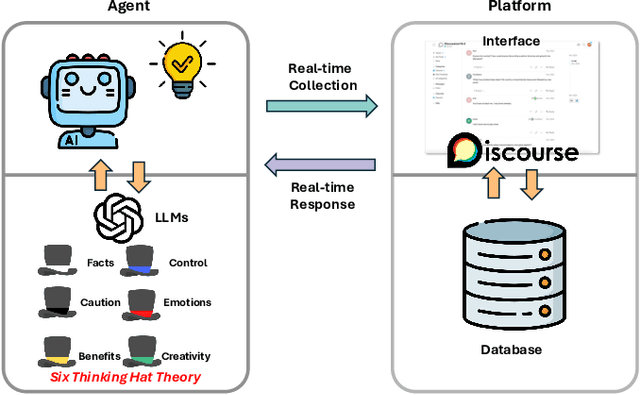

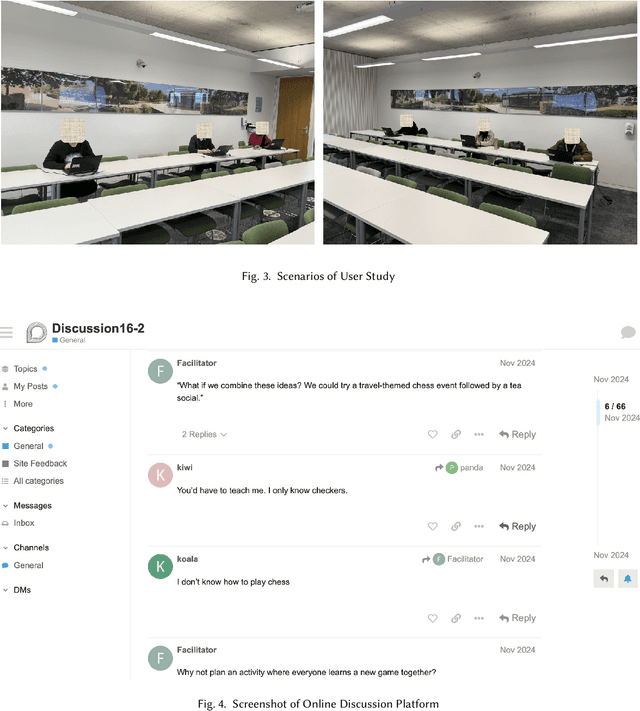
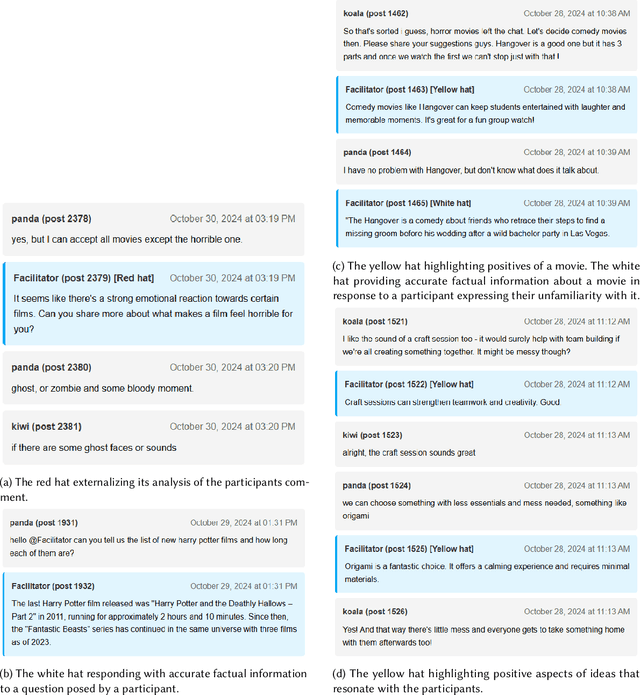
Consensus building is inherently challenging due to the diverse opinions held by stakeholders. Effective facilitation is crucial to support the consensus building process and enable efficient group decision making. However, the effectiveness of facilitation is often constrained by human factors such as limited experience and scalability. In this research, we propose a Parallel Thinking-based Facilitation Agent (PTFA) that facilitates online, text-based consensus building processes. The PTFA automatically collects textual posts and leverages large language models (LLMs) to perform all of the six distinct roles of the well-established Six Thinking Hats technique in parallel thinking. To illustrate the potential of PTFA, a pilot study was carried out and PTFA's ability in idea generation, emotional probing, and deeper analysis of ideas was demonstrated. Furthermore, a comprehensive dataset that contains not only the conversational content among the participants but also between the participants and the agent is constructed for future study.
From Intelligent Agents to Trustworthy Human-Centred Multiagent Systems
Oct 05, 2022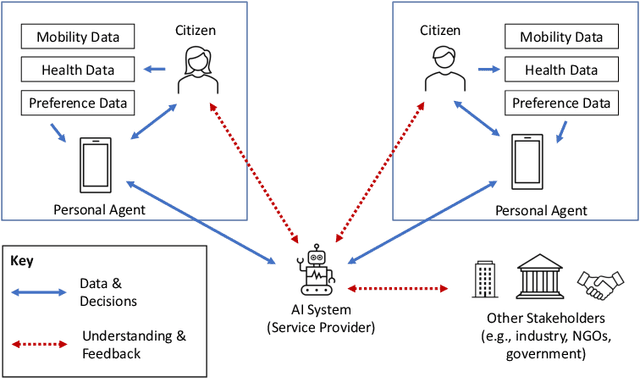
The Agents, Interaction and Complexity research group at the University of Southampton has a long track record of research in multiagent systems (MAS). We have made substantial scientific contributions across learning in MAS, game-theoretic techniques for coordinating agent systems, and formal methods for representation and reasoning. We highlight key results achieved by the group and elaborate on recent work and open research challenges in developing trustworthy autonomous systems and deploying human-centred AI systems that aim to support societal good.
* Appears in the Special Issue on Multi-Agent Systems Research in the United Kingdom
Coordinating Multiagent Industrial Symbiosis
Jun 02, 2020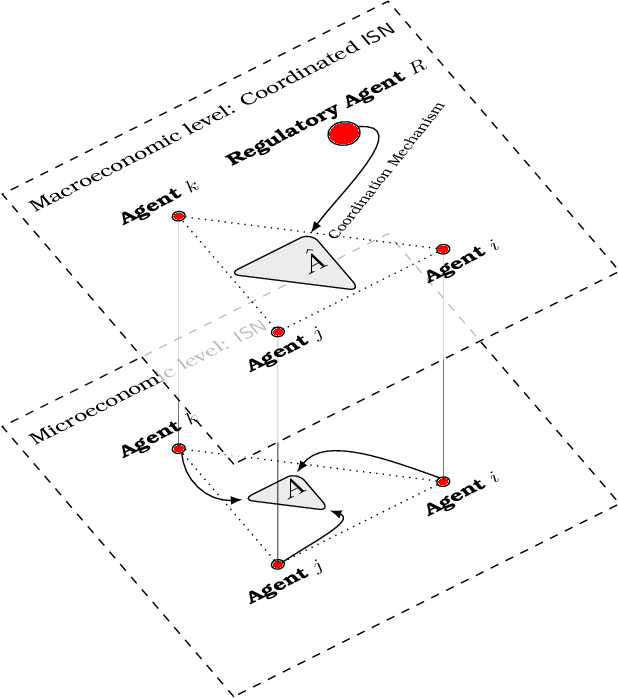
We present a formal multiagent framework for coordinating a class of collaborative industrial practices called Industrial Symbiotic Networks (ISNs) as cooperative games. The game-theoretic formulation of ISNs enables systematic reasoning about what we call the ISN implementation problem. Specifically, the characteristics of ISNs may lead to the inapplicability of standard fair and stable benefit allocation methods. Inspired by realistic ISN scenarios and following the literature on normative multiagent systems, we consider regulations and normative socio-economic policies as coordination instruments that in combination with ISN games resolve the situation. In this multiagent system, employing Marginal Contribution Nets (MC-Nets) as rule-based cooperative game representations foster the combination of regulations and ISN games with no loss in expressiveness. We develop algorithmic methods for generating regulations that ensure the implementability of ISNs and as a policy support, present the policy requirements that guarantee the implementability of all the desired ISNs in a balanced-budget way.
Quantified Degrees of Group Responsibility (Extended Abstract)
Jan 23, 2018This paper builds on an existing notion of group responsibility and proposes two ways to define the degree of group responsibility: structural and functional degrees of responsibility. These notions measure the potential responsibilities of (agent) groups for avoiding a state of affairs. According to these notions, a degree of responsibility for a state of affairs can be assigned to a group of agents if, and to the extent that, the group has the potential to preclude the state of affairs.