 Add to Chrome
 Add to Firefox
 Add to Edge
Instruction-Conditioned Exploration for Reinforcement Learning with Self-Distillation to an Unconditioned Policy
Aug 05, 2026
Post-training Large Language Models (LLMs) with Reinforcement Learning (RL) has become an important tool for improving model capabilities, but the LLM action-space structure introduces challenges distinct from classical RL, with implications for inducing exploration. New methods are required that leverage the broad knowledge and flexibility of pre-trained LLMs to deliberately generate diverse experience at training time. We propose Instruction-Conditioned Exploration (ICE), which appends one of a small fixed set of instructions to task prompts during training, using the same set for every problem, increasing the coverage of behaviours attempted. To facilitate ICE, we combine RL on the instruction-conditioned policy with self-distillation of its correct rollouts into the unconditioned test-time policy. ICE with this objective improves Qwen3-1.7B held-out pass@1 performance at 4K response length on mathematical reasoning tasks by $5.0\%$ relative to training with DAPO, with improvement persisting at a longer 8K context. The improvement does not appear for Qwen3-4B at 4K, where the instructions do not expand base-model coverage.

Instruction-Conditioned Exploration with Asymmetric Reinforcement Learning and Self-Distillation
Aug 03, 2026Post-training Large Language Models (LLMs) with Reinforcement Learning (RL) has become an important tool for improving model capabilities, but the LLM action-space structure introduces challenges distinct from classical RL, with implications for inducing exploration. New methods are required that leverage the broad knowledge and flexibility of pre-trained LLMs to deliberately generate diverse experience at training time. We propose Instruction-Conditioned Exploration (ICE), which supplements task prompts during training with one of several distinct instructions, increasing the coverage of behaviours attempted. To facilitate ICE, we propose Asymmetric-RL/SD, a combined Reinforcement Learning and Self-Distillation training objective, to transfer explored behaviours to the unconditioned test-time policy. ICE with the Asymmetric-RL/SD objective improves Qwen3-1.7B held-out pass@1 performance at $4$K response length on mathematical reasoning tasks by $5.0\%$ relative to training with DAPO, with improvement persisting at a longer 8K context.
Facilitating Automated Online Consensus Building through Parallel Thinking
Mar 16, 2025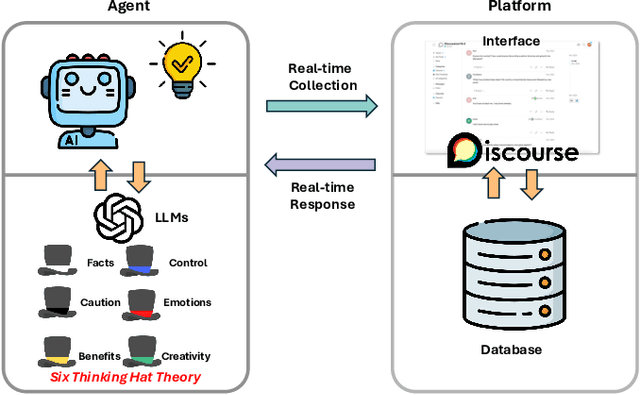

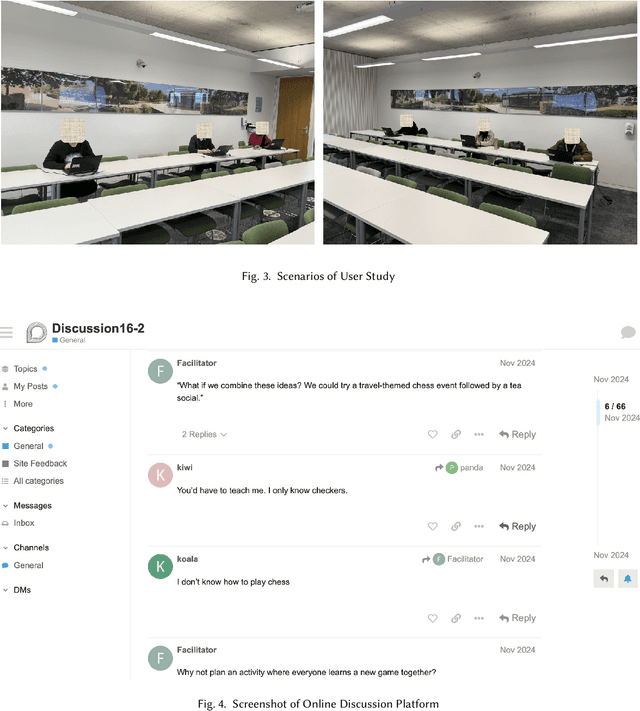
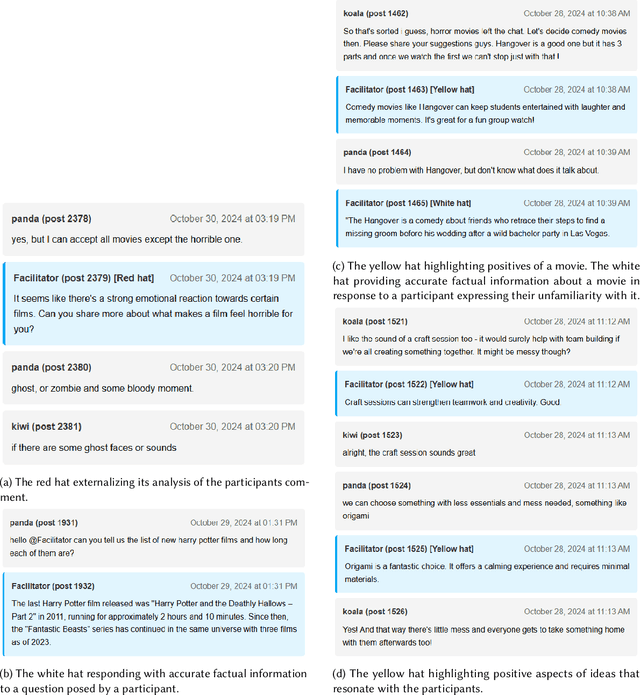
Consensus building is inherently challenging due to the diverse opinions held by stakeholders. Effective facilitation is crucial to support the consensus building process and enable efficient group decision making. However, the effectiveness of facilitation is often constrained by human factors such as limited experience and scalability. In this research, we propose a Parallel Thinking-based Facilitation Agent (PTFA) that facilitates online, text-based consensus building processes. The PTFA automatically collects textual posts and leverages large language models (LLMs) to perform all of the six distinct roles of the well-established Six Thinking Hats technique in parallel thinking. To illustrate the potential of PTFA, a pilot study was carried out and PTFA's ability in idea generation, emotional probing, and deeper analysis of ideas was demonstrated. Furthermore, a comprehensive dataset that contains not only the conversational content among the participants but also between the participants and the agent is constructed for future study.