 Add to Chrome
 Add to Firefox
 Add to Edge
Instruction-Conditioned Exploration for Reinforcement Learning with Self-Distillation to an Unconditioned Policy
Aug 05, 2026
Post-training Large Language Models (LLMs) with Reinforcement Learning (RL) has become an important tool for improving model capabilities, but the LLM action-space structure introduces challenges distinct from classical RL, with implications for inducing exploration. New methods are required that leverage the broad knowledge and flexibility of pre-trained LLMs to deliberately generate diverse experience at training time. We propose Instruction-Conditioned Exploration (ICE), which appends one of a small fixed set of instructions to task prompts during training, using the same set for every problem, increasing the coverage of behaviours attempted. To facilitate ICE, we combine RL on the instruction-conditioned policy with self-distillation of its correct rollouts into the unconditioned test-time policy. ICE with this objective improves Qwen3-1.7B held-out pass@1 performance at 4K response length on mathematical reasoning tasks by $5.0\%$ relative to training with DAPO, with improvement persisting at a longer 8K context. The improvement does not appear for Qwen3-4B at 4K, where the instructions do not expand base-model coverage.

Instruction-Conditioned Exploration with Asymmetric Reinforcement Learning and Self-Distillation
Aug 03, 2026Post-training Large Language Models (LLMs) with Reinforcement Learning (RL) has become an important tool for improving model capabilities, but the LLM action-space structure introduces challenges distinct from classical RL, with implications for inducing exploration. New methods are required that leverage the broad knowledge and flexibility of pre-trained LLMs to deliberately generate diverse experience at training time. We propose Instruction-Conditioned Exploration (ICE), which supplements task prompts during training with one of several distinct instructions, increasing the coverage of behaviours attempted. To facilitate ICE, we propose Asymmetric-RL/SD, a combined Reinforcement Learning and Self-Distillation training objective, to transfer explored behaviours to the unconditioned test-time policy. ICE with the Asymmetric-RL/SD objective improves Qwen3-1.7B held-out pass@1 performance at $4$K response length on mathematical reasoning tasks by $5.0\%$ relative to training with DAPO, with improvement persisting at a longer 8K context.
An AI-Based Decision-Support Pipeline for Day-Ahead Photovoltaic Forecasting
Aug 03, 2026Reliable photovoltaic (PV) forecasts are needed for low-carbon energy systems, but newly deployed sites often have short, imperfect records. This makes standard day-ahead forecasting difficult: persistence and physical baselines can be sensitive to calibration and timestamp alignment, while single machine-learning models may capture only one structure in the data and overstate skill under non-temporal validation. We study this problem at a United Kingdom charging-station site, where PV forecast errors affect charging availability, storage scheduling, and downstream control. Using measured inverter output and publicly available meteorological inputs, we develop a deployment-oriented environmental-AI pipeline for day-ahead hourly PV forecasting. The pipeline corrects timestamp conventions, constructs leakage-safe solar-geometry and clearness-index features, adds short-term atmospheric context, and combines complementary predictors through validation-learned stacking. Against smart persistence, a clear-sky baseline that adjusts recent PV output using expected clear-sky irradiance, the best ensemble reduces daylight normalised RMSE by about 32% under random day-blocked evaluation and 9% under the stricter rolling-origin protocol. It also reduces daylight RMSE relative to the strongest individual machine-learning baseline by 6.6% and 6.4%, respectively. The results show that physics-aware stacking can support PV forecasts from limited site data, but its value depends on model class, evaluation protocol, and deployment context.
AdaHome: An Adaptive Smart Home Assistant using Local Small Language Models
Jul 20, 2026Smart home assistants interpret a wide range of user commands, from explicit device control to underspecified and preference dependent requests. While recent systems based on Large Language Models (LLMs) improve this capability, they often rely on heavyweight reasoning pipelines and cloud-based deployment, limiting their efficiency and suitability for resource-constrained environments, and raising privacy concerns. In addition, existing approaches provide limited support for stable long-term personalization. To address these issues, we present AdaHome, an adaptive smart home assistant designed for locally deployed small language models in smart home environments. Rather than applying complex reasoning uniformly, AdaHome introduces an intent-aware planning framework that dynamically routes commands either to straightforward prompt-based or lightweight reasoning-based components. For commands requiring interpretation, we adopt a Chain-of-Draft strategy to enable efficient and stable decision-making. To support personalization, we further propose a preference adaptation mechanism that learns from user feedback over time without requiring prompt augmentation or model retraining. We evaluate AdaHome against representative LLM-based baselines under a unified small model setting. AdaHome achieves substantially higher accuracy on direct commands (86.7%) while reducing latency by up to 3$\times$. Furthermore, it maintains competitive performance on ambiguous inputs with lower computational cost. In multi-turn scenarios, AdaHome achieves 88% preference consistency, compared to 52.5% for a prompt augmentation baseline.
HMCF: A Human-in-the-loop Multi-Robot Collaboration Framework Based on Large Language Models
May 01, 2025Rapid advancements in artificial intelligence (AI) have enabled robots to performcomplex tasks autonomously with increasing precision. However, multi-robot systems (MRSs) face challenges in generalization, heterogeneity, and safety, especially when scaling to large-scale deployments like disaster response. Traditional approaches often lack generalization, requiring extensive engineering for new tasks and scenarios, and struggle with managing diverse robots. To overcome these limitations, we propose a Human-in-the-loop Multi-Robot Collaboration Framework (HMCF) powered by large language models (LLMs). LLMs enhance adaptability by reasoning over diverse tasks and robot capabilities, while human oversight ensures safety and reliability, intervening only when necessary. Our framework seamlessly integrates human oversight, LLM agents, and heterogeneous robots to optimize task allocation and execution. Each robot is equipped with an LLM agent capable of understanding its capabilities, converting tasks into executable instructions, and reducing hallucinations through task verification and human supervision. Simulation results show that our framework outperforms state-of-the-art task planning methods, achieving higher task success rates with an improvement of 4.76%. Real-world tests demonstrate its robust zero-shot generalization feature and ability to handle diverse tasks and environments with minimal human intervention.
Improving Controller Generalization with Dimensionless Markov Decision Processes
Apr 14, 2025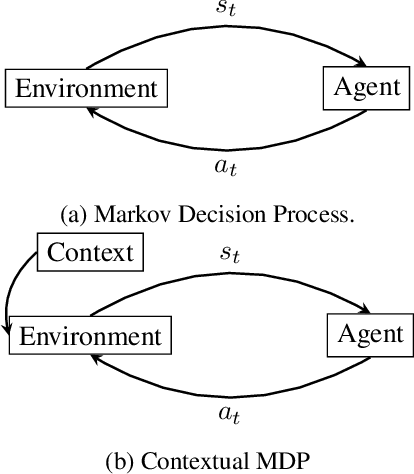
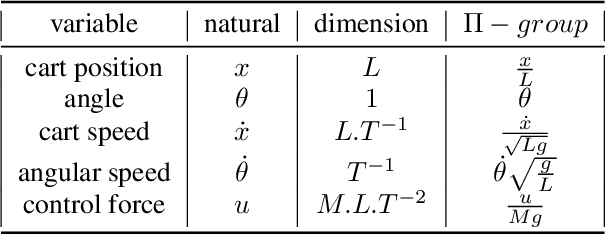
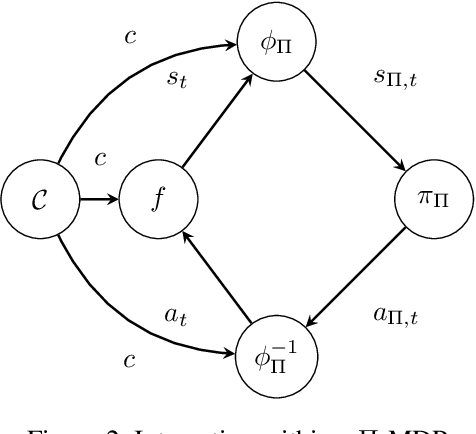
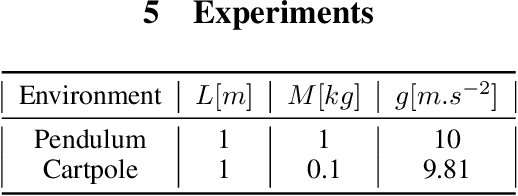
Controllers trained with Reinforcement Learning tend to be very specialized and thus generalize poorly when their testing environment differs from their training one. We propose a Model-Based approach to increase generalization where both world model and policy are trained in a dimensionless state-action space. To do so, we introduce the Dimensionless Markov Decision Process ($\Pi$-MDP): an extension of Contextual-MDPs in which state and action spaces are non-dimensionalized with the Buckingham-$\Pi$ theorem. This procedure induces policies that are equivariant with respect to changes in the context of the underlying dynamics. We provide a generic framework for this approach and apply it to a model-based policy search algorithm using Gaussian Process models. We demonstrate the applicability of our method on simulated actuated pendulum and cartpole systems, where policies trained on a single environment are robust to shifts in the distribution of the context.
Facilitating Automated Online Consensus Building through Parallel Thinking
Mar 16, 2025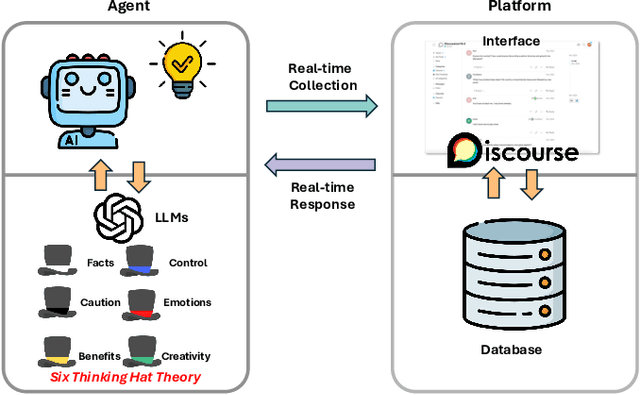

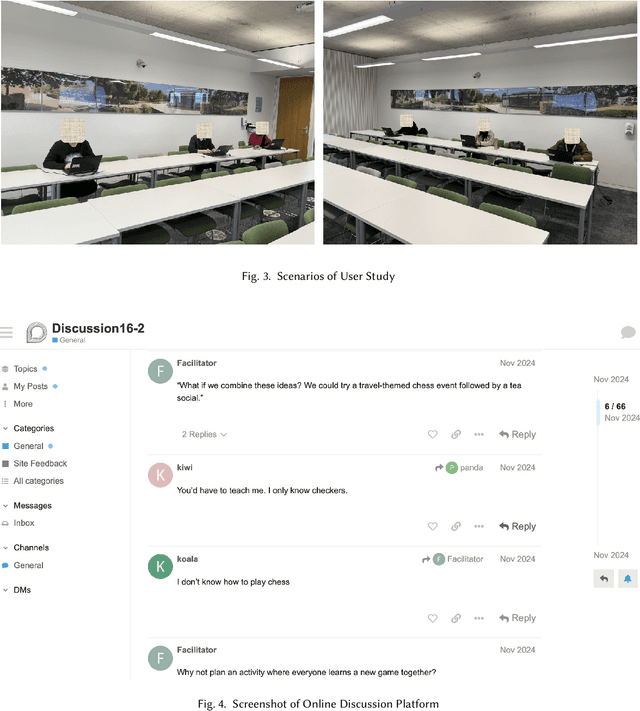

Consensus building is inherently challenging due to the diverse opinions held by stakeholders. Effective facilitation is crucial to support the consensus building process and enable efficient group decision making. However, the effectiveness of facilitation is often constrained by human factors such as limited experience and scalability. In this research, we propose a Parallel Thinking-based Facilitation Agent (PTFA) that facilitates online, text-based consensus building processes. The PTFA automatically collects textual posts and leverages large language models (LLMs) to perform all of the six distinct roles of the well-established Six Thinking Hats technique in parallel thinking. To illustrate the potential of PTFA, a pilot study was carried out and PTFA's ability in idea generation, emotional probing, and deeper analysis of ideas was demonstrated. Furthermore, a comprehensive dataset that contains not only the conversational content among the participants but also between the participants and the agent is constructed for future study.
Active Inference and Human--Computer Interaction
Dec 19, 2024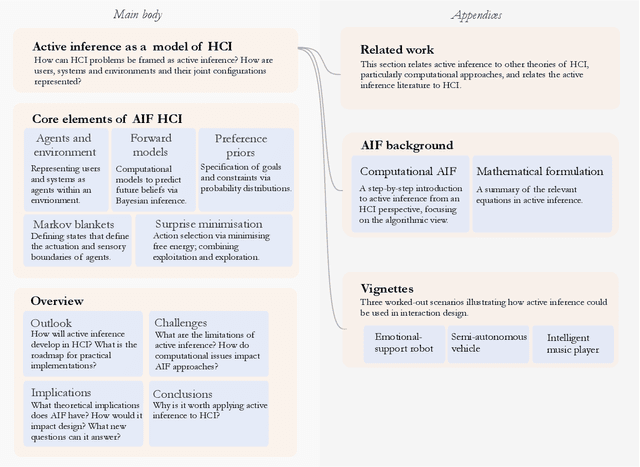
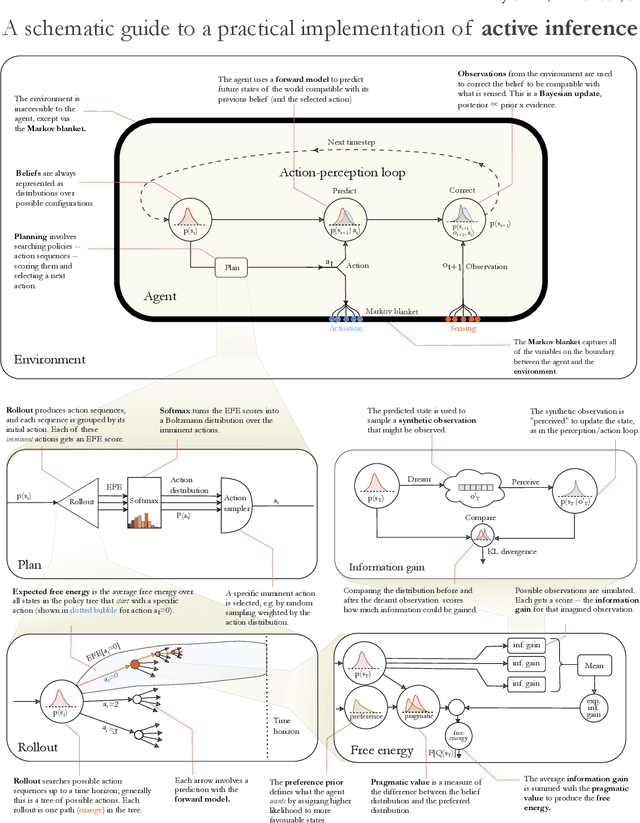

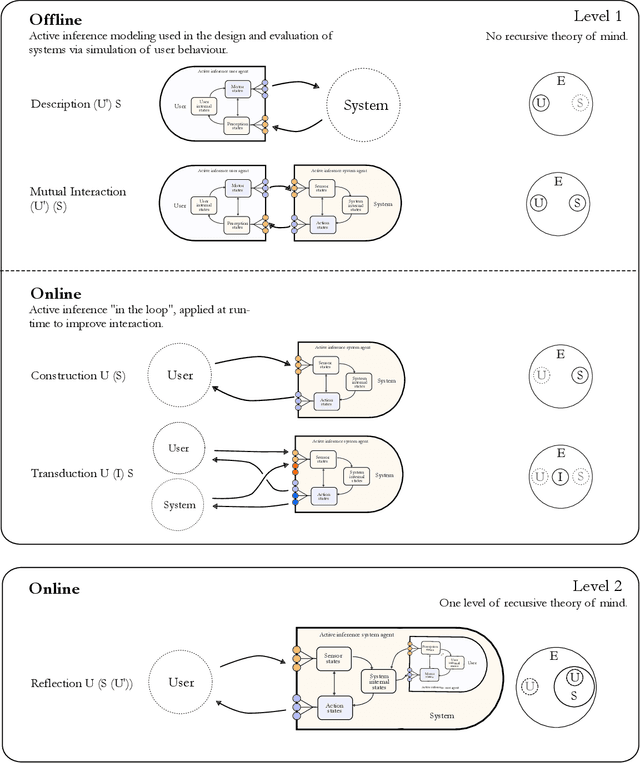
Active Inference is a closed-loop computational theoretical basis for understanding behaviour, based on agents with internal probabilistic generative models that encode their beliefs about how hidden states in their environment cause their sensations. We review Active Inference and how it could be applied to model the human-computer interaction loop. Active Inference provides a coherent framework for managing generative models of humans, their environments, sensors and interface components. It informs off-line design and supports real-time, online adaptation. It provides model-based explanations for behaviours observed in HCI, and new tools to measure important concepts such as agency and engagement. We discuss how Active Inference offers a new basis for a theory of interaction in HCI, tools for design of modern, complex sensor-based systems, and integration of artificial intelligence technologies, enabling it to cope with diversity in human users and contexts. We discuss the practical challenges in implementing such Active Inference-based systems.
Integrating LSTM and BERT for Long-Sequence Data Analysis in Intelligent Tutoring Systems
Apr 24, 2024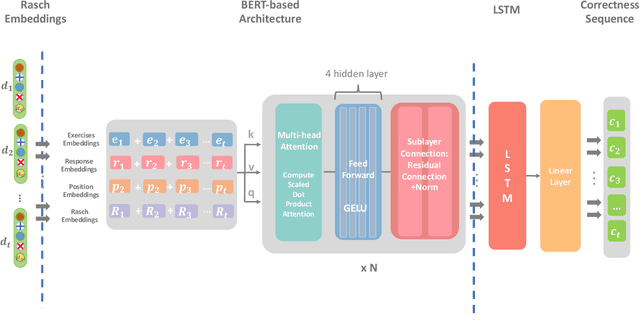
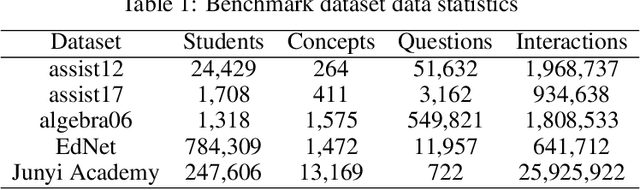
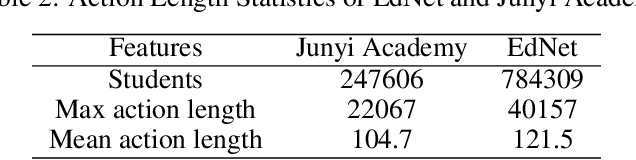
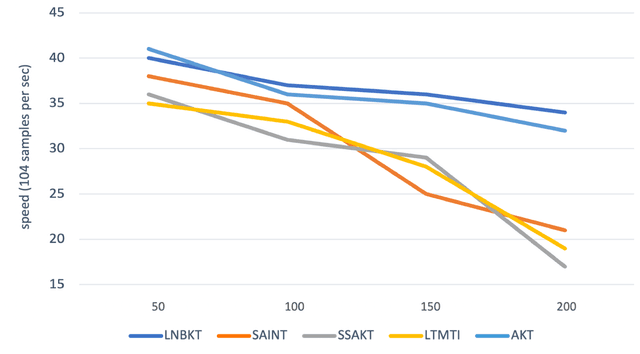
The field of Knowledge Tracing aims to understand how students learn and master knowledge over time by analyzing their historical behaviour data. To achieve this goal, many researchers have proposed Knowledge Tracing models that use data from Intelligent Tutoring Systems to predict students' subsequent actions. However, with the development of Intelligent Tutoring Systems, large-scale datasets containing long-sequence data began to emerge. Recent deep learning based Knowledge Tracing models face obstacles such as low efficiency, low accuracy, and low interpretability when dealing with large-scale datasets containing long-sequence data. To address these issues and promote the sustainable development of Intelligent Tutoring Systems, we propose a LSTM BERT-based Knowledge Tracing model for long sequence data processing, namely LBKT, which uses a BERT-based architecture with a Rasch model-based embeddings block to deal with different difficulty levels information and an LSTM block to process the sequential characteristic in students' actions. LBKT achieves the best performance on most benchmark datasets on the metrics of ACC and AUC. Additionally, an ablation study is conducted to analyse the impact of each component of LBKT's overall performance. Moreover, we used t-SNE as the visualisation tool to demonstrate the model's embedding strategy. The results indicate that LBKT is faster, more interpretable, and has a lower memory cost than the traditional deep learning based Knowledge Tracing methods.
Combinatorial Client-Master Multiagent Deep Reinforcement Learning for Task Offloading in Mobile Edge Computing
Feb 18, 2024Recently, there has been an explosion of mobile applications that perform computationally intensive tasks such as video streaming, data mining, virtual reality, augmented reality, image processing, video processing, face recognition, and online gaming. However, user devices (UDs), such as tablets and smartphones, have a limited ability to perform the computation needs of the tasks. Mobile edge computing (MEC) has emerged as a promising technology to meet the increasing computing demands of UDs. Task offloading in MEC is a strategy that meets the demands of UDs by distributing tasks between UDs and MEC servers. Deep reinforcement learning (DRL) is gaining attention in task-offloading problems because it can adapt to dynamic changes and minimize online computational complexity. However, the various types of continuous and discrete resource constraints on UDs and MEC servers pose challenges to the design of an efficient DRL-based task-offloading strategy. Existing DRL-based task-offloading algorithms focus on the constraints of the UDs, assuming the availability of enough storage resources on the server. Moreover, existing multiagent DRL (MADRL)--based task-offloading algorithms are homogeneous agents and consider homogeneous constraints as a penalty in their reward function. We proposed a novel combinatorial client-master MADRL (CCM\_MADRL) algorithm for task offloading in MEC (CCM\_MADRL\_MEC) that enables UDs to decide their resource requirements and the server to make a combinatorial decision based on the requirements of the UDs. CCM\_MADRL\_MEC is the first MADRL in task offloading to consider server storage capacity in addition to the constraints in the UDs. By taking advantage of the combinatorial action selection, CCM\_MADRL\_MEC has shown superior convergence over existing MADDPG and heuristic algorithms.