 Add to Chrome
 Add to Firefox
 Add to Edge
LiZAD: A Lightweight Zero-Shot Anomaly Detection Framework for Industrial Manufacturing
Jul 02, 2026
In modern high-throughput industrial production lines, product configurations and visual characteristics frequently change, making it impractical to collect and annotate data for every new scenario. This dynamic setting makes Zero-Shot Anomaly Detection (ZSAD) particularly suitable, as it enables defect detection without requiring training on target-specific samples. Although recent ZSAD approaches show promising results, they are computationally intensive and thus unsuitable for deployment on resource-constrained devices. We propose LiZAD: a lightweight framework designed for real-time ZSAD specifically tailored for use on edge devices. The proposed approach pairs the dense and spatially aware visual features of DINOv3, crucial for precise pixel-level localization, with the highly computationally efficient text embeddings of MobileCLIP2. These features are then mapped into a shared latent space via low-memory trainable projection heads. Compared to six state-of-the-art ZSAD models, LiZAD achieves an average memory reduction of 61.5%, a parameter reduction of 74.6%, and a speedup of 3.02x in terms of latency. Despite substantial reductions in computational and memory costs, our approach maintains competitive anomaly detection performance, dropping the average P-AUROC by just 6.4% relative to the best state-of-the-art model across the VisA, BTAD, MPDD, and MVTec-AD datasets. Finally, it is successfully deployed on the NVIDIA Jetson NX and Jetson AGX edge devices and tested on the real production line of the Industrial Computer Engineering Laboratory (ICE Lab) at the University of Verona. The code is available at https://github.com/intelligolabs/LiZAD.

ChronosAD: Leveraging Time Series Foundation Models for Accurate Anomaly Detection
May 31, 2026Time series anomaly detection is a crucial task in various domains, including finance, healthcare, and industry. However, existing methods often struggle to generalize across different datasets, especially when anomalies are subtle or context-dependent. To solve this issue, we introduce ChronosAD, a novel architecture for anomaly detection that uses a time series foundation model as a feature extractor. Specifically, it employs a two-stage pipeline: first, it uses the foundation model to extract embeddings for each time series in a zero-shot manner. Then, a custom-developed Temporal Block, composed of Bidirectional Long Short-Term Memory (BiLSTM) and Multi-Head Attention, refines these embeddings to capture temporal dependencies and highlight salient patterns. Unlike previous approaches, our model requires minimal task-specific tuning and demonstrates robust generalization across a wide range of domains, including industrial, medical, cyber-physical, and automotive systems. Extensive experiments on 11 benchmarks show that ChronosAD outperforms existing methods by 4.72% in AUC and 6.60% in AP on average. The source code is available at https://github.com/intelligolabs/ChronosAD.
Anomaly-Aware Vision-Language Adapters for Zero-Shot Anomaly Detection
May 12, 2026Zero-shot anomaly detection aims to identify defects in unseen categories without target-specific training. Existing methods usually apply the same feature transformation to all samples, treating normal and anomalous data uniformly despite their fundamentally asymmetric distributions, compact normals versus diverse anomalies. We instead exploit this natural asymmetry by proposing AVA-DINO, an anomaly-aware vision-language adaptation framework with dual specialized branches for normal and anomalous patterns that adapt frozen DINOv3 visual features. During training on auxiliary data, the two branches are learned jointly with a text-guided routing mechanism and explicit routing regularization that encourages branch specialization. At test time, only the input image and fixed, predefined language descriptions are used to dynamically combine the two branches, enabling an asymmetric activation. This design prevents degenerate uniform routing and allows context-specific feature transformations. Experiments across nine industrial and medical benchmarks demonstrate state-of-the-art performance, achieving 93.5% image-AUROC on MVTec-AD and strong cross-domain generalization to medical imaging without domain-specific fine-tuning. https://github.com/aqeeelmirza/AVA-DINO
Towards Automated Solar Panel Integrity: Hybrid Deep Feature Extraction for Advanced Surface Defect Identification
Apr 13, 2026To ensure energy efficiency and reliable operations, it is essential to monitor solar panels in generation plants to detect defects. It is quite labor-intensive, time consuming and costly to manually monitor large-scale solar plants and those installed in remote areas. Manual inspection may also be susceptible to human errors. Consequently, it is necessary to create an automated, intelligent defect-detection system, that ensures continuous monitoring, early fault detection, and maximum power generation. We proposed a novel hybrid method for defect detection in SOLAR plates by combining both handcrafted and deep learning features. Local Binary Pattern (LBP), Histogram of Gradients (HoG) and Gabor Filters were used for the extraction of handcrafted features. Deep features extracted by leveraging the use of DenseNet-169. Both handcrafted and deep features were concatenated and then fed to three distinct types of classifiers, including Support Vector Machines (SVM), Extreme Gradient Boost (XGBoost) and Light Gradient-Boosting Machine (LGBM). Experimental results evaluated on the augmented dataset show the superior performance, especially DenseNet-169 + Gabor (SVM), had the highest scores with 99.17% accuracy which was higher than all the other systems. In general, the proposed hybrid framework offers better defect-detection accuracy, resistance, and flexibility that has a solid basis on the real-life use of the automated PV panels monitoring system.
KairosAD: A SAM-Based Model for Industrial Anomaly Detection on Embedded Devices
May 30, 2025In the era of intelligent manufacturing, anomaly detection has become essential for maintaining quality control on modern production lines. However, while many existing models show promising performance, they are often too large, computationally demanding, and impractical to deploy on resource-constrained embedded devices that can be easily installed on the production lines of Small and Medium Enterprises (SMEs). To bridge this gap, we present KairosAD, a novel supervised approach that uses the power of the Mobile Segment Anything Model (MobileSAM) for image-based anomaly detection. KairosAD has been evaluated on the two well-known industrial anomaly detection datasets, i.e., MVTec-AD and ViSA. The results show that KairosAD requires 78% fewer parameters and boasts a 4x faster inference time compared to the leading state-of-the-art model, while maintaining comparable AUROC performance. We deployed KairosAD on two embedded devices, the NVIDIA Jetson NX, and the NVIDIA Jetson AGX. Finally, KairosAD was successfully installed and tested on the real production line of the Industrial Computer Engineering Laboratory (ICE Lab) at the University of Verona. The code is available at https://github.com/intelligolabs/KairosAD.
Material synthesis through simulations guided by machine learning: a position paper
Nov 21, 2024


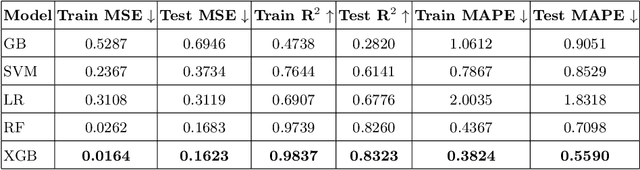
In this position paper, we propose an approach for sustainable data collection in the field of optimal mix design for marble sludge reuse. Marble sludge, a calcium-rich residual from stone-cutting processes, can be repurposed by mixing it with various ingredients. However, determining the optimal mix design is challenging due to the variability in sludge composition and the costly, time-consuming nature of experimental data collection. Also, we investigate the possibility of using machine learning models using meta-learning as an optimization tool to estimate the correct quantity of stone-cutting sludge to be used in aggregates to obtain a mix design with specific mechanical properties that can be used successfully in the building industry. Our approach offers two key advantages: (i) through simulations, a large dataset can be generated, saving time and money during the data collection phase, and (ii) Utilizing machine learning models, with performance enhancement through hyper-parameter optimization via meta-learning, to estimate optimal mix designs reducing the need for extensive manual experimentation, lowering costs, minimizing environmental impact, and accelerating the processing of quarry sludge. Our idea promises to streamline the marble sludge reuse process by leveraging collective data and advanced machine learning, promoting sustainability and efficiency in the stonecutting sector.
SITUATE: Indoor Human Trajectory Prediction through Geometric Features and Self-Supervised Vision Representation
Sep 01, 2024Patterns of human motion in outdoor and indoor environments are substantially different due to the scope of the environment and the typical intentions of people therein. While outdoor trajectory forecasting has received significant attention, indoor forecasting is still an underexplored research area. This paper proposes SITUATE, a novel approach to cope with indoor human trajectory prediction by leveraging equivariant and invariant geometric features and a self-supervised vision representation. The geometric learning modules model the intrinsic symmetries and human movements inherent in indoor spaces. This concept becomes particularly important because self-loops at various scales and rapid direction changes often characterize indoor trajectories. On the other hand, the vision representation module is used to acquire spatial-semantic information about the environment to predict users' future locations more accurately. We evaluate our method through comprehensive experiments on the two most famous indoor trajectory forecasting datasets, i.e., TH\"OR and Supermarket, obtaining state-of-the-art performance. Furthermore, we also achieve competitive results in outdoor scenarios, showing that indoor-oriented forecasting models generalize better than outdoor-oriented ones. The source code is available at https://github.com/intelligolabs/SITUATE.
Trends in deep learning for medical hyperspectral image analysis
Nov 27, 2020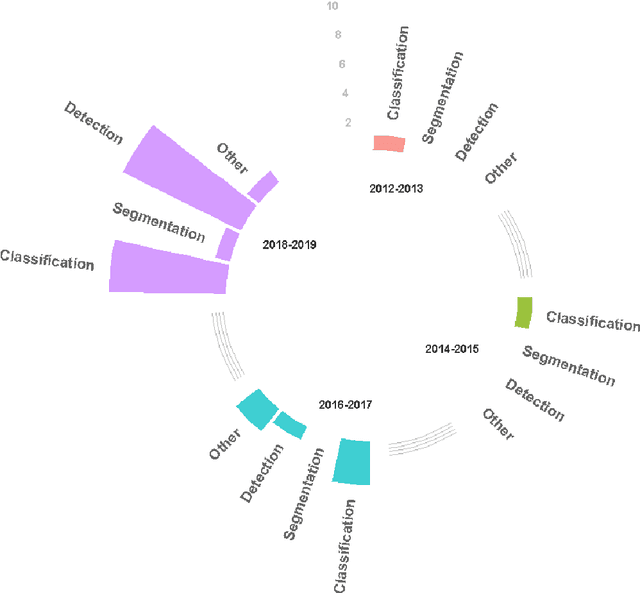
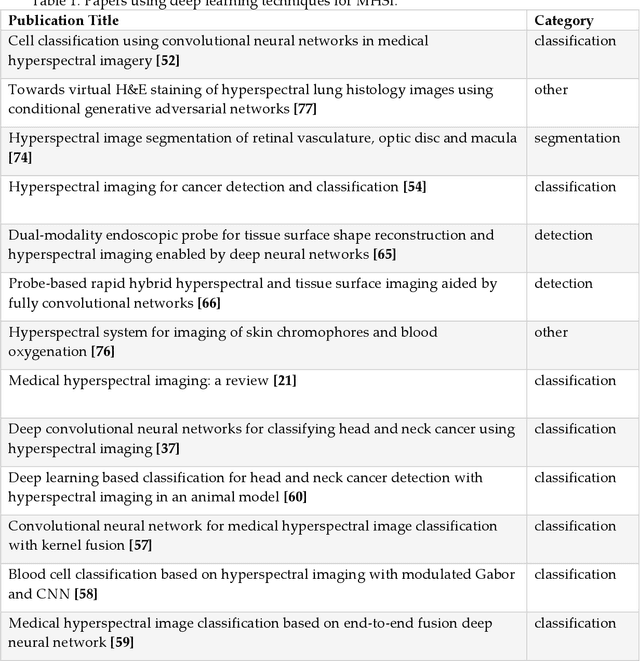
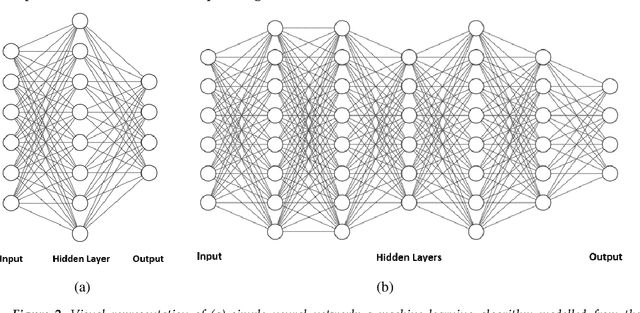
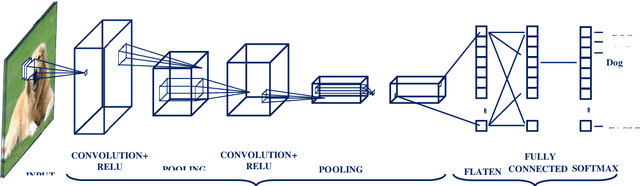
Deep learning algorithms have seen acute growth of interest in their applications throughout several fields of interest in the last decade, with medical hyperspectral imaging being a particularly promising domain. So far, to the best of our knowledge, there is no review paper that discusses the implementation of deep learning for medical hyperspectral imaging, which is what this review paper aims to accomplish by examining publications that currently utilize deep learning to perform effective analysis of medical hyperspectral imagery. This paper discusses deep learning concepts that are relevant and applicable to medical hyperspectral imaging analysis, several of which have been implemented since the boom in deep learning. This will comprise of reviewing the use of deep learning for classification, segmentation, and detection in order to investigate the analysis of medical hyperspectral imaging. Lastly, we discuss the current and future challenges pertaining to this discipline and the possible efforts to overcome such trials.