 Add to Chrome
 Add to Firefox
 Add to Edge
Towards Automated Solar Panel Integrity: Hybrid Deep Feature Extraction for Advanced Surface Defect Identification
Apr 13, 2026
To ensure energy efficiency and reliable operations, it is essential to monitor solar panels in generation plants to detect defects. It is quite labor-intensive, time consuming and costly to manually monitor large-scale solar plants and those installed in remote areas. Manual inspection may also be susceptible to human errors. Consequently, it is necessary to create an automated, intelligent defect-detection system, that ensures continuous monitoring, early fault detection, and maximum power generation. We proposed a novel hybrid method for defect detection in SOLAR plates by combining both handcrafted and deep learning features. Local Binary Pattern (LBP), Histogram of Gradients (HoG) and Gabor Filters were used for the extraction of handcrafted features. Deep features extracted by leveraging the use of DenseNet-169. Both handcrafted and deep features were concatenated and then fed to three distinct types of classifiers, including Support Vector Machines (SVM), Extreme Gradient Boost (XGBoost) and Light Gradient-Boosting Machine (LGBM). Experimental results evaluated on the augmented dataset show the superior performance, especially DenseNet-169 + Gabor (SVM), had the highest scores with 99.17% accuracy which was higher than all the other systems. In general, the proposed hybrid framework offers better defect-detection accuracy, resistance, and flexibility that has a solid basis on the real-life use of the automated PV panels monitoring system.

Exploring Convolutional Neural Networks for Rice Grain Classification: An Explainable AI Approach
May 07, 2025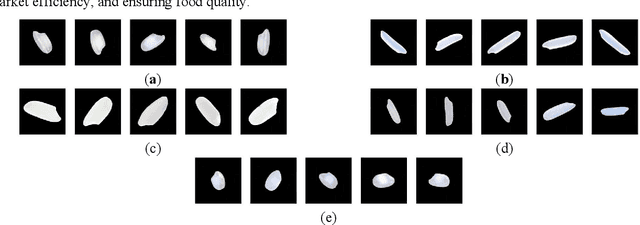
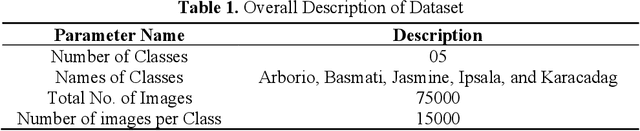
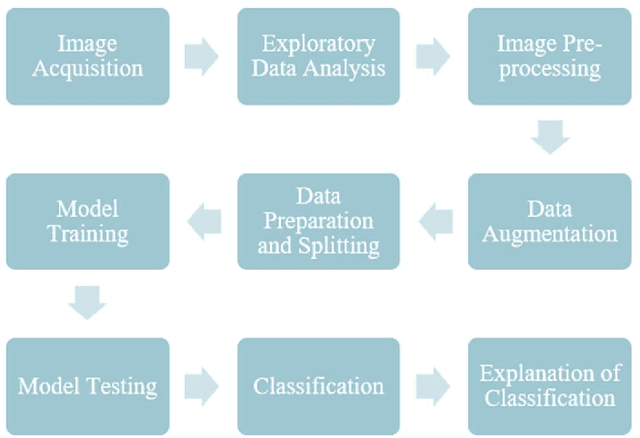
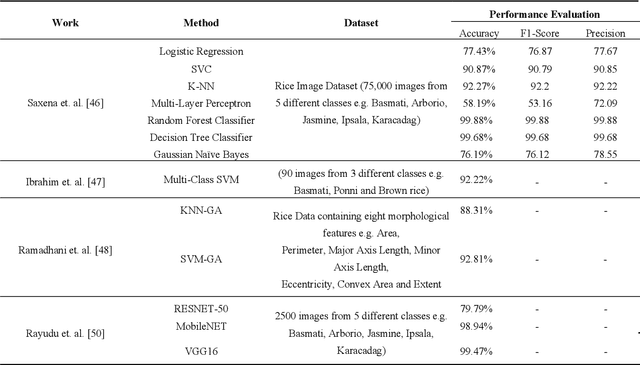
Rice is an essential staple food worldwide that is important in promoting international trade, economic growth, and nutrition. Asian countries such as China, India, Pakistan, Thailand, Vietnam, and Indonesia are notable for their significant contribution to the cultivation and utilization of rice. These nations are also known for cultivating different rice grains, including short and long grains. These sizes are further classified as basmati, jasmine, kainat saila, ipsala, arborio, etc., catering to diverse culinary preferences and cultural traditions. For both local and international trade, inspecting and maintaining the quality of rice grains to satisfy customers and preserve a country's reputation is necessary. Manual quality check and classification is quite a laborious and time-consuming process. It is also highly prone to mistakes. Therefore, an automatic solution must be proposed for the effective and efficient classification of different varieties of rice grains. This research paper presents an automatic framework based on a convolutional neural network (CNN) for classifying different varieties of rice grains. We evaluated the proposed model based on performance metrics such as accuracy, recall, precision, and F1-Score. The CNN model underwent rigorous training and validation, achieving a remarkable accuracy rate and a perfect area under each class's Receiver Operating Characteristic (ROC) curve. The confusion matrix analysis confirmed the model's effectiveness in distinguishing between the different rice varieties, indicating minimal misclassifications. Additionally, the integration of explainability techniques such as LIME (Local Interpretable Model-agnostic Explanations) and SHAP (SHapley Additive exPlanations) provided valuable insights into the model's decision-making process, revealing how specific features of the rice grains influenced classification outcomes.