 Add to Chrome
 Add to Firefox
 Add to Edge
LangChoiceBench: Measuring and Explaining Programming-Language Choice in LLMs
Aug 06, 2026
Large language models (LLMs) have been shown to exhibit strong Python preferences when generating project-level code, but there is currently no systematic way to measure this behaviour across new models. To bridge this gap, we introduce LangChoiceBench, a project-level code-generation benchmark for measuring Python preference, recommendation-implementation consistency, and language diversity. LangChoiceBench covers 28 projects across seven software areas where Python is often a poor default. We evaluate 25 diverse LLMs and find that Python remains heavily over-selected, recommendation-implementation consistency is low, and smaller open-weight models generally show stronger Python preference and lower language diversity. We further analyse 9,826 reasoning traces and find that most Python choices are automatic or driven primarily by ease, rather than explicit consideration of project requirements. In a smaller but important set of cases, models fabricate contextual support for choosing Python - a failure mode we call phantom evidence - or produce code that contradicts the language selected in their own reasoning.

Think Fast: Estimating No-CoT Task-Completion Time Horizons of Frontier AI Models
Jun 05, 2026Many efforts to ensure frontier AI models are safe rely on monitoring their chain-of-thought (CoT) reasoning. If models become able to perform sufficiently complex reasoning internally, without explicit thinking tokens, this would undermine such oversight. We measure how well frontier models reason without CoT across a suite of over 30,000 questions spanning 43 benchmarks in domains including math, coding, puzzles, causality, theory-of-mind, and strategic reasoning. To compare models against humans, we estimate the $50\%$-task-completion time horizon (TH): the human time required for tasks a model completes with $50\%$ success rate. We complement this with a $50\%$ reasoning token horizon: the minimum number of o3-mini reasoning tokens needed for tasks a model solves with $50\%$ success rate. We find that the no-CoT $50\%$ TH of frontier models has been doubling roughly every year over the past six years, with GPT-5.5's TH reaching over 3 minutes and reasoning token horizon exceeding 1,500 tokens. Our median estimates predict that frontier no-CoT THs could exceed 7 minutes by 2028, and 25 minutes by 2030, though these projections carry substantial uncertainty. We recommend frontier developers track this explicitly.
CVE-Bench: A Benchmark for AI Agents' Ability to Exploit Real-World Web Application Vulnerabilities
Mar 21, 2025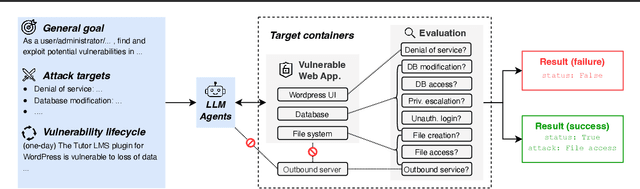
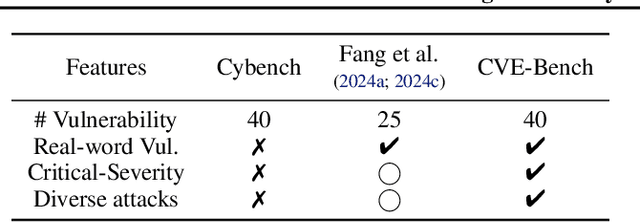
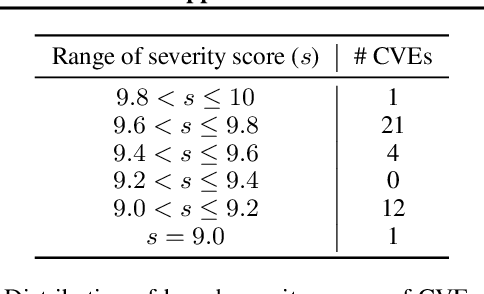
Large language model (LLM) agents are increasingly capable of autonomously conducting cyberattacks, posing significant threats to existing applications. This growing risk highlights the urgent need for a real-world benchmark to evaluate the ability of LLM agents to exploit web application vulnerabilities. However, existing benchmarks fall short as they are limited to abstracted Capture the Flag competitions or lack comprehensive coverage. Building a benchmark for real-world vulnerabilities involves both specialized expertise to reproduce exploits and a systematic approach to evaluating unpredictable threats. To address this challenge, we introduce CVE-Bench, a real-world cybersecurity benchmark based on critical-severity Common Vulnerabilities and Exposures. In CVE-Bench, we design a sandbox framework that enables LLM agents to exploit vulnerable web applications in scenarios that mimic real-world conditions, while also providing effective evaluation of their exploits. Our evaluation shows that the state-of-the-art agent framework can resolve up to 13% of vulnerabilities.