 Add to Chrome
 Add to Firefox
 Add to Edge
Spike Hijacking in Late-Interaction Retrieval
Apr 06, 2026
Late-interaction retrieval models rely on hard maximum similarity (MaxSim) to aggregate token-level similarities. Although effective, this winner-take-all pooling rule may structurally bias training dynamics. We provide a mechanistic study of gradient routing and robustness in MaxSim-based retrieval. In a controlled synthetic environment with in-batch contrastive training, we demonstrate that MaxSim induces significantly higher patch-level gradient concentration than smoother alternatives such as Top-k pooling and softmax aggregation. While sparse routing can improve early discrimination, it also increases sensitivity to document length: as the number of document patches grows, MaxSim degrades more sharply than mild smoothing variants. We corroborate these findings on a real-world multi-vector retrieval benchmark, where controlled document-length sweeps reveal similar brittleness under hard max pooling. Together, our results isolate pooling-induced gradient concentration as a structural property of late-interaction retrieval and highlight a sparsity-robustness tradeoff. These findings motivate principled alternatives to hard max pooling in multi-vector retrieval systems.

RouteNator: A Router-Based Multi-Modal Architecture for Generating Synthetic Training Data for Function Calling LLMs
May 15, 2025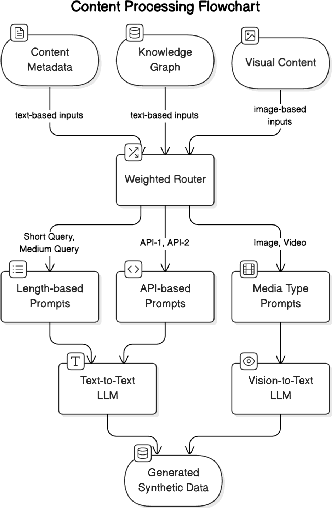
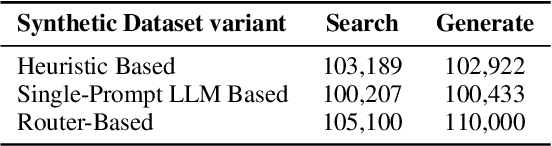
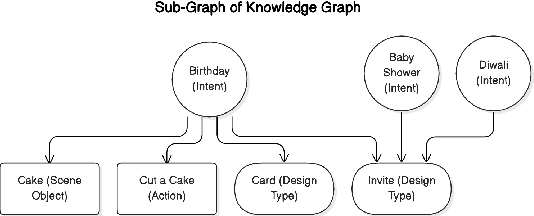
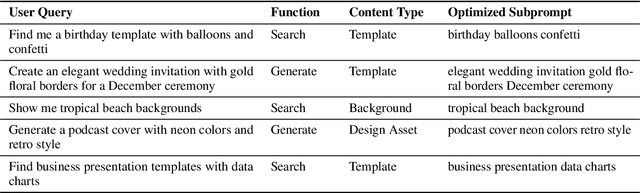
This paper addresses fine-tuning Large Language Models (LLMs) for function calling tasks when real user interaction data is unavailable. In digital content creation tools, where users express their needs through natural language queries that must be mapped to API calls, the lack of real-world task-specific data and privacy constraints for training on it necessitate synthetic data generation. Existing approaches to synthetic data generation fall short in diversity and complexity, failing to replicate real-world data distributions and leading to suboptimal performance after LLM fine-tuning. We present a novel router-based architecture that leverages domain resources like content metadata and structured knowledge graphs, along with text-to-text and vision-to-text language models to generate high-quality synthetic training data. Our architecture's flexible routing mechanism enables synthetic data generation that matches observed real-world distributions, addressing a fundamental limitation of traditional approaches. Evaluation on a comprehensive set of real user queries demonstrates significant improvements in both function classification accuracy and API parameter selection. Models fine-tuned with our synthetic data consistently outperform traditional approaches, establishing new benchmarks for function calling tasks.
* Proceedings of the 4th International Workshop on Knowledge-Augmented Methods for Natural Language Processing
Domain-specific Question Answering with Hybrid Search
Dec 04, 2024


Domain specific question answering is an evolving field that requires specialized solutions to address unique challenges. In this paper, we show that a hybrid approach combining a fine-tuned dense retriever with keyword based sparse search methods significantly enhances performance. Our system leverages a linear combination of relevance signals, including cosine similarity from dense retrieval, BM25 scores, and URL host matching, each with tunable boost parameters. Experimental results indicate that this hybrid method outperforms our single-retriever system, achieving improved accuracy while maintaining robust contextual grounding. These findings suggest that integrating multiple retrieval methodologies with weighted scoring effectively addresses the complexities of domain specific question answering in enterprise settings.