 Add to Chrome
 Add to Firefox
 Add to Edge
Algorithms for adaptive and heteroskedastic linear regression at the computational threshold
Aug 19, 2026
We study finite-sample linear regression in the presence of varied and unknown label noise, focusing on the heteroskedastic and adaptive linear regression models. Heteroskedastic linear regression models settings where the labels are of varying quality. We receive $n$ pairs $(X_i,Y_i)$ with labels $Y_i=X_i^\topβ+\varepsilon_i$, where $\varepsilon_i\sim N(0,σ_i^2)$ and the variances are unknown to the estimator. One natural measurement of the difficulty of this problem is the number of samples $m$ for which $σ_i^2\le1$ (larger $m$ is easier). We obtain a polynomial-time estimator with rate $\tilde{O}((nd^3/m^4)^{1/6})$ when $m\gg d^{3/4}n^{1/4}$, as well as nearly-matching lower bounds. For $d=O(1)$, our estimator achieves error $o(1)$ when $m\gg n^{1/4}$, whereas $L_1$ regression and other traditional approaches require $m\gg n^{1/2}$. In adaptive linear regression, the errors are drawn i.i.d. from an unknown distribution $p$, and our goal is to design a generic estimator that performs nearly as well as the best custom estimator that knows $p$. We introduce a (computationally inefficient) adaptive estimator that, so long as $p$ is a mixture of $k$ symmetric log-concave densities, achieves error comparable with the optimal estimator that knows $p$ and has $\tildeΘ(n/k)$ samples. For $k=1$, we show that $L_q$ regression (with data-dependent $q$) gives a polynomial-time estimator. Finally, to study the computational limits of both problems, we introduce the planted linear regression problem, where $X_i\sim N(0,I_d)$, $m$ unknown samples are noiseless, and the rest have error $\varepsilon_i\sim N(0,1)$. We conjecture that recovering $β$ up to error $\ll\sqrt{d/n}$ (or exactly) may have an information-computation gap between $m=d+1$ and $m\sim d^{3/4}n^{1/4}$, as is suggested by our near-matching polynomial-time estimator and statistical query (SQ) lower bound.

High-Dimensional Procrustes Matching via Tree Counts
Jul 09, 2026Suppose we observe two sets of $n$ Gaussian vectors in $\mathbb{R}^d$, with the promise that, after applying a permutation of $[n]$ and a rotation of $\mathbb{R}^d$, the two sets are $ρ$-correlated. The Procrustes matching problem asks us to recover the unknown permutation of $[n]$ that aligns the two sets. The problem is well-studied in the low-dimensional regime $d=O(\log n)$, but the high-dimensional regime $d\gg \log n$ has remained largely uncharted: prior matching guarantees require nearly perfect correlation $ρ=1-o(1)$, even for information-theoretic recovery. Our main result is a polynomial-time algorithm for exact recovery at constant correlation. The algorithm works by computing and comparing weighted counts of a specially chosen family of ``wide'' trees. So long as $d\ge \mathrm{polylog}(n)$, the algorithm succeeds with high probability for any $ρ^2>\sqrtα$, where $α\approx 0.338$ is Otter's tree-counting constant. We complement this algorithmic result with an improved information-theoretic guarantee, showing that exact recovery is possible when $ρ^2 \gtrsim \max\{\log n/d,\sqrt{\log n/n}\}$. We also carry out a low-degree advantage calculation, which suggests that the condition $ρ^2 > \sqrtα$ is necessary for any tree-counting algorithm.
Easy, robust approximate message passing for planted spike models
May 30, 2026We present a simple and efficient algorithm for robust approximate message passing (AMP) in the spiked matrix setting. In particular, let $\varepsilon$ be a sufficiently small constant, and suppose that $X \in \mathbb R^{n \times n}$ is a Gaussian matrix with a planted rank-$1$ spike, and $E \in \mathbb R^{n \times n}$ is an adversarially chosen matrix supported on an $\varepsilon n \times \varepsilon n$ principal minor. Let $v_{\mathrm{AMP}}(X)$ be the output of an AMP iteration on the uncorrupted matrix $X$. We give a procedure that, given access only to the corrupted matrix $Y = X + E$, computes a vector $v_{\mathrm{ALG}}(Y)$ which is $\tilde{O}(\sqrt{\varepsilon})$-close to $v_{\mathrm{AMP}}(X)$, for any of a class of AMP iterations which includes sparse Principal Component Analysis (PCA), non-negative PCA, and $\mathbb Z_2$ synchronization. Our algorithm consists of a spectral pre-processing step combined with a robust spectral initialization procedure; given these inputs, we prove that (perhaps surprisingly) AMP is robust out-of-the-box.
Fast, robust approximate message passing
Nov 05, 2024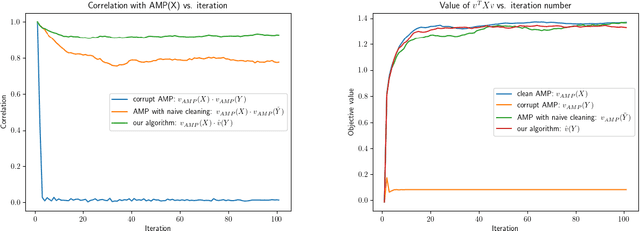
We give a fast, spectral procedure for implementing approximate-message passing (AMP) algorithms robustly. For any quadratic optimization problem over symmetric matrices $X$ with independent subgaussian entries, and any separable AMP algorithm $\mathcal A$, our algorithm performs a spectral pre-processing step and then mildly modifies the iterates of $\mathcal A$. If given the perturbed input $X + E \in \mathbb R^{n \times n}$ for any $E$ supported on a $\varepsilon n \times \varepsilon n$ principal minor, our algorithm outputs a solution $\hat v$ which is guaranteed to be close to the output of $\mathcal A$ on the uncorrupted $X$, with $\|\mathcal A(X) - \hat v\|_2 \le f(\varepsilon) \|\mathcal A(X)\|_2$ where $f(\varepsilon) \to 0$ as $\varepsilon \to 0$ depending only on $\varepsilon$.
Semidefinite programs simulate approximate message passing robustly
Nov 15, 2023Approximate message passing (AMP) is a family of iterative algorithms that generalize matrix power iteration. AMP algorithms are known to optimally solve many average-case optimization problems. In this paper, we show that a large class of AMP algorithms can be simulated in polynomial time by \emph{local statistics hierarchy} semidefinite programs (SDPs), even when an unknown principal minor of measure $1/\mathrm{polylog}(\mathrm{dimension})$ is adversarially corrupted. Ours are the first robust guarantees for many of these problems. Further, our results offer an interesting counterpoint to strong lower bounds against less constrained SDP relaxations for average-case max-cut-gain (a.k.a. "optimizing the Sherrington-Kirkpatrick Hamiltonian") and other problems.
Spectral clustering in the Gaussian mixture block model
Apr 29, 2023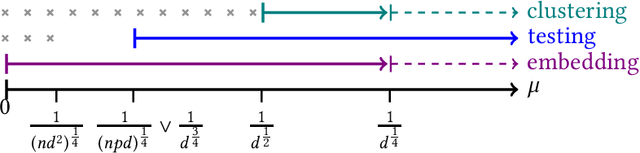
Gaussian mixture block models are distributions over graphs that strive to model modern networks: to generate a graph from such a model, we associate each vertex $i$ with a latent feature vector $u_i \in \mathbb{R}^d$ sampled from a mixture of Gaussians, and we add edge $(i,j)$ if and only if the feature vectors are sufficiently similar, in that $\langle u_i,u_j \rangle \ge \tau$ for a pre-specified threshold $\tau$. The different components of the Gaussian mixture represent the fact that there may be different types of nodes with different distributions over features -- for example, in a social network each component represents the different attributes of a distinct community. Natural algorithmic tasks associated with these networks are embedding (recovering the latent feature vectors) and clustering (grouping nodes by their mixture component). In this paper we initiate the study of clustering and embedding graphs sampled from high-dimensional Gaussian mixture block models, where the dimension of the latent feature vectors $d\to \infty$ as the size of the network $n \to \infty$. This high-dimensional setting is most appropriate in the context of modern networks, in which we think of the latent feature space as being high-dimensional. We analyze the performance of canonical spectral clustering and embedding algorithms for such graphs in the case of 2-component spherical Gaussian mixtures, and begin to sketch out the information-computation landscape for clustering and embedding in these models.
The Franz-Parisi Criterion and Computational Trade-offs in High Dimensional Statistics
May 19, 2022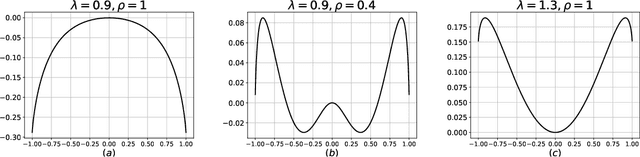
Many high-dimensional statistical inference problems are believed to possess inherent computational hardness. Various frameworks have been proposed to give rigorous evidence for such hardness, including lower bounds against restricted models of computation (such as low-degree functions), as well as methods rooted in statistical physics that are based on free energy landscapes. This paper aims to make a rigorous connection between the seemingly different low-degree and free-energy based approaches. We define a free-energy based criterion for hardness and formally connect it to the well-established notion of low-degree hardness for a broad class of statistical problems, namely all Gaussian additive models and certain models with a sparse planted signal. By leveraging these rigorous connections we are able to: establish that for Gaussian additive models the "algebraic" notion of low-degree hardness implies failure of "geometric" local MCMC algorithms, and provide new low-degree lower bounds for sparse linear regression which seem difficult to prove directly. These results provide both conceptual insights into the connections between different notions of hardness, as well as concrete technical tools such as new methods for proving low-degree lower bounds.
A Robust Spectral Algorithm for Overcomplete Tensor Decomposition
Mar 05, 2022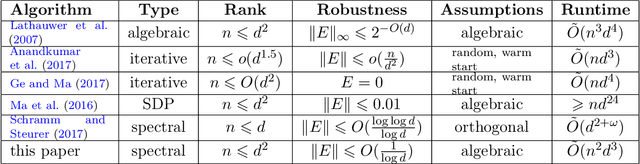
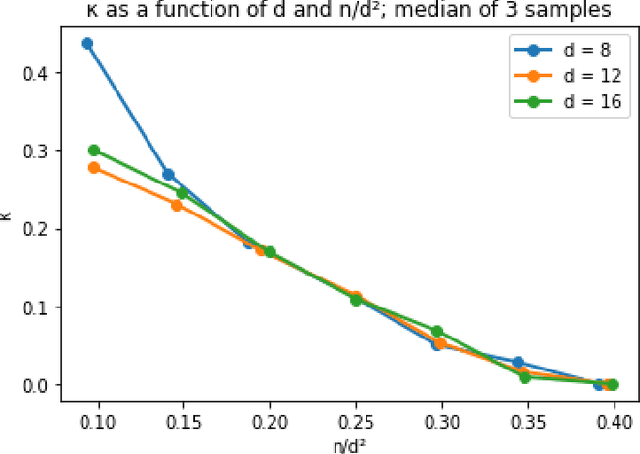
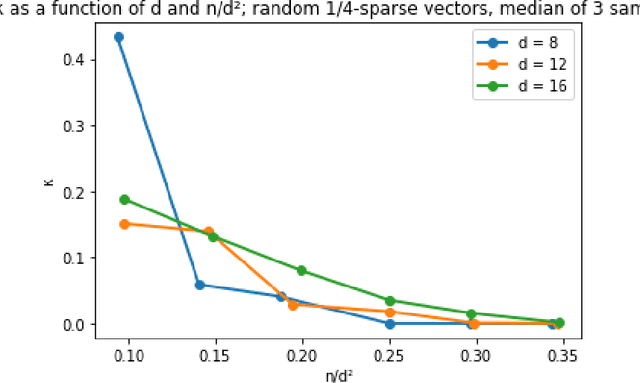
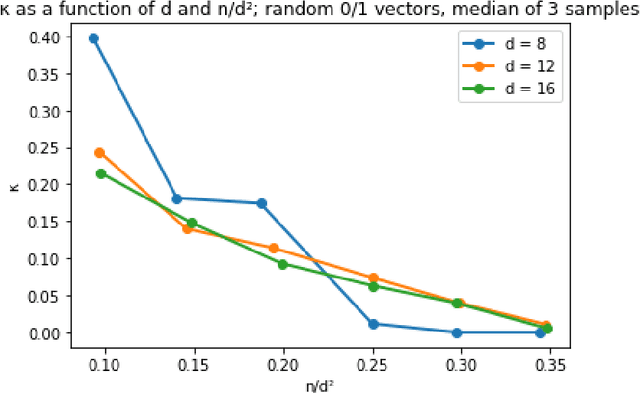
We give a spectral algorithm for decomposing overcomplete order-4 tensors, so long as their components satisfy an algebraic non-degeneracy condition that holds for nearly all (all but an algebraic set of measure $0$) tensors over $(\mathbb{R}^d)^{\otimes 4}$ with rank $n \le d^2$. Our algorithm is robust to adversarial perturbations of bounded spectral norm. Our algorithm is inspired by one which uses the sum-of-squares semidefinite programming hierarchy (Ma, Shi, and Steurer STOC'16, arXiv:1610.01980), and we achieve comparable robustness and overcompleteness guarantees under similar algebraic assumptions. However, our algorithm avoids semidefinite programming and may be implemented as a series of basic linear-algebraic operations. We consequently obtain a much faster running time than semidefinite programming methods: our algorithm runs in time $\tilde O(n^2d^3) \le \tilde O(d^7)$, which is subquadratic in the input size $d^4$ (where we have suppressed factors related to the condition number of the input tensor).
* 60 pages, 4 figures, ACM Annual Workshop on Computational Learning Theory 2019
Robust Regression Revisited: Acceleration and Improved Estimation Rates
Jun 22, 2021We study fast algorithms for statistical regression problems under the strong contamination model, where the goal is to approximately optimize a generalized linear model (GLM) given adversarially corrupted samples. Prior works in this line of research were based on the robust gradient descent framework of Prasad et. al., a first-order method using biased gradient queries, or the Sever framework of Diakonikolas et. al., an iterative outlier-removal method calling a stationary point finder. We present nearly-linear time algorithms for robust regression problems with improved runtime or estimation guarantees compared to the state-of-the-art. For the general case of smooth GLMs (e.g. logistic regression), we show that the robust gradient descent framework of Prasad et. al. can be accelerated, and show our algorithm extends to optimizing the Moreau envelopes of Lipschitz GLMs (e.g. support vector machines), answering several open questions in the literature. For the well-studied case of robust linear regression, we present an alternative approach obtaining improved estimation rates over prior nearly-linear time algorithms. Interestingly, our method starts with an identifiability proof introduced in the context of the sum-of-squares algorithm of Bakshi and Prasad, which achieved optimal error rates while requiring large polynomial runtime and sample complexity. We reinterpret their proof within the Sever framework and obtain a dramatically faster and more sample-efficient algorithm under fewer distributional assumptions.
Non-asymptotic approximations of neural networks by Gaussian processes
Feb 17, 2021We study the extent to which wide neural networks may be approximated by Gaussian processes when initialized with random weights. It is a well-established fact that as the width of a network goes to infinity, its law converges to that of a Gaussian process. We make this quantitative by establishing explicit convergence rates for the central limit theorem in an infinite-dimensional functional space, metrized with a natural transportation distance. We identify two regimes of interest; when the activation function is polynomial, its degree determines the rate of convergence, while for non-polynomial activations, the rate is governed by the smoothness of the function.