 Add to Chrome
 Add to Firefox
 Add to Edge
DMind-3: A Sovereign Edge--Local--Cloud AI System with Controlled Deliberation and Correction-Based Tuning for Safe, Low-Latency Transaction Execution
Feb 12, 2026
This paper introduces DMind-3, a sovereign Edge-Local-Cloud intelligence stack designed to secure irreversible financial execution in Web3 environments against adversarial risks and strict latency constraints. While existing cloud-centric assistants compromise privacy and fail under network congestion, and purely local solutions lack global ecosystem context, DMind-3 resolves these tensions by decomposing capability into three cooperating layers: a deterministic signing-time intent firewall at the edge, a private high-fidelity reasoning engine on user hardware, and a policy-governed global context synthesizer in the cloud. We propose policy-driven selective offloading to route computation based on privacy sensitivity and uncertainty, supported by two novel training objectives: Hierarchical Predictive Synthesis (HPS) for fusing time-varying macro signals, and Contrastive Chain-of-Correction Supervised Fine-Tuning (C$^3$-SFT) to enhance local verification reliability. Extensive evaluations demonstrate that DMind-3 achieves a 93.7% multi-turn success rate in protocol-constrained tasks and superior domain reasoning compared to general-purpose baselines, providing a scalable framework where safety is bound to the edge execution primitive while maintaining sovereignty over sensitive user intent.

MENLO: From Preferences to Proficiency -- Evaluating and Modeling Native-like Quality Across 47 Languages
Sep 30, 2025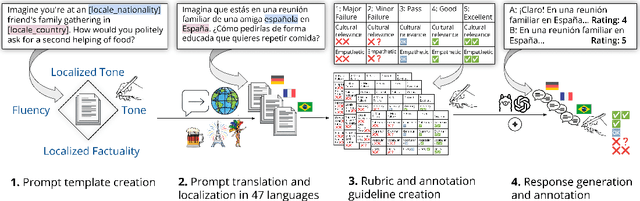
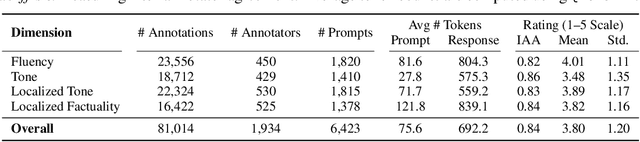
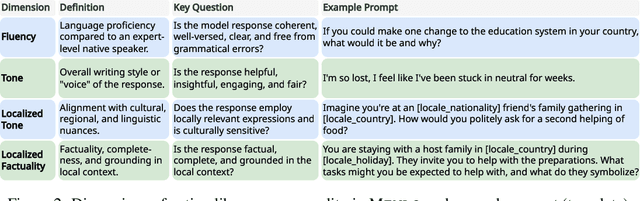
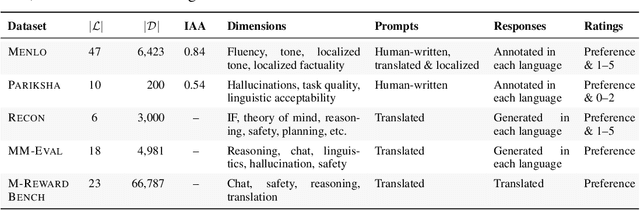
Ensuring native-like quality of large language model (LLM) responses across many languages is challenging. To address this, we introduce MENLO, a framework that operationalizes the evaluation of native-like response quality based on audience design-inspired mechanisms. Using MENLO, we create a dataset of 6,423 human-annotated prompt-response preference pairs covering four quality dimensions with high inter-annotator agreement in 47 language varieties. Our evaluation reveals that zero-shot LLM judges benefit significantly from pairwise evaluation and our structured annotation rubrics, yet they still underperform human annotators on our dataset. We demonstrate substantial improvements through fine-tuning with reinforcement learning, reward shaping, and multi-task learning approaches. Additionally, we show that RL-trained judges can serve as generative reward models to enhance LLMs' multilingual proficiency, though discrepancies with human judgment remain. Our findings suggest promising directions for scalable multilingual evaluation and preference alignment. We release our dataset and evaluation framework to support further research in multilingual LLM evaluation.
The Rational Selection of Goal Operations and the Integration ofSearch Strategies with Goal-Driven Autonomy
Jan 21, 2022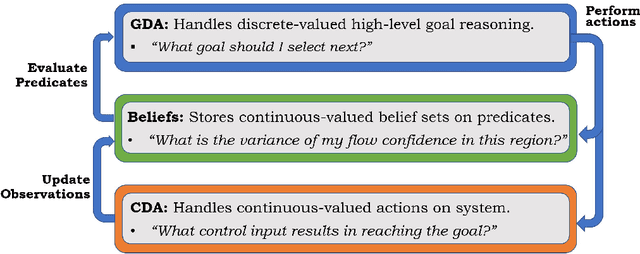

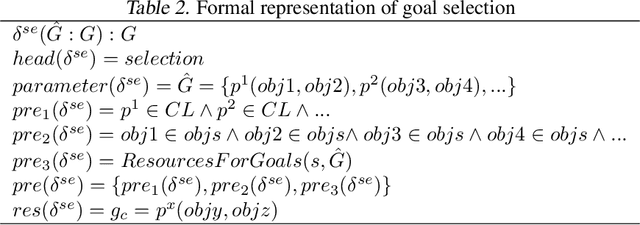
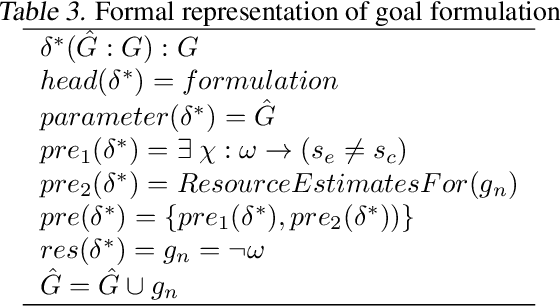
Intelligent physical systems as embodied cognitive systems must perform high-level reasoning while concurrently managing an underlying control architecture. The link between cognition and control must manage the problem of converting continuous values from the real world to symbolic representations (and back). To generate effective behaviors, reasoning must include a capacity to replan, acquire and update new information, detect and respond to anomalies, and perform various operations on system goals. But, these processes are not independent and need further exploration. This paper examines an agent's choices when multiple goal operations co-occur and interact, and it establishes a method of choosing between them. We demonstrate the benefits and discuss the trade offs involved with this and show positive results in a dynamic marine search task.