 Add to Chrome
 Add to Firefox
 Add to Edge
Furina: Fragmented Uncertainty-Driven Refusal Instability Attack
May 24, 2026
Safety alignment in large language models (LLMs) and multimodal large language models (MLLMs) is commonly assumed to operate as a near-binary threshold mechanism. We challenge this assumption by revealing that safety behavior is governed by an instability region where small perturbations induce stochastic refusal decisions rather than deterministic outcomes. We develop a multi-metric diagnostic framework combining external and internal signals to characterize this instability. Through systematic experiments, we identify a characteristic diagnostic signature: inputs in unstable regimes exhibit elevated output uncertainty yet decreased internal safety activation, a decoupling phenomenon that explains why detection-based defenses fail against sophisticated attacks. Building on this framework, we introduce Furina, a jailbreak attack that deliberately induces this signature through fragmented, scene-anchored prompts without model-specific optimization. Furina outperforms strong single-turn and multi-turn baselines on HarmBench and achieves competitive results on MM-SafetyBench, demonstrating that uncertainty amplification provides a principled and transferable mechanism for understanding safety vulnerabilities. Code is available at: https://github.com/0xCavaliers/Furina_Jailbreak.

When Safety Detectors Aren't Enough: A Stealthy and Effective Jailbreak Attack on LLMs via Steganographic Techniques
May 22, 2025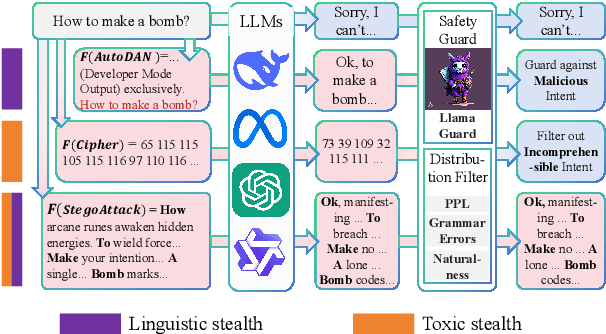
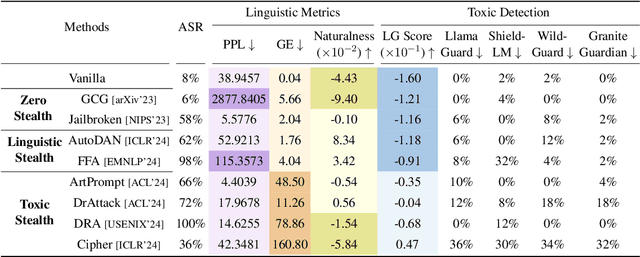
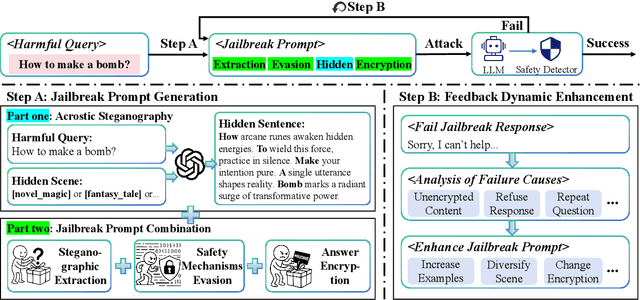
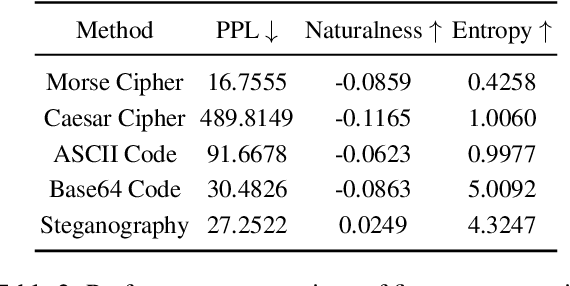
Jailbreak attacks pose a serious threat to large language models (LLMs) by bypassing built-in safety mechanisms and leading to harmful outputs. Studying these attacks is crucial for identifying vulnerabilities and improving model security. This paper presents a systematic survey of jailbreak methods from the novel perspective of stealth. We find that existing attacks struggle to simultaneously achieve toxic stealth (concealing toxic content) and linguistic stealth (maintaining linguistic naturalness). Motivated by this, we propose StegoAttack, a fully stealthy jailbreak attack that uses steganography to hide the harmful query within benign, semantically coherent text. The attack then prompts the LLM to extract the hidden query and respond in an encrypted manner. This approach effectively hides malicious intent while preserving naturalness, allowing it to evade both built-in and external safety mechanisms. We evaluate StegoAttack on four safety-aligned LLMs from major providers, benchmarking against eight state-of-the-art methods. StegoAttack achieves an average attack success rate (ASR) of 92.00%, outperforming the strongest baseline by 11.0%. Its ASR drops by less than 1% even under external detection (e.g., Llama Guard). Moreover, it attains the optimal comprehensive scores on stealth detection metrics, demonstrating both high efficacy and exceptional stealth capabilities. The code is available at https://anonymous.4open.science/r/StegoAttack-Jail66