 Add to Chrome
 Add to Firefox
 Add to Edge
Texture-Shape Bias Balancing for Robust Synthetic-to-Real Semantic Segmentation in Automotive NIR Imagery
Jun 13, 2026
Semantic segmentation is a fundamental component of visual perception in modern automotive systems, enabling pixel-level scene understanding. Near-Infrared imaging (NIR) offers stable detection under difficult illumination conditions, but the development of domain-specific semantic segmentation models remains challenging due to the lack of high-quality annotated data from real-world scenarios. Synthetic datasets offer a scalable alternative, but models trained on synthetic images often suffer performance degradation when transferred to real domains. We present the first systematic study on synthetic to real domain adaptation for semantic segmentation in NIR images in the automotive domain. We propose a generative augmentation framework that transforms synthetic images into realistic NIR-style variants via our introduced target style adaptation (TSA). TSA fine-tunes a latent diffusion model via low-rank adaptation on a small curated set of real NIR images and applies it to synthetic training data using structure-preserving multi-signal conditioning. To reduce texture bias and improve segmentation robustness, we further apply a Voronoi-based style diversification strategy (VSD) that modifies the original textures while preserving scene geometry. Experiments with multiple model architectures on NIR data from vehicle interiors and street scenes show that balancing inductive bias during training leads to noticeably more robust semantic segmentation and effectively reduces the domain gap in our real-world scenarios by up to 63.6% on exterior and 28.4% on interior data. The code is available at GitHub.

InCaRPose: In-Cabin Relative Camera Pose Estimation Model and Dataset
Apr 04, 2026Camera extrinsic calibration is a fundamental task in computer vision. However, precise relative pose estimation in constrained, highly distorted environments, such as in-cabin automotive monitoring (ICAM), remains challenging. We present InCaRPose, a Transformer-based architecture designed for robust relative pose prediction between image pairs, which can be used for camera extrinsic calibration. By leveraging frozen backbone features such as DINOv3 and a Transformer-based decoder, our model effectively captures the geometric relationship between a reference and a target view. Unlike traditional methods, our approach achieves absolute metric-scale translation within the physically plausible adjustment range of in-cabin camera mounts in a single inference step, which is critical for ICAM, where accurate real-world distances are required for safety-relevant perception. We specifically address the challenges of highly distorted fisheye cameras in automotive interiors by training exclusively on synthetic data. Our model is capable of generalization to real-world cabin environments without relying on the exact same camera intrinsics and additionally achieves competitive performance on the public 7-Scenes dataset. Despite having limited training data, InCaRPose maintains high precision in both rotation and translation, even with a ViT-Small backbone. This enables real-time performance for time-critical inference, such as driver monitoring in supervised autonomous driving. We release our real-world In-Cabin-Pose test dataset consisting of highly distorted vehicle-interior images and our code at https://github.com/felixstillger/InCaRPose.
Principal Component Clustering for Semantic Segmentation in Synthetic Data Generation
Jun 25, 2024
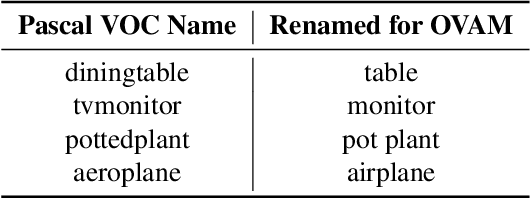
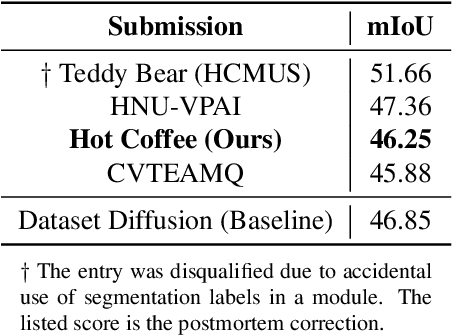

This technical report outlines our method for generating a synthetic dataset for semantic segmentation using a latent diffusion model. Our approach eliminates the need for additional models specifically trained on segmentation data and is part of our submission to the CVPR 2024 workshop challenge, entitled CVPR 2024 workshop challenge "SyntaGen Harnessing Generative Models for Synthetic Visual Datasets". Our methodology uses self-attentions to facilitate a novel head-wise semantic information condensation, thereby enabling the direct acquisition of class-agnostic image segmentation from the Stable Diffusion latents. Furthermore, we employ non-prompt-influencing cross-attentions from text to pixel, thus facilitating the classification of the previously generated masks. Finally, we propose a mask refinement step by using only the output image by Stable Diffusion.