 Add to Chrome
 Add to Firefox
 Add to Edge
Vision-Language-Action in Robotics: A Survey of Datasets, Benchmarks, and Data Engines
Apr 24, 2026
Despite remarkable progress in Vision--Language--Action (VLA) models, a central bottleneck remains underexamined: the data infrastructure that underlies embodied learning. In this survey, we argue that future advances in VLA will depend less on model architecture and more on the co-design of high-fidelity data engines and structured evaluation protocols. To this end, we present a systematic, data-centric analysis of VLA research organized around three pillars: datasets, benchmarks, and data engines. For datasets, we categorize real-world and synthetic corpora along embodiment diversity, modality composition, and action space formulation, revealing a persistent fidelity-cost trade-off that fundamentally constrains large-scale collection. For benchmarks, we analyze task complexity and environment structure jointly, exposing structural gaps in compositional generalization and long-horizon reasoning evaluation that existing protocols fail to address. For data engines, we examine simulation-based, video-reconstruction, and automated task-generation paradigms, identifying their shared limitations in physical grounding and sim-to-real transfer. Synthesizing these analyses, we distill four open challenges: representation alignment, multimodal supervision, reasoning assessment, and scalable data generation. Addressing them, we argue, requires treating data infrastructure as a first-class research problem rather than a background concern.

Agent KB: Leveraging Cross-Domain Experience for Agentic Problem Solving
Jul 08, 2025As language agents tackle increasingly complex tasks, they struggle with effective error correction and experience reuse across domains. We introduce Agent KB, a hierarchical experience framework that enables complex agentic problem solving via a novel Reason-Retrieve-Refine pipeline. Agent KB addresses a core limitation: agents traditionally cannot learn from each other's experiences. By capturing both high-level strategies and detailed execution logs, Agent KB creates a shared knowledge base that enables cross-agent knowledge transfer. Evaluated on the GAIA benchmark, Agent KB improves success rates by up to 16.28 percentage points. On the most challenging tasks, Claude-3 improves from 38.46% to 57.69%, while GPT-4 improves from 53.49% to 73.26% on intermediate tasks. On SWE-bench code repair, Agent KB enables Claude-3 to improve from 41.33% to 53.33%. Our results suggest that Agent KB provides a modular, framework-agnostic infrastructure for enabling agents to learn from past experiences and generalize successful strategies to new tasks.
QG-SMS: Enhancing Test Item Analysis via Student Modeling and Simulation
Mar 07, 2025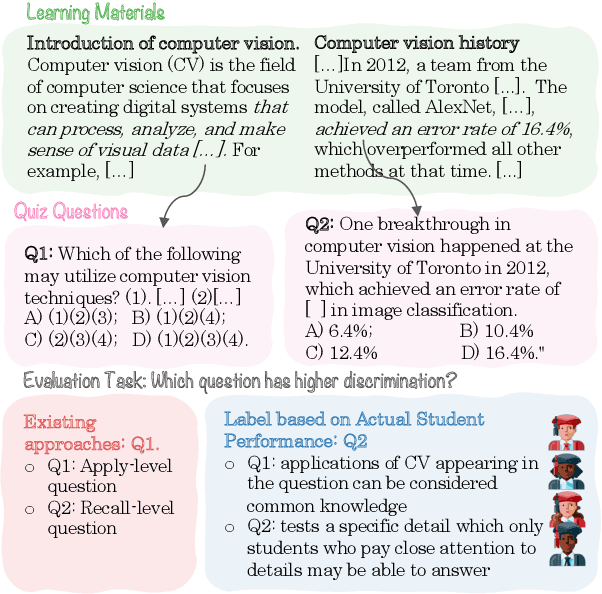
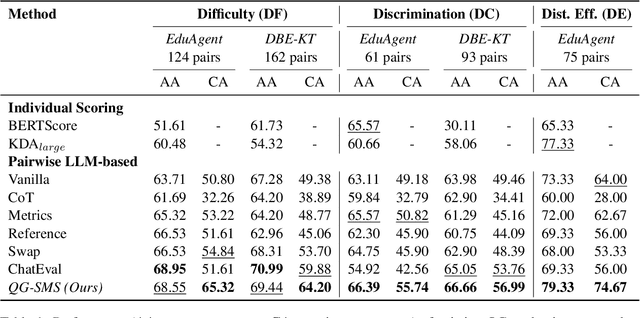
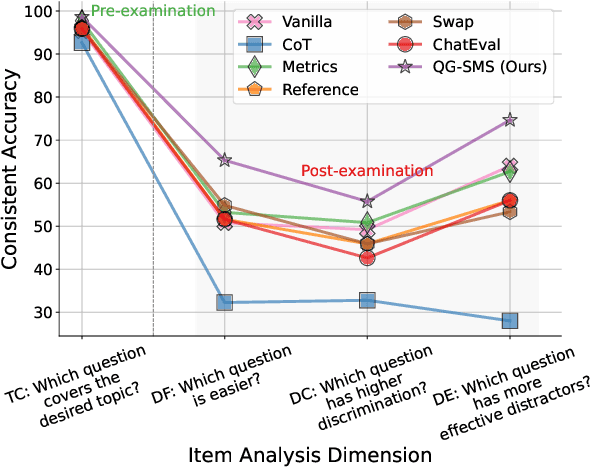
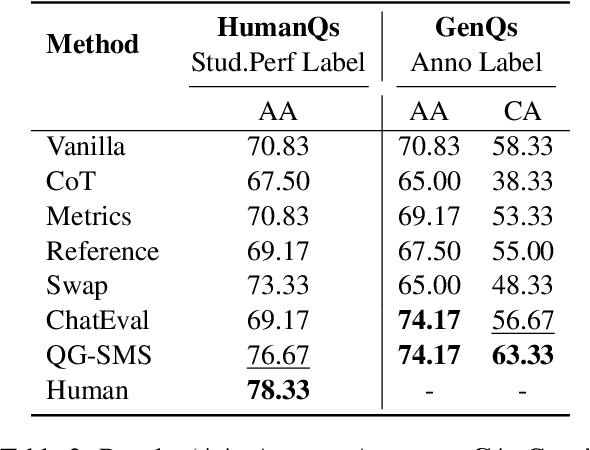
While the Question Generation (QG) task has been increasingly adopted in educational assessments, its evaluation remains limited by approaches that lack a clear connection to the educational values of test items. In this work, we introduce test item analysis, a method frequently used by educators to assess test question quality, into QG evaluation. Specifically, we construct pairs of candidate questions that differ in quality across dimensions such as topic coverage, item difficulty, item discrimination, and distractor efficiency. We then examine whether existing QG evaluation approaches can effectively distinguish these differences. Our findings reveal significant shortcomings in these approaches with respect to accurately assessing test item quality in relation to student performance. To address this gap, we propose a novel QG evaluation framework, QG-SMS, which leverages Large Language Model for Student Modeling and Simulation to perform test item analysis. As demonstrated in our extensive experiments and human evaluation study, the additional perspectives introduced by the simulated student profiles lead to a more effective and robust assessment of test items.