 Add to Chrome
 Add to Firefox
 Add to Edge
Pride and Prejudice: Toward an Information-Theoretic Framework for Mutually Communicative Driver Behavior Modeling
Jun 15, 2026
Mixed autonomy driving becomes unsafe and inefficient when autonomous vehicles (AVs) and human-driven vehicles (HVs) misread each other's intentions. We study this problem as implicit mutual communication in lane changes. The proposed framework models how the ego vehicle both expresses its intent and probes the other driver's preference under epistemic uncertainty. It combines a level-k Bayesian persuasion game with virtual features for proactive signaling, information-theoretic rewards for mutual communication, and adaptive weights of communication affordances. We further introduce the Pride-Inquiry (P-I) and Pride-Prejudice (P-P) planes to analyze communication intensity and tendency. The model is calibrated with a Communication-Based Multi-Agent Inverse Reinforcement Learning algorithm (C-MIRL) on the naturalistic NGSIM dataset. Compared with the non-communicative baseline, the proposed model reduces the prediction error of mandatory lane changes by up to 20% while maintaining strong generalization. Driver-In-the-Loop questionnaire scores are positively correlated with the calibrated communication variables, supporting the subjective validity of the model. The learned rewards further show that inquiry and listening affordances contribute more than pride and expression alone, and that inquiry preference varies more strongly across drivers. These results support explicit modeling of mutual communication and epistemic uncertainty in interactive driving.

Lateral Force Prediction using Gaussian Process Regression for Intelligent Tire Systems
Sep 25, 2020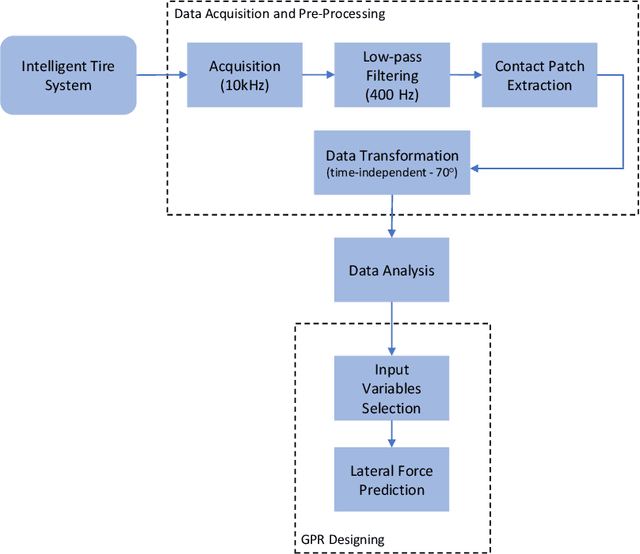
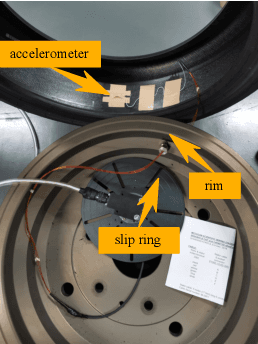
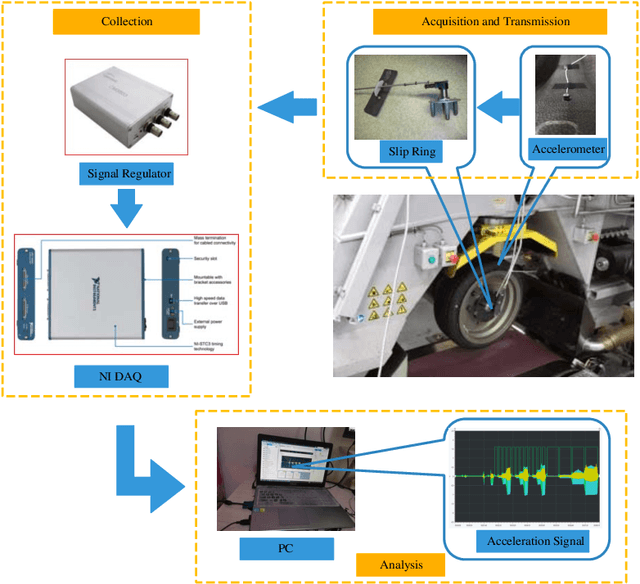
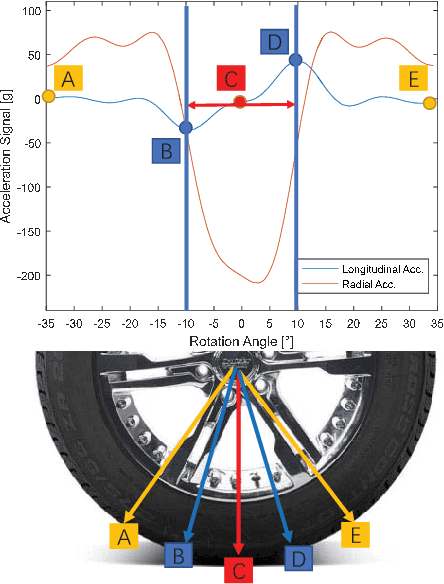
Understanding the dynamic behavior of tires and their interactions with road plays an important role in designing integrated vehicle control strategies. Accordingly, having access to reliable information about the tire-road interactions through tire embedded sensors is very demanding for developing enhanced vehicle control systems. Thus, the main objectives of the present research work are i. to analyze data from an experimental accelerometer-based intelligent tire acquired over a wide range of maneuvers, with different vertical loads, velocities, and high slip angles; and ii. to develop a lateral force predictor based on a machine learning tool, more specifically the Gaussian Process Regression (GPR) technique. It is delineated that the proposed intelligent tire system can provide reliable information about the tire-road interactions even in the case of high slip angles. Besides, the lateral forces model based on GPR can predict forces with acceptable accuracy and provide level of uncertainties that can be very useful for designing vehicle control strategies.