 Add to Chrome
 Add to Firefox
 Add to Edge
Towards Faithful Sentimental Image Captioning via Evidence-Aware Multi-Agent Reasoning
Jul 28, 2026
Sentimental Image Captioning (SIC) requires balancing emotional expression with visual fidelity. Existing methods often struggle with this trade-off, leading to hallucinations due to insufficient local grounding and the lack of sentimental verification mechanisms. To address these limitations, we propose SEA-Cap, a Sentiment-Evidence-Aware Multi-Agent System for faithful and evidence-grounded sentimental image captioning. SEA-Cap incorporates a Sentiment Evidence Miner that extracts structured, local affective cues to shift sentiment control from global attributes to verifiable object-level evidence. Leveraging this evidence, our framework orchestrates a collaborative workflow where a Generator, Hallucination Checker, and Arbitrator iteratively refine captions via a shared blackboard. By explicitly auditing generated content against mined visual evidence, SEA-Cap ensures both sentiment accuracy and factual consistency. Extensive experiments on two benchmark datasets demonstrate that SEA-Cap effectively mitigates hallucinations and achieves state-of-the-art performance.

Exploiting Emotion-Semantic Correlations for Empathetic Response Generation
Feb 27, 2024


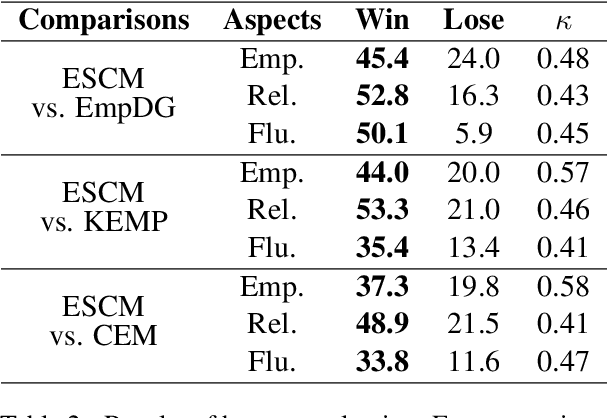
Empathetic response generation aims to generate empathetic responses by understanding the speaker's emotional feelings from the language of dialogue. Recent methods capture emotional words in the language of communicators and construct them as static vectors to perceive nuanced emotions. However, linguistic research has shown that emotional words in language are dynamic and have correlations with other grammar semantic roles, i.e., words with semantic meanings, in grammar. Previous methods overlook these two characteristics, which easily lead to misunderstandings of emotions and neglect of key semantics. To address this issue, we propose a dynamical Emotion-Semantic Correlation Model (ESCM) for empathetic dialogue generation tasks. ESCM constructs dynamic emotion-semantic vectors through the interaction of context and emotions. We introduce dependency trees to reflect the correlations between emotions and semantics. Based on dynamic emotion-semantic vectors and dependency trees, we propose a dynamic correlation graph convolutional network to guide the model in learning context meanings in dialogue and generating empathetic responses. Experimental results on the EMPATHETIC-DIALOGUES dataset show that ESCM understands semantics and emotions more accurately and expresses fluent and informative empathetic responses. Our analysis results also indicate that the correlations between emotions and semantics are frequently used in dialogues, which is of great significance for empathetic perception and expression.