 Add to Chrome
 Add to Firefox
 Add to Edge
SMoES: Soft Modality-Guided Expert Specialization in MoE-VLMs
Apr 27, 2026
Mixture-of-Experts (MoE) has become a prevalent backbone for large vision-language models (VLMs), yet how modality-specific signals should guide expert routing remains under-explored. Existing routing strategies are either hand-crafted or modality-agnostic, relying on idealized priors that ignore the layer-dependent modality fusion patterns in MoE-VLMs and provide little guidance for expert specialization. We propose Soft Modality-guided Expert Specialization (SMoES), which consists of dynamic soft modality scores that capture layer-dependent fusion patterns, an expert binning mechanism aligned with expert-parallel deployment, and an inter-bin mutual information regularization that encourages coherent modality specialization. Our method leverages attention-based or Gaussian-statistics modality scores to optimize mutual information regularization. Experiments across four MoE-based VLMs and 16 benchmarks demonstrate improvement on both effectiveness and efficiency: 0.9% and 4.2% average gain on multimodal and language-only tasks, 56.1% reduction in EP communication overhead, and 12.3% throughput improvement under realistic deployment. These results validate that aligning routing with modality-aware expert specialization unlocks MoE-VLM capacity and efficiency.

Semantic Hierarchical Prompt Tuning for Parameter-Efficient Fine-Tuning
Dec 24, 2024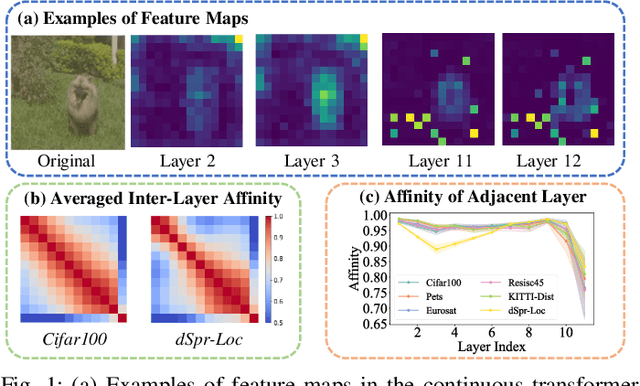
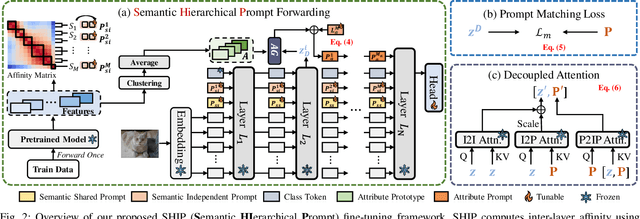
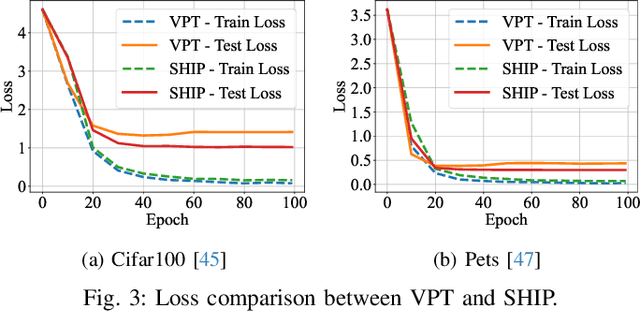
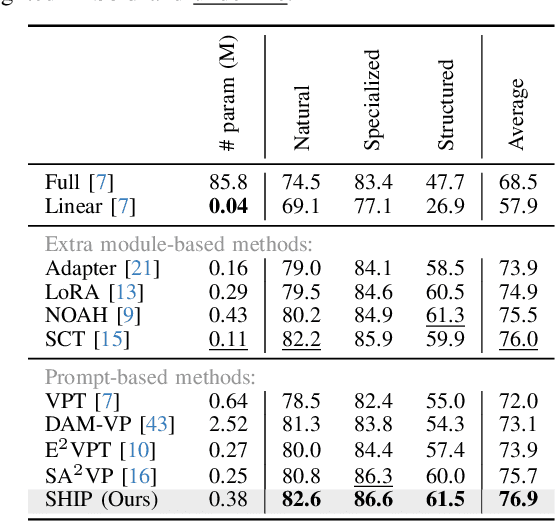
As the scale of vision models continues to grow, Visual Prompt Tuning (VPT) has emerged as a parameter-efficient transfer learning technique, noted for its superior performance compared to full fine-tuning. However, indiscriminately applying prompts to every layer without considering their inherent correlations, can cause significant disturbances, leading to suboptimal transferability. Additionally, VPT disrupts the original self-attention structure, affecting the aggregation of visual features, and lacks a mechanism for explicitly mining discriminative visual features, which are crucial for classification. To address these issues, we propose a Semantic Hierarchical Prompt (SHIP) fine-tuning strategy. We adaptively construct semantic hierarchies and use semantic-independent and semantic-shared prompts to learn hierarchical representations. We also integrate attribute prompts and a prompt matching loss to enhance feature discrimination and employ decoupled attention for robustness and reduced inference costs. SHIP significantly improves performance, achieving a 4.9% gain in accuracy over VPT with a ViT-B/16 backbone on VTAB-1k tasks. Our code is available at https://github.com/haoweiz23/SHIP.
Low-Confidence Samples Mining for Semi-supervised Object Detection
Jun 28, 2023Reliable pseudo-labels from unlabeled data play a key role in semi-supervised object detection (SSOD). However, the state-of-the-art SSOD methods all rely on pseudo-labels with high confidence, which ignore valuable pseudo-labels with lower confidence. Additionally, the insufficient excavation for unlabeled data results in an excessively low recall rate thus hurting the network training. In this paper, we propose a novel Low-confidence Samples Mining (LSM) method to utilize low-confidence pseudo-labels efficiently. Specifically, we develop an additional pseudo information mining (PIM) branch on account of low-resolution feature maps to extract reliable large-area instances, the IoUs of which are higher than small-area ones. Owing to the complementary predictions between PIM and the main branch, we further design self-distillation (SD) to compensate for both in a mutually-learning manner. Meanwhile, the extensibility of the above approaches enables our LSM to apply to Faster-RCNN and Deformable-DETR respectively. On the MS-COCO benchmark, our method achieves 3.54% mAP improvement over state-of-the-art methods under 5% labeling ratios.
Semi-Supervised Object Detection with Adaptive Class-Rebalancing Self-Training
Jul 11, 2021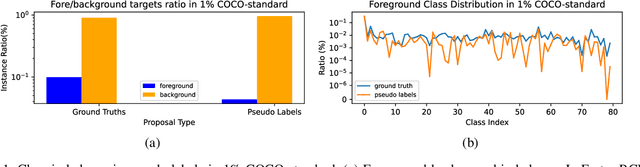
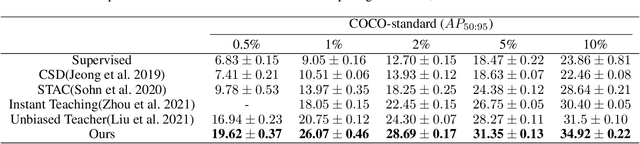
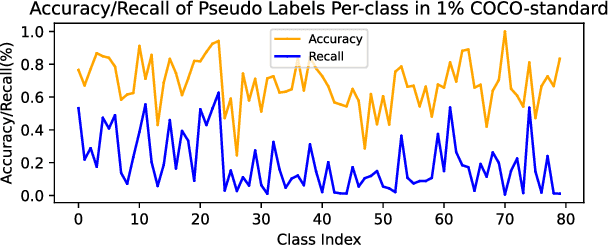
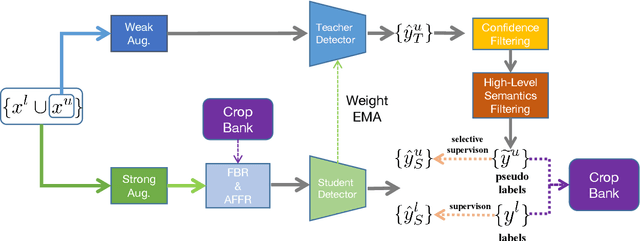
This study delves into semi-supervised object detection (SSOD) to improve detector performance with additional unlabeled data. State-of-the-art SSOD performance has been achieved recently by self-training, in which training supervision consists of ground truths and pseudo-labels. In current studies, we observe that class imbalance in SSOD severely impedes the effectiveness of self-training. To address the class imbalance, we propose adaptive class-rebalancing self-training (ACRST) with a novel memory module called CropBank. ACRST adaptively rebalances the training data with foreground instances extracted from the CropBank, thereby alleviating the class imbalance. Owing to the high complexity of detection tasks, we observe that both self-training and data-rebalancing suffer from noisy pseudo-labels in SSOD. Therefore, we propose a novel two-stage filtering algorithm to generate accurate pseudo-labels. Our method achieves satisfactory improvements on MS-COCO and VOC benchmarks. When using only 1\% labeled data in MS-COCO, our method achieves 17.02 mAP improvement over supervised baselines, and 5.32 mAP improvement compared with state-of-the-art methods.