 Add to Chrome
 Add to Firefox
 Add to Edge
XDomainBench: Diagnosing Reasoning Collapse in High-Dimensional Scientific Knowledge Composition
May 14, 2026
Large Language Models (LLMs) are increasingly deployed for knowledge synthesis, yet their capacity for compositional generalization in scientific knowledge remains under-characterized. Existing benchmarks primarily focus on single-turn restricted scenarios, failing to capture the capability boundaries exposed by real-world interactive scientific workflows. To address this, we introduce XDomainBench, a diagnostic benchmark for interactive interdisciplinary scientific reasoning. We formalize the composition order and mixture structure to enable systematic stress-testing from single-discipline to inter-disciplinary, comprising 8,598 interactive sessions across 20 domains and 4 task categories, with 8 realistic trajectory patterns covering difficulty and domain-mixture dynamics, simulating real AI4S scenarios. Large-scale evaluation of LLMs reveals a systematic reasoning collapse as composition order increases, stemming from two root causes: (i) direct difficulty increases induced by domain composition, and (ii) indirect interaction-amplified failures where trajectory patterns trigger error accumulation, reasoning breaks, and domain confusion, ultimately leading to session collapse.

MPU: Towards Secure and Privacy-Preserving Knowledge Unlearning for Large Language Models
Feb 27, 2026Machine unlearning for large language models often faces a privacy dilemma in which strict constraints prohibit sharing either the server's parameters or the client's forget set. To address this dual non-disclosure constraint, we propose MPU, an algorithm-agnostic privacy-preserving Multiple Perturbed Copies Unlearning framework that primarily introduces two server-side modules: Pre-Process for randomized copy generation and Post-Process for update aggregation. In Pre-Process, the server distributes multiple perturbed and reparameterized model instances, allowing the client to execute unlearning locally on its private forget set without accessing the server's exact original parameters. After local unlearning, the server performs Post-Process by inverting the reparameterization and aggregating updates with a harmonic denoising procedure to alleviate the impact of perturbation. Experiments with seven unlearning algorithms show that MPU achieves comparable unlearning performance to noise-free baselines, with most algorithms' average degradation well below 1% under 10% noise, and can even outperform the noise-free baseline for some algorithms under 1% noise. Code is available at https://github.com/Tristan-SHU/MPU.
M-Loss: Quantifying Model Merging Compatibility with Limited Unlabeled Data
Feb 09, 2026Training of large-scale models is both computationally intensive and often constrained by the availability of labeled data. Model merging offers a compelling alternative by directly integrating the weights of multiple source models without requiring additional data or extensive training. However, conventional model merging techniques, such as parameter averaging, often suffer from the unintended combination of non-generalizable features, especially when source models exhibit significant weight disparities. Comparatively, model ensembling generally provides more stable and superior performance that aggregates multiple models by averaging outputs. However, it incurs higher inference costs and increased storage requirements. While previous studies experimentally showed the similarities between model merging and ensembling, theoretical evidence and evaluation metrics remain lacking. To address this gap, we introduce Merging-ensembling loss (M-Loss), a novel evaluation metric that quantifies the compatibility of merging source models using very limited unlabeled data. By measuring the discrepancy between parameter averaging and model ensembling at layer and node levels, M-Loss facilitates more effective merging strategies. Specifically, M-Loss serves both as a quantitative criterion of the theoretical feasibility of model merging, and a guide for parameter significance in model pruning. Our theoretical analysis and empirical evaluations demonstrate that incorporating M-Loss into the merging process significantly improves the alignment between merged models and model ensembling, providing a scalable and efficient framework for accurate model consolidation.
Oblivionis: A Lightweight Learning and Unlearning Framework for Federated Large Language Models
Aug 12, 2025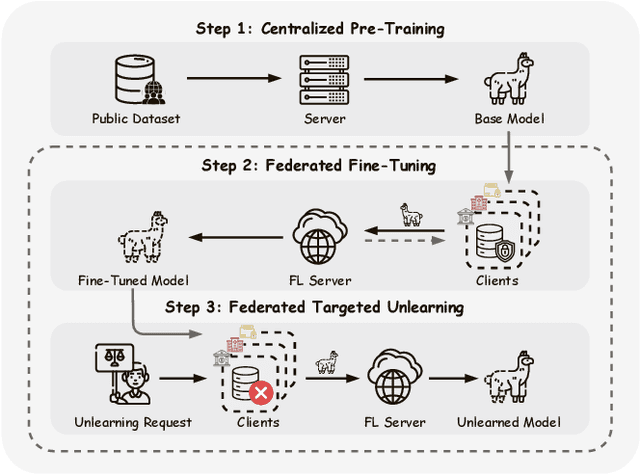
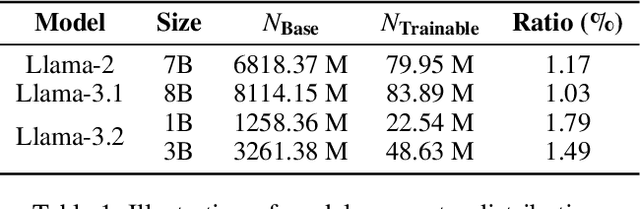
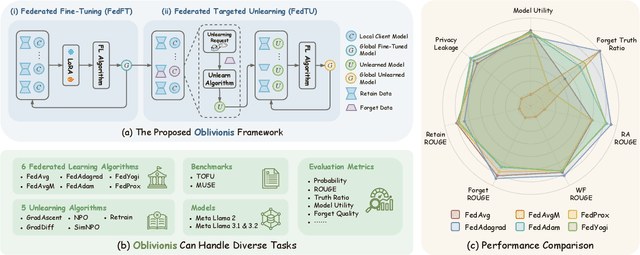
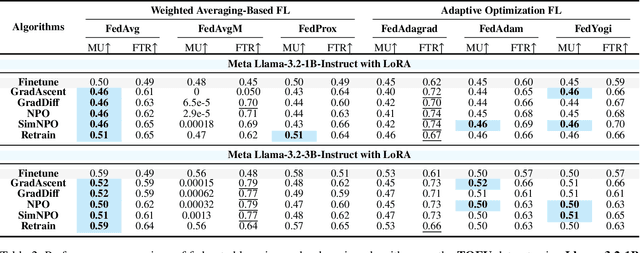
Large Language Models (LLMs) increasingly leverage Federated Learning (FL) to utilize private, task-specific datasets for fine-tuning while preserving data privacy. However, while federated LLM frameworks effectively enable collaborative training without raw data sharing, they critically lack built-in mechanisms for regulatory compliance like GDPR's right to be forgotten. Integrating private data heightens concerns over data quality and long-term governance, yet existing distributed training frameworks offer no principled way to selectively remove specific client contributions post-training. Due to distributed data silos, stringent privacy constraints, and the intricacies of interdependent model aggregation, federated LLM unlearning is significantly more complex than centralized LLM unlearning. To address this gap, we introduce Oblivionis, a lightweight learning and unlearning framework that enables clients to selectively remove specific private data during federated LLM training, enhancing trustworthiness and regulatory compliance. By unifying FL and unlearning as a dual optimization objective, we incorporate 6 FL and 5 unlearning algorithms for comprehensive evaluation and comparative analysis, establishing a robust pipeline for federated LLM unlearning. Extensive experiments demonstrate that Oblivionis outperforms local training, achieving a robust balance between forgetting efficacy and model utility, with cross-algorithm comparisons providing clear directions for future LLM development.