 Add to Chrome
 Add to Firefox
 Add to Edge
A survey of AI-generated voices and their detection
Aug 15, 2026
The ability of artificial intelligence (AI) models to generate highly realistic human voices has advanced rapidly. These technologies power accessibility tools, virtual assistants and creative applications, but they also enable harmful uses, including impersonation, fraud and disinformation. Recent incidents of voice cloning scams targeting businesses and political leaders underscore the urgent need for robust safeguards. Unlike image and video deepfakes, the detection of synthetic voices poses unique challenges due to the complexity of phonetics, prosody and auditory perception. This survey offers a comprehensive overview of AI voice generation and detection methods, encompassing both the technical foundations and the latest state-of-the-art advances. This study also identifies key open challenges, benchmark resources and future directions to make this survey useful for future researchers.

The Voiceprint Fallacy: Why Voices Are Not Unique Biometric Imprints
Aug 08, 2026In recent years, the term voiceprint has regained attention, particularly in technological applications and policy-making contexts, often carrying the assumption that a person's voice constitutes a stable and unique biometric trace analogous to a fingerprint. Yet this conception has been repeatedly criticized and rejected by forensic voice experts throughout the decades since its introduction. Although voices undoubtedly contain speaker-related information, this simplified conception obscures the highly dynamic and context-dependent nature of speech. This article revisits the voiceprint fallacy and reconsiders what can count as evidence of speaker identity by reviewing the historical development of voiceprint identification, evidence on human voice variability, developments in forensic voice comparison, research on human and automatic speaker recognition, and the recent challenge posed by deepfake speech to speaker identity. We point out that the voiceprint metaphor and its underlying implications are scientifically misleading because they transform a probabilistic source of speaker information into an imagined stable object of identity. To avoid treating voices as imprint-like traces, we recommend that voice evidence be interpreted through validated and calibrated probabilistic frameworks that explicitly account for variability, uncertainty, and alternative explanations.
Acoustic and perceptual differences between standard and accented Chinese speech and their voice clones
Apr 02, 2026Voice cloning is often evaluated in terms of overall quality, but less is known about accent preservation and its perceptual consequences. We compare standard and heavily accented Mandarin speech and their voice clones using a combined computational and perceptual design. Embedding-based analyses show no reliable accented-standard difference in original-clone distances across systems. In the perception study, clones are rated as more similar to their originals for standard than for accented speakers, and intelligibility increases from original to clone, with a larger gain for accented speech. These results show that accent variation can shape perceived identity match and intelligibility in voice cloning even when it is not reflected in an off-the-shelf speaker-embedding distance, and they motivate evaluating speaker identity preservation and accent preservation as separable dimensions.
Assessing the Ability of Neural TTS Systems to Model Consonant-Induced F0 Perturbation
Mar 22, 2026This study proposes a segmental-level prosodic probing framework to evaluate neural TTS models' ability to reproduce consonant-induced f0 perturbation, a fine-grained segmental-prosodic effect that reflects local articulatory mechanisms. We compare synthetic and natural speech realizations for thousands of words, stratified by lexical frequency, using Tacotron 2 and FastSpeech 2 trained on the same speech corpus (LJ Speech). These controlled analyses are then complemented by a large-scale evaluation spanning multiple advanced TTS systems. Results show accurate reproduction for high-frequency words but poor generalization to low-frequency items, suggesting that the examined TTS architectures rely more on lexical-level memorization than on abstract segmental-prosodic encoding. This finding highlights a limitation in such TTS systems' ability to generalize prosodic detail beyond seen data. The proposed probe offers a linguistically informed diagnostic framework that may inform future TTS evaluation methods, and has implications for interpretability and authenticity assessment in synthetic speech.
* Accepted for publication in Computer Speech & Language
Forensic deepfake audio detection using segmental speech features
May 20, 2025This study explores the potential of using acoustic features of segmental speech sounds to detect deepfake audio. These features are highly interpretable because of their close relationship with human articulatory processes and are expected to be more difficult for deepfake models to replicate. The results demonstrate that certain segmental features commonly used in forensic voice comparison are effective in identifying deep-fakes, whereas some global features provide little value. These findings underscore the need to approach audio deepfake detection differently for forensic voice comparison and offer a new perspective on leveraging segmental features for this purpose.
A Survey on Foundation-Model-Based Industrial Defect Detection
Feb 26, 2025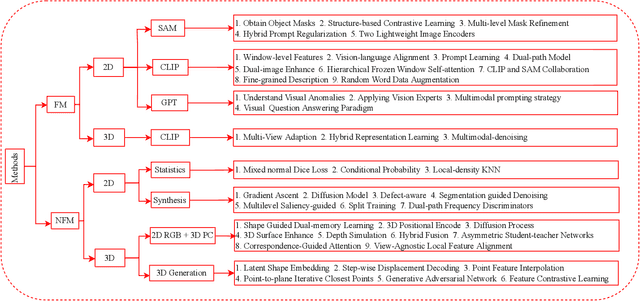
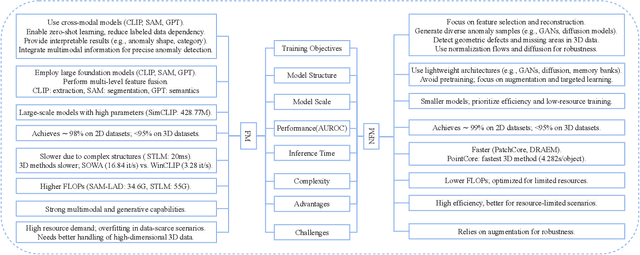
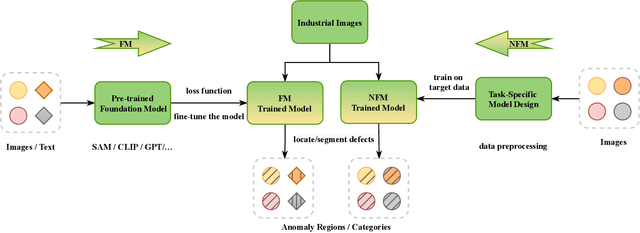
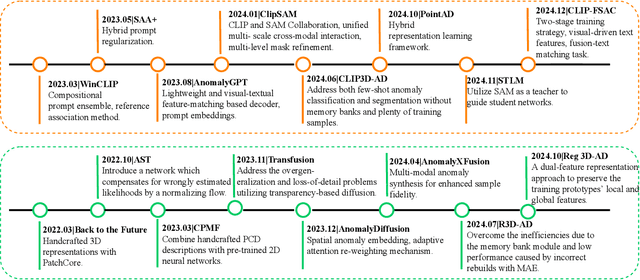
As industrial products become abundant and sophisticated, visual industrial defect detection receives much attention, including two-dimensional and three-dimensional visual feature modeling. Traditional methods use statistical analysis, abnormal data synthesis modeling, and generation-based models to separate product defect features and complete defect detection. Recently, the emergence of foundation models has brought visual and textual semantic prior knowledge. Many methods are based on foundation models (FM) to improve the accuracy of detection, but at the same time, increase model complexity and slow down inference speed. Some FM-based methods have begun to explore lightweight modeling ways, which have gradually attracted attention and deserve to be systematically analyzed. In this paper, we conduct a systematic survey with comparisons and discussions of foundation model methods from different aspects and briefly review non-foundation model (NFM) methods recently published. Furthermore, we discuss the differences between FM and NFM methods from training objectives, model structure and scale, model performance, and potential directions for future exploration. Through comparison, we find FM methods are more suitable for few-shot and zero-shot learning, which are more in line with actual industrial application scenarios and worthy of in-depth research.
Neural Networks with Different Initialization Methods for Depression Detection
May 10, 2022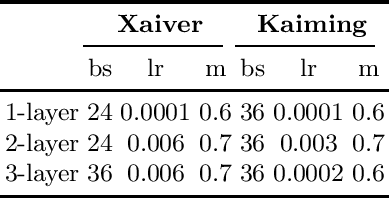
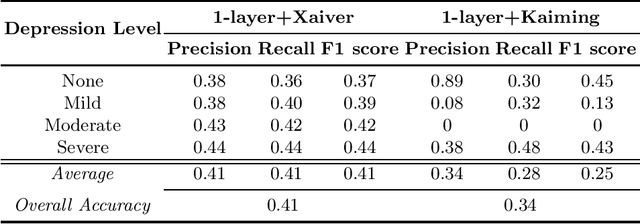
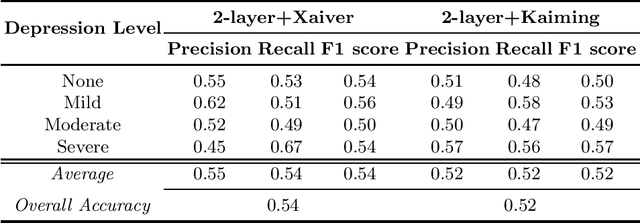
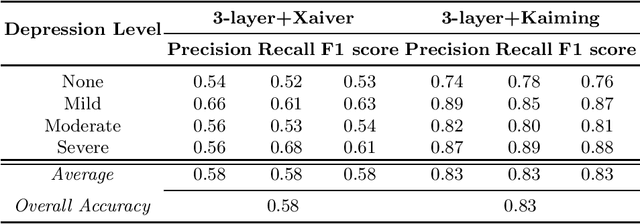
As a common mental disorder, depression is a leading cause of various diseases worldwide. Early detection and treatment of depression can dramatically promote remission and prevent relapse. However, conventional ways of depression diagnosis require considerable human effort and cause economic burden, while still being prone to misdiagnosis. On the other hand, recent studies report that physical characteristics are major contributors to the diagnosis of depression, which inspires us to mine the internal relationship by neural networks instead of relying on clinical experiences. In this paper, neural networks are constructed to predict depression from physical characteristics. Two initialization methods are examined - Xaiver and Kaiming initialization. Experimental results show that a 3-layers neural network with Kaiming initialization achieves $83\%$ accuracy.