 Add to Chrome
 Add to Firefox
 Add to Edge
HierCAD: Hierarchical Text-to-CAD Design via Structure Alignment and Parameter Grounding
Jul 13, 2026
Recent text-to-CAD approaches have shown promising results by leveraging large language models, but they often struggle with maintaining structural consistency in complex designs and accurately grounding geometric parameters. To address these issues, we propose HierCAD, a hierarchical text-to-CAD framework that improves both structural reasoning and parameter prediction. HierCAD reformulates CAD generation as progressive reasoning by decomposing CAD construction trees into object-level procedural reasoning and part-level topology reasoning trajectories. To further improve generation fidelity, we introduce a unified Structure Alignment and Parameter Grounding (SAPG) learning strategy. Structure alignment aligns topology reasoning trajectories with their corresponding parametric CAD spans, while parameter grounding mitigates shortcut learning through structure-preserving parameter perturbations and ranking-based supervision. Experiments demonstrate that HierCAD outperforms prior state-of-the-art methods on both CAD sequence generation and reconstructed CAD model evaluation. Our code is available at https://github.com/Collab-Gen/HierCAD.

End-to-End Modeling via Information Tree for One-Shot Natural Language Spatial Video Grounding
Mar 15, 2022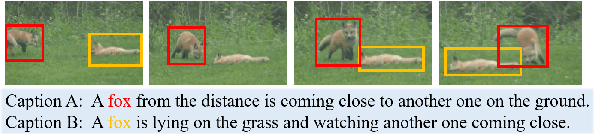
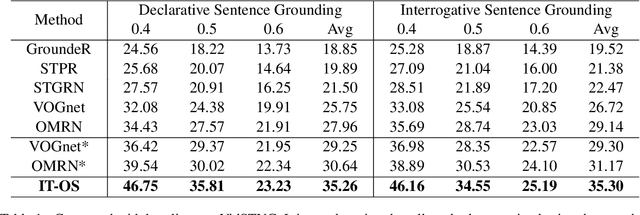
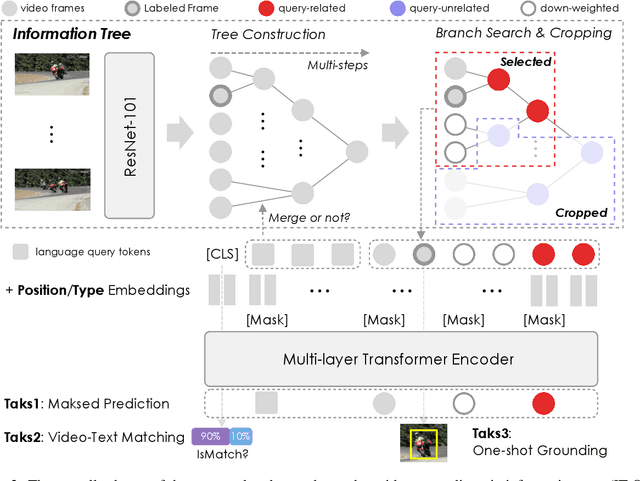
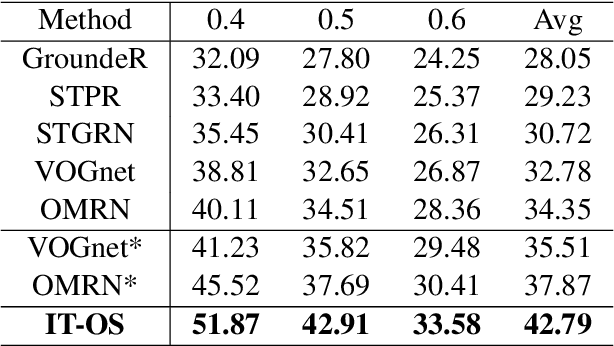
Natural language spatial video grounding aims to detect the relevant objects in video frames with descriptive sentences as the query. In spite of the great advances, most existing methods rely on dense video frame annotations, which require a tremendous amount of human effort. To achieve effective grounding under a limited annotation budget, we investigate one-shot video grounding, and learn to ground natural language in all video frames with solely one frame labeled, in an end-to-end manner. One major challenge of end-to-end one-shot video grounding is the existence of videos frames that are either irrelevant to the language query or the labeled frames. Another challenge relates to the limited supervision, which might result in ineffective representation learning. To address these challenges, we designed an end-to-end model via Information Tree for One-Shot video grounding (IT-OS). Its key module, the information tree, can eliminate the interference of irrelevant frames based on branch search and branch cropping techniques. In addition, several self-supervised tasks are proposed based on the information tree to improve the representation learning under insufficient labeling. Experiments on the benchmark dataset demonstrate the effectiveness of our model.