 Add to Chrome
 Add to Firefox
 Add to Edge
EgoSafe: A First-Person Mobile-Captured Benchmark for Visual Safety Understanding
Jul 29, 2026
Reliable visual safety understanding in real-world scenarios demands more than just object recognition; it requires causal reasoning under epistemic uncertainty. While Large Vision-Language Models (LVLMs) demonstrate impressive semantic alignment on standard benchmarks, they often struggle to distinguish between superficial correlation and genuine forensic logic when grounded in the dynamic, partially observable nature of first-person experiences. Existing evaluations, dominated by third-person surveillance footage and binary classification metrics, fail to expose this cognitive gap. To address this, we introduce EgoSafe-Bench, a benchmark specifically designed to probe forensic reasoning in egocentric safety scenarios. It comprises 12,000 unique evaluation samples, generated by pairing each of the 3,000 video clips with a QA chain governed by our proposed Hierarchical Reasoning Evaluation (HRE) protocol. Unlike standard benchmarks, HRE mandates a rigorous reasoning trajectory from initial feature anchoring to blind-spot deduction and intent inference, thereby enforcing logical consistency and penalizing shortcut-based predictions.Extensive evaluations of state-of-the-art LVLMs (e.g., Qwen3-VL, Gemini, VideoLLaMA 3) reveal a significant perception-reasoning decoupling: models often achieve high descriptive scores but exhibit notable fragility in causal reasoning and logical closure. Our work provides both a challenging dataset and a systematic evaluation framework to foster the development of logically robust video understanding systems.

ShuffleFlow: Scalable Posterior Inference for Bayesian Inverse Imaging
Jun 19, 2026Variational inference (VI) is a powerful method for principled posterior inference for scientific inverse imaging. VI learns the posterior distribution, often with a flow-based network, which can cheaply generate posterior samples upon optimization, and can flexibly incorporate score-based or classic priors. However, its application to large-scale image reconstruction is severely hindered by the poor scalability of the flow-based networks. In this work, we introduce ShuffleFlow, a scalable VI framework to address this challenge. Our method breaks down the problem into three parts: a pixel-unshuffling-based image coordinate sampler, a neural field as feature encoder, and a conditional normalizing flow (CNF) as posterior estimator. Specifically, our framework partitions an image into a stack of sub-images with pixel-unshuffling and uses a shared CNF to model the joint distribution of the sub-image stack. We condition the CNF on the output of a neural field, which embeds feature vectors corresponding to pixel-unshuffling sample locations to capture spatial structures, and share the flow's latent variable across the channels to model their correlations. We demonstrate our method's effectiveness and efficiency on both linear and nonlinear imaging inverse problems, and show its ability to more rapidly generate a high-sample-count posterior than diffusion samplers.
SpiderCam: Low-Power Snapshot Depth from Differential Defocus
Mar 18, 2026We introduce SpiderCam, an FPGA-based snapshot depth-from-defocus camera which produces 480x400 sparse depth maps in real-time at 32.5 FPS over a working range of 52 cm while consuming 624 mW of power in total. SpiderCam comprises a custom camera that simultaneously captures two differently focused images of the same scene, processed with a SystemVerilog implementation of depth from differential defocus (DfDD) on a low-power FPGA. To achieve state-of-the-art power consumption, we present algorithmic improvements to DfDD that overcome challenges caused by low-power sensors, and design a memory-local implementation for streaming depth computation on a device that is too small to store even a single image pair. We report the first sub-Watt total power measurement for passive FPGA-based 3D cameras in the literature.
Neural Fields for Adaptive Photoacoustic Computed Tomography
Sep 17, 2024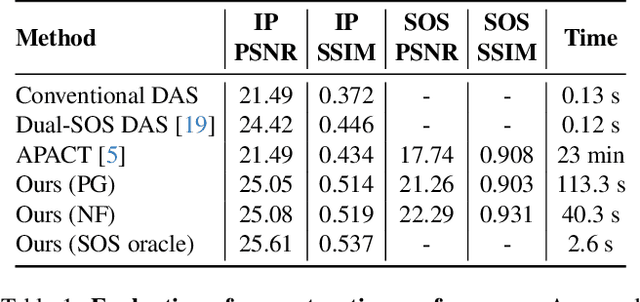
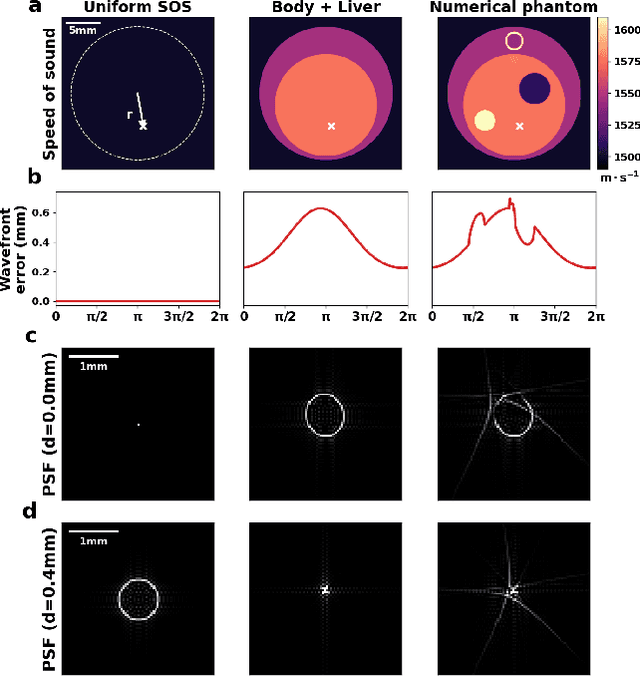
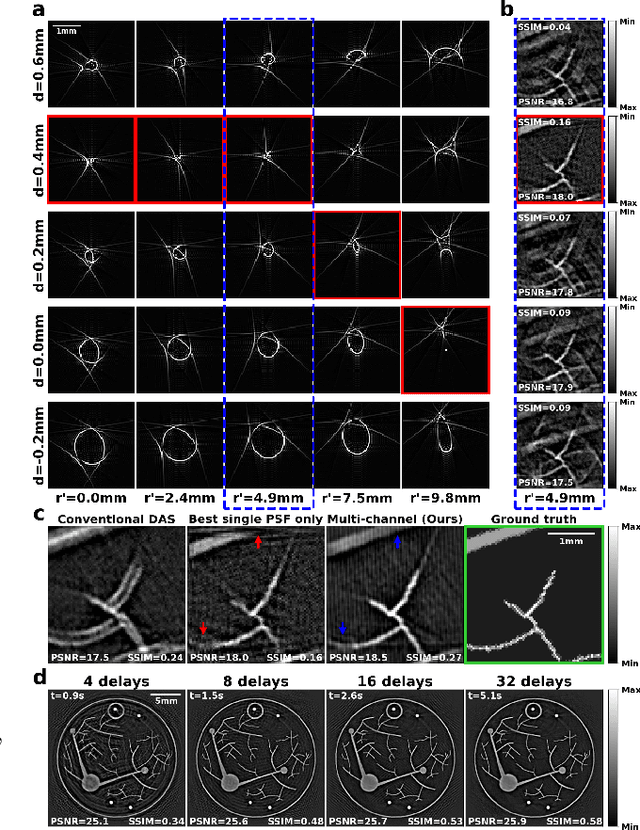
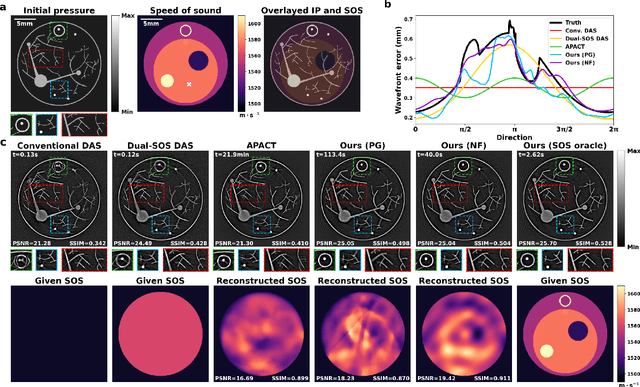
Photoacoustic computed tomography (PACT) is a non-invasive imaging modality with wide medical applications. Conventional PACT image reconstruction algorithms suffer from wavefront distortion caused by the heterogeneous speed of sound (SOS) in tissue, which leads to image degradation. Accounting for these effects improves image quality, but measuring the SOS distribution is experimentally expensive. An alternative approach is to perform joint reconstruction of the initial pressure image and SOS using only the PA signals. Existing joint reconstruction methods come with limitations: high computational cost, inability to directly recover SOS, and reliance on inaccurate simplifying assumptions. Implicit neural representation, or neural fields, is an emerging technique in computer vision to learn an efficient and continuous representation of physical fields with a coordinate-based neural network. In this work, we introduce NF-APACT, an efficient self-supervised framework utilizing neural fields to estimate the SOS in service of an accurate and robust multi-channel deconvolution. Our method removes SOS aberrations an order of magnitude faster and more accurately than existing methods. We demonstrate the success of our method on a novel numerical phantom as well as an experimentally collected phantom and in vivo data. Our code and numerical phantom are available at https://github.com/Lukeli0425/NF-APACT.
Galaxy Image Deconvolution for Weak Gravitational Lensing with Physics-informed Deep Learning
Nov 03, 2022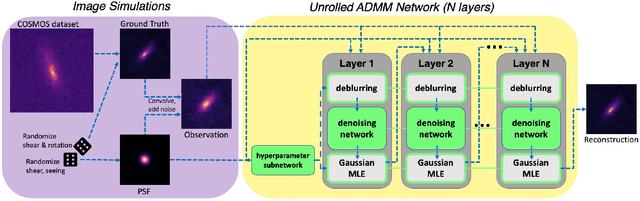
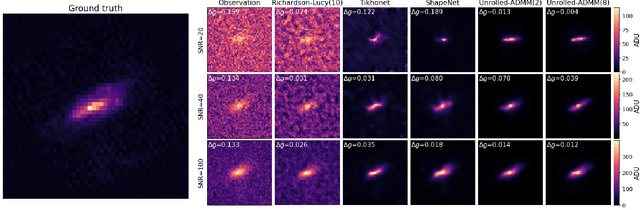
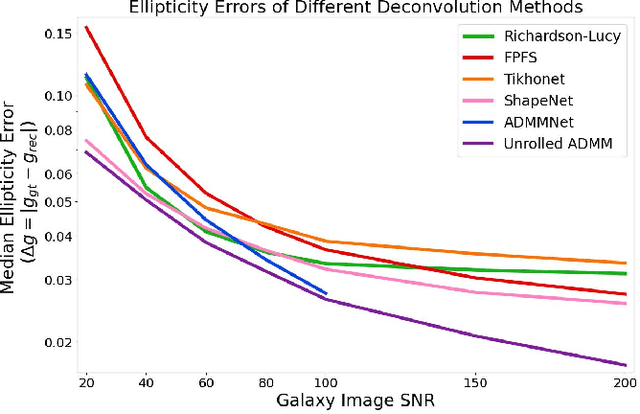
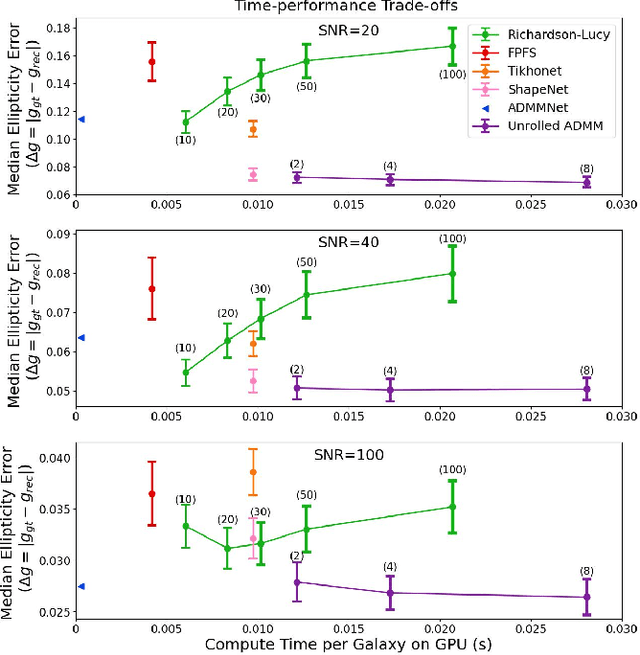
Removing optical and atmospheric blur from galaxy images significantly improves galaxy shape measurements for weak gravitational lensing and galaxy evolution studies. This ill-posed linear inverse problem is usually solved with deconvolution algorithms enhanced by regularisation priors or deep learning. We introduce a so-called "physics-based deep learning" approach to the Point Spread Function (PSF) deconvolution problem in galaxy surveys. We apply algorithm unrolling and the Plug-and-Play technique to the Alternating Direction Method of Multipliers (ADMM) with a Poisson noise model and use a neural network to learn appropriate priors from simulated galaxy images. We characterise the time-performance trade-off of several methods for galaxies of differing brightness levels, showing an improvement of 26% (SNR=20)/48% (SNR=100) compared to standard methods and 14% (SNR=20) compared to modern methods.