 Add to Chrome
 Add to Firefox
 Add to Edge
BamiBERT: A New BERT-based Language Model for Vietnamese
Jul 02, 2026
In this paper, we introduce BamiBERT, a new BERT-based pre-trained language model for Vietnamese that addresses key limitations of PhoBERT -- the current de facto Vietnamese text encoder. Trained from scratch on a 129GB corpus of general-domain Vietnamese text for 20 epochs, BamiBERT supports an extended context length of up to 2048 tokens and operates directly on raw input, eliminating the need for external word segmentation. Across 8 Vietnamese benchmarks, it achieves the best score on 11 of 15 metrics and the second-best on 3 others, setting a new state of the art among "base"-sized Vietnamese encoders and demonstrating strong cross-domain generalization. We release BamiBERT at: https://huggingface.co/Qualcomm-AI-Research/BamiBERT

MERRIN: A Benchmark for Multimodal Evidence Retrieval and Reasoning in Noisy Web Environments
Apr 15, 2026Motivated by the underspecified, multi-hop nature of search queries and the multimodal, heterogeneous, and often conflicting nature of real-world web results, we introduce MERRIN (Multimodal Evidence Retrieval and Reasoning in Noisy Web Environments), a human-annotated benchmark for evaluating search-augmented agents. MERRIN measures AI agents' ability to identify relevant modalities, retrieve multimodal evidence, and perform multi-hop reasoning over noisy web sources. It differs from prior work in three important aspects: (1) using natural language queries without explicit modality cues, (2) incorporating underexplored modalities such as video and audio, and (3) requiring the retrieval of complex, often noisy or conflicting multimodal evidence during web search. We evaluate diverse search agents powered by ten models, including strong closed-source models (e.g., GPT-5.4-mini, Gemini 3/3.1 Flash/Pro) and open-weight models (Qwen3-4B/30B/235B), across three search settings (no search, native search, and agentic search). Our results show that MERRIN is highly challenging: the average accuracy across all agents is 22.3%, with the best-performing agent reaching only 40.1%. We further observe that while stronger agents like Gemini Deep Research achieve higher performance, gains are modest due to over-exploration; they take more steps and use more tools, but are often distracted by conflicting or partially relevant web content, leading to incorrect answers. Compared to humans, these agents consume more resources yet achieve lower accuracy, largely due to inefficient source selection and an overreliance on text modalities. These findings highlight the need for search agents capable of robust search and reasoning across diverse modalities in noisy web environments, making MERRIN a valuable testbed for evaluating such capabilities.
$π^2$: Structure-Originated Reasoning Data Improves Long-Context Reasoning Ability of Large Language Models
Apr 06, 2026We study a pipeline that curates reasoning data from initial structured data for improving long-context reasoning in large language models (LLMs). Our approach, $π^2$, constructs high-quality reasoning data through rigorous QA curation: 1) extracting and expanding tables from Wikipedia, 2) from the collected tables and relevant context, generating realistic and multi-hop analytical reasoning questions whose answers are automatically determined and verified through dual-path code execution, and 3) back-translating step-by-step structured reasoning traces as solutions of QA pairs given realistic web-search context. Supervised fine-tuning with \textsc{\small{gpt-oss-20b}} and \textsc{\small{Qwen3-4B-Instruct-2507}} on $π^2$ yields consistent improvements across four long-context reasoning benchmarks and our alike $π^2$-Bench, with average absolute accuracy gains of +4.3% and +2.7% respectively. Notably, our dataset facilitates self-distillation, where \textsc{\small{gpt-oss-20b}} even improves its average performance by +4.4% with its own reasoning traces, demonstrating $π^2$'s usefulness. Our code, data, and models are open-source at https://github.com/vt-pi-squared/pi-squared.
Towards Unsupervised Speaker Diarization System for Multilingual Telephone Calls Using Pre-trained Whisper Model and Mixture of Sparse Autoencoders
Jul 02, 2024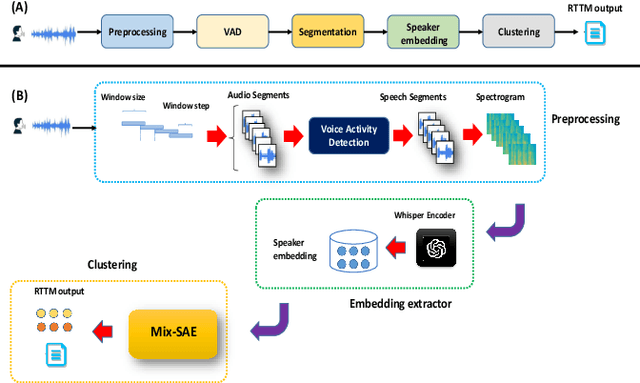

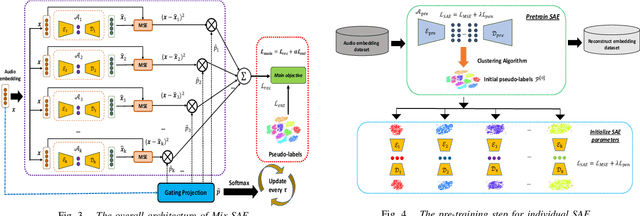
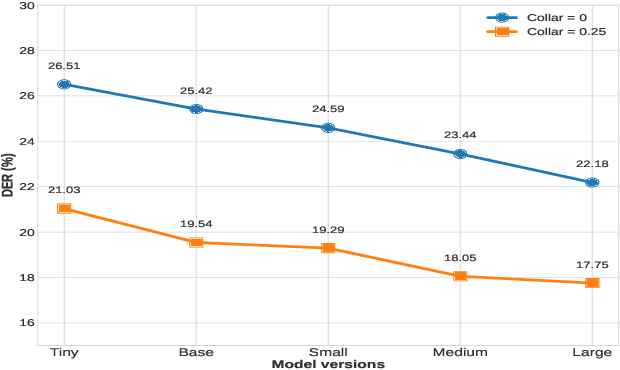
Existing speaker diarization systems heavily rely on large amounts of manually annotated data, which is labor-intensive and challenging to collect in real-world scenarios. Additionally, the language-specific constraint in speaker diarization systems significantly hinders their applicability and scalability in multilingual settings. In this paper, we therefore propose a cluster-based speaker diarization system for multilingual telephone call applications. The proposed system supports multiple languages and does not require large-scale annotated data for the training process as leveraging the multilingual Whisper model to extract speaker embeddings and proposing a novel Mixture of Sparse Autoencoders (Mix-SAE) network architecture for unsupervised speaker clustering. Experimental results on the evaluating dataset derived from two-speaker subsets of CALLHOME and CALLFRIEND telephonic speech corpora demonstrate superior efficiency of the proposed Mix-SAE network to other autoencoder-based clustering methods. The overall performance of our proposed system also indicates the promising potential of our approach in developing unsupervised multilingual speaker diarization applications within the context of limited annotated data and enhancing the integration ability into comprehensive multi-task speech analysis systems (i.e. multiple tasks of speech-to-text, language detection, speaker diarization integrated in a low-complexity system).
JPIS: A Joint Model for Profile-based Intent Detection and Slot Filling with Slot-to-Intent Attention
Dec 16, 2023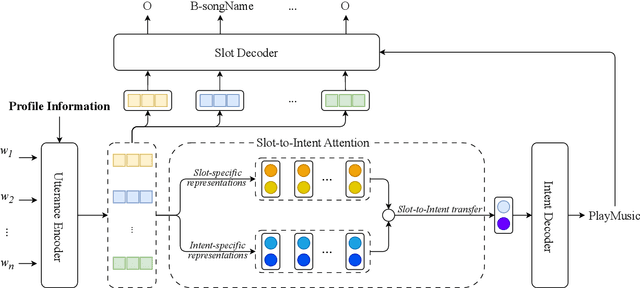
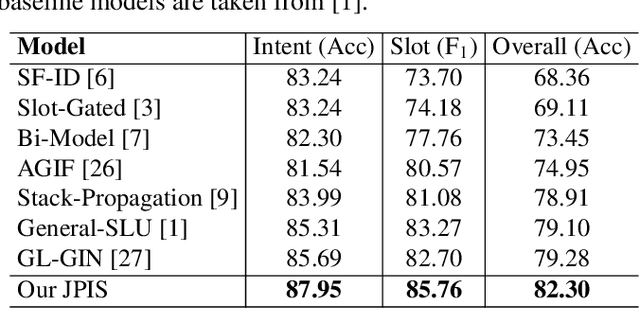

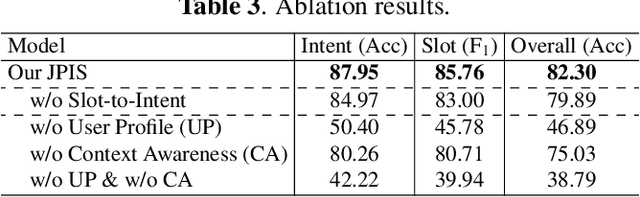
Profile-based intent detection and slot filling are important tasks aimed at reducing the ambiguity in user utterances by leveraging user-specific supporting profile information. However, research in these two tasks has not been extensively explored. To fill this gap, we propose a joint model, namely JPIS, designed to enhance profile-based intent detection and slot filling. JPIS incorporates the supporting profile information into its encoder and introduces a slot-to-intent attention mechanism to transfer slot information representations to intent detection. Experimental results show that our JPIS substantially outperforms previous profile-based models, establishing a new state-of-the-art performance in overall accuracy on the Chinese benchmark dataset ProSLU.
MISCA: A Joint Model for Multiple Intent Detection and Slot Filling with Intent-Slot Co-Attention
Dec 10, 2023
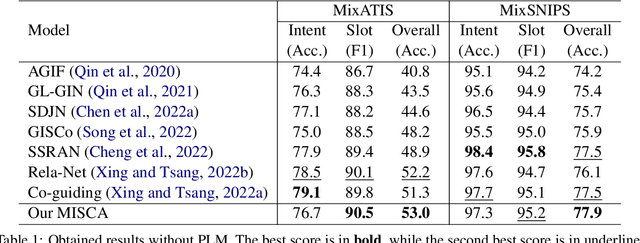


The research study of detecting multiple intents and filling slots is becoming more popular because of its relevance to complicated real-world situations. Recent advanced approaches, which are joint models based on graphs, might still face two potential issues: (i) the uncertainty introduced by constructing graphs based on preliminary intents and slots, which may transfer intent-slot correlation information to incorrect label node destinations, and (ii) direct incorporation of multiple intent labels for each token w.r.t. token-level intent voting might potentially lead to incorrect slot predictions, thereby hurting the overall performance. To address these two issues, we propose a joint model named MISCA. Our MISCA introduces an intent-slot co-attention mechanism and an underlying layer of label attention mechanism. These mechanisms enable MISCA to effectively capture correlations between intents and slot labels, eliminating the need for graph construction. They also facilitate the transfer of correlation information in both directions: from intents to slots and from slots to intents, through multiple levels of label-specific representations, without relying on token-level intent information. Experimental results show that MISCA outperforms previous models, achieving new state-of-the-art overall accuracy performances on two benchmark datasets MixATIS and MixSNIPS. This highlights the effectiveness of our attention mechanisms.
XPhoneBERT: A Pre-trained Multilingual Model for Phoneme Representations for Text-to-Speech
May 31, 2023We present XPhoneBERT, the first multilingual model pre-trained to learn phoneme representations for the downstream text-to-speech (TTS) task. Our XPhoneBERT has the same model architecture as BERT-base, trained using the RoBERTa pre-training approach on 330M phoneme-level sentences from nearly 100 languages and locales. Experimental results show that employing XPhoneBERT as an input phoneme encoder significantly boosts the performance of a strong neural TTS model in terms of naturalness and prosody and also helps produce fairly high-quality speech with limited training data. We publicly release our pre-trained XPhoneBERT with the hope that it would facilitate future research and downstream TTS applications for multiple languages. Our XPhoneBERT model is available at https://github.com/VinAIResearch/XPhoneBERT