 Add to Chrome
 Add to Firefox
 Add to Edge
The BigScience ROOTS Corpus: A 1.6TB Composite Multilingual Dataset
Mar 07, 2023


As language models grow ever larger, the need for large-scale high-quality text datasets has never been more pressing, especially in multilingual settings. The BigScience workshop, a 1-year international and multidisciplinary initiative, was formed with the goal of researching and training large language models as a values-driven undertaking, putting issues of ethics, harm, and governance in the foreground. This paper documents the data creation and curation efforts undertaken by BigScience to assemble the Responsible Open-science Open-collaboration Text Sources (ROOTS) corpus, a 1.6TB dataset spanning 59 languages that was used to train the 176-billion-parameter BigScience Large Open-science Open-access Multilingual (BLOOM) language model. We further release a large initial subset of the corpus and analyses thereof, and hope to empower large-scale monolingual and multilingual modeling projects with both the data and the processing tools, as well as stimulate research around this large multilingual corpus.

Joint Representations of Text and Knowledge Graphs for Retrieval and Evaluation
Feb 28, 2023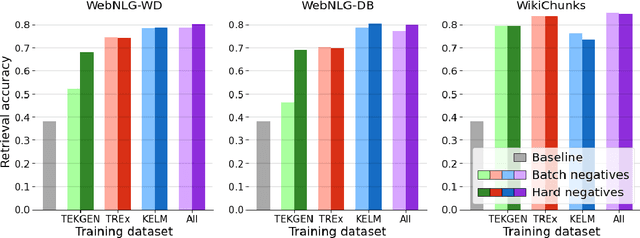
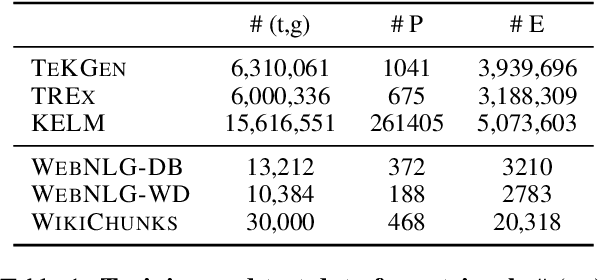
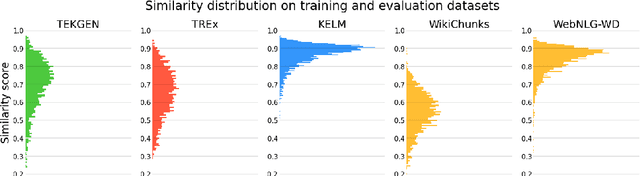
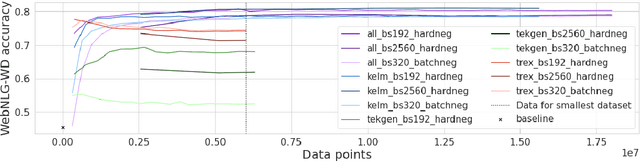
A key feature of neural models is that they can produce semantic vector representations of objects (texts, images, speech, etc.) ensuring that similar objects are close to each other in the vector space. While much work has focused on learning representations for other modalities, there are no aligned cross-modal representations for text and knowledge base (KB) elements. One challenge for learning such representations is the lack of parallel data, which we use contrastive training on heuristics-based datasets and data augmentation to overcome, training embedding models on (KB graph, text) pairs. On WebNLG, a cleaner manually crafted dataset, we show that they learn aligned representations suitable for retrieval. We then fine-tune on annotated data to create EREDAT (Ensembled Representations for Evaluation of DAta-to-Text), a similarity metric between English text and KB graphs. EREDAT outperforms or matches state-of-the-art metrics in terms of correlation with human judgments on WebNLG even though, unlike them, it does not require a reference text to compare against.
BLOOM: A 176B-Parameter Open-Access Multilingual Language Model
Nov 09, 2022Large language models (LLMs) have been shown to be able to perform new tasks based on a few demonstrations or natural language instructions. While these capabilities have led to widespread adoption, most LLMs are developed by resource-rich organizations and are frequently kept from the public. As a step towards democratizing this powerful technology, we present BLOOM, a 176B-parameter open-access language model designed and built thanks to a collaboration of hundreds of researchers. BLOOM is a decoder-only Transformer language model that was trained on the ROOTS corpus, a dataset comprising hundreds of sources in 46 natural and 13 programming languages (59 in total). We find that BLOOM achieves competitive performance on a wide variety of benchmarks, with stronger results after undergoing multitask prompted finetuning. To facilitate future research and applications using LLMs, we publicly release our models and code under the Responsible AI License.
What Language Model to Train if You Have One Million GPU Hours?
Nov 08, 2022


The crystallization of modeling methods around the Transformer architecture has been a boon for practitioners. Simple, well-motivated architectural variations can transfer across tasks and scale, increasing the impact of modeling research. However, with the emergence of state-of-the-art 100B+ parameters models, large language models are increasingly expensive to accurately design and train. Notably, it can be difficult to evaluate how modeling decisions may impact emergent capabilities, given that these capabilities arise mainly from sheer scale alone. In the process of building BLOOM--the Big Science Large Open-science Open-access Multilingual language model--our goal is to identify an architecture and training setup that makes the best use of our 1,000,000 A100-GPU-hours budget. Specifically, we perform an ablation study at the billion-parameter scale comparing different modeling practices and their impact on zero-shot generalization. In addition, we study the impact of various popular pre-training corpora on zero-shot generalization. We also study the performance of a multilingual model and how it compares to the English-only one. Finally, we consider the scaling behaviour of Transformers to choose the target model size, shape, and training setup. All our models and code are open-sourced at https://huggingface.co/bigscience .
Crosslingual Generalization through Multitask Finetuning
Nov 03, 2022Multitask prompted finetuning (MTF) has been shown to help large language models generalize to new tasks in a zero-shot setting, but so far explorations of MTF have focused on English data and models. We apply MTF to the pretrained multilingual BLOOM and mT5 model families to produce finetuned variants called BLOOMZ and mT0. We find finetuning large multilingual language models on English tasks with English prompts allows for task generalization to non-English languages that appear only in the pretraining corpus. Finetuning on multilingual tasks with English prompts further improves performance on English and non-English tasks leading to various state-of-the-art zero-shot results. We also investigate finetuning on multilingual tasks with prompts that have been machine-translated from English to match the language of each dataset. We find training on these machine-translated prompts leads to better performance on human-written prompts in the respective languages. Surprisingly, we find models are capable of zero-shot generalization to tasks in languages they have never intentionally seen. We conjecture that the models are learning higher-level capabilities that are both task- and language-agnostic. In addition, we introduce xP3, a composite of supervised datasets in 46 languages with English and machine-translated prompts. Our code, datasets and models are publicly available at https://github.com/bigscience-workshop/xmtf.
What Language Model Architecture and Pretraining Objective Work Best for Zero-Shot Generalization?
Apr 12, 2022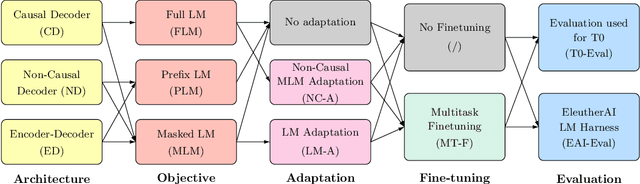
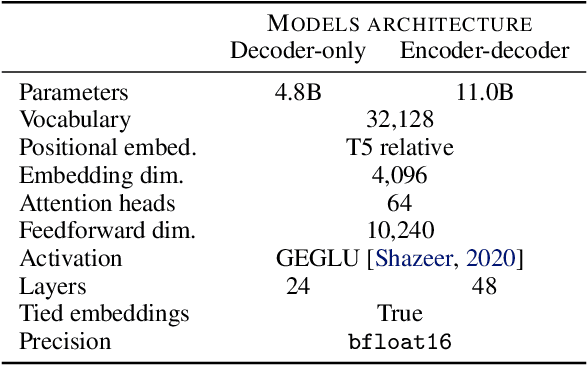
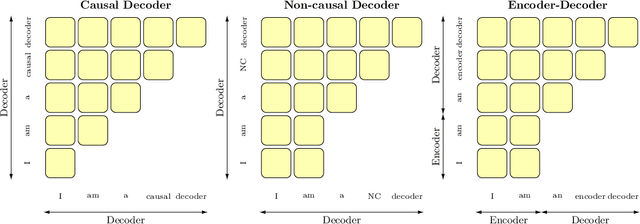
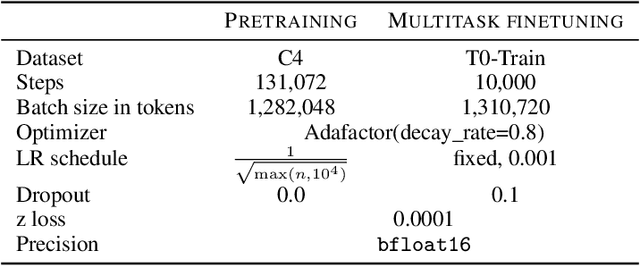
Large pretrained Transformer language models have been shown to exhibit zero-shot generalization, i.e. they can perform a wide variety of tasks that they were not explicitly trained on. However, the architectures and pretraining objectives used across state-of-the-art models differ significantly, and there has been limited systematic comparison of these factors. In this work, we present a large-scale evaluation of modeling choices and their impact on zero-shot generalization. In particular, we focus on text-to-text models and experiment with three model architectures (causal/non-causal decoder-only and encoder-decoder), trained with two different pretraining objectives (autoregressive and masked language modeling), and evaluated with and without multitask prompted finetuning. We train models with over 5 billion parameters for more than 170 billion tokens, thereby increasing the likelihood that our conclusions will transfer to even larger scales. Our experiments show that causal decoder-only models trained on an autoregressive language modeling objective exhibit the strongest zero-shot generalization after purely unsupervised pretraining. However, models with non-causal visibility on their input trained with a masked language modeling objective followed by multitask finetuning perform the best among our experiments. We therefore consider the adaptation of pretrained models across architectures and objectives. We find that pretrained non-causal decoder models can be adapted into performant generative causal decoder models, using autoregressive language modeling as a downstream task. Furthermore, we find that pretrained causal decoder models can be efficiently adapted into non-causal decoder models, ultimately achieving competitive performance after multitask finetuning. Code and checkpoints are available at https://github.com/bigscience-workshop/architecture-objective.
Multitask Prompted Training Enables Zero-Shot Task Generalization
Oct 15, 2021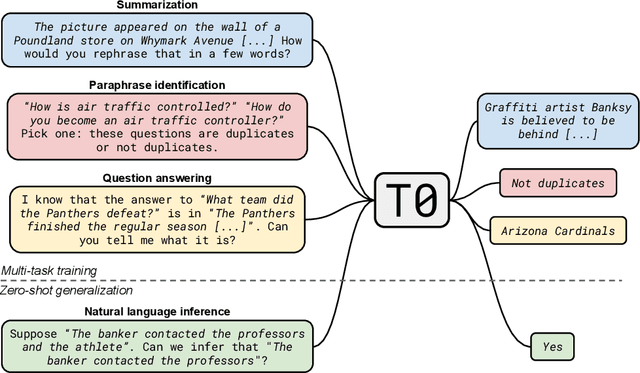

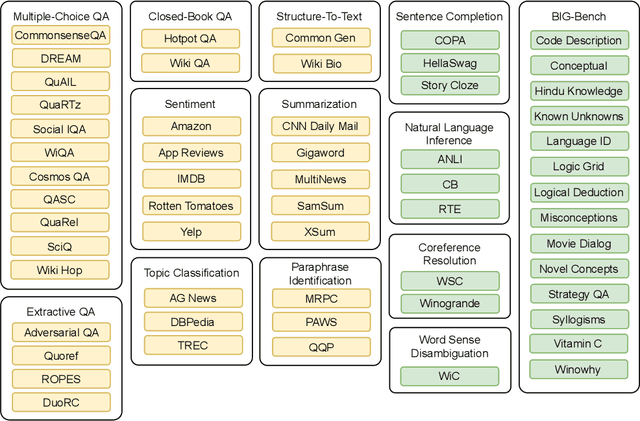
Large language models have recently been shown to attain reasonable zero-shot generalization on a diverse set of tasks. It has been hypothesized that this is a consequence of implicit multitask learning in language model training. Can zero-shot generalization instead be directly induced by explicit multitask learning? To test this question at scale, we develop a system for easily mapping general natural language tasks into a human-readable prompted form. We convert a large set of supervised datasets, each with multiple prompts using varying natural language. These prompted datasets allow for benchmarking the ability of a model to perform completely unseen tasks specified in natural language. We fine-tune a pretrained encoder-decoder model on this multitask mixture covering a wide variety of tasks. The model attains strong zero-shot performance on several standard datasets, often outperforming models 16x its size. Further, our approach attains strong performance on a subset of tasks from the BIG-Bench benchmark, outperforming models 6x its size. All prompts and trained models are available at github.com/bigscience-workshop/promptsource/.
Datasets: A Community Library for Natural Language Processing
Sep 07, 2021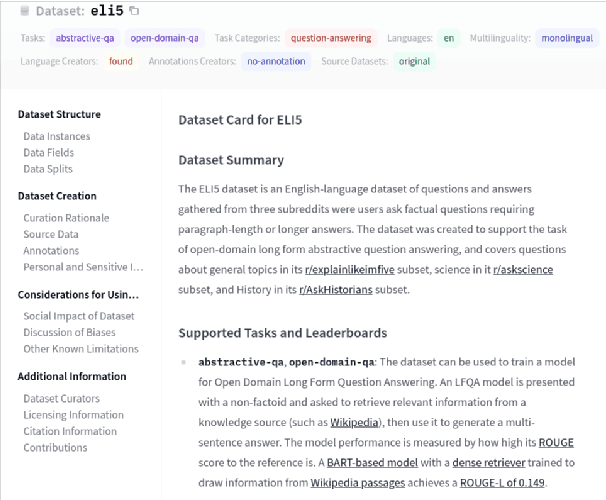
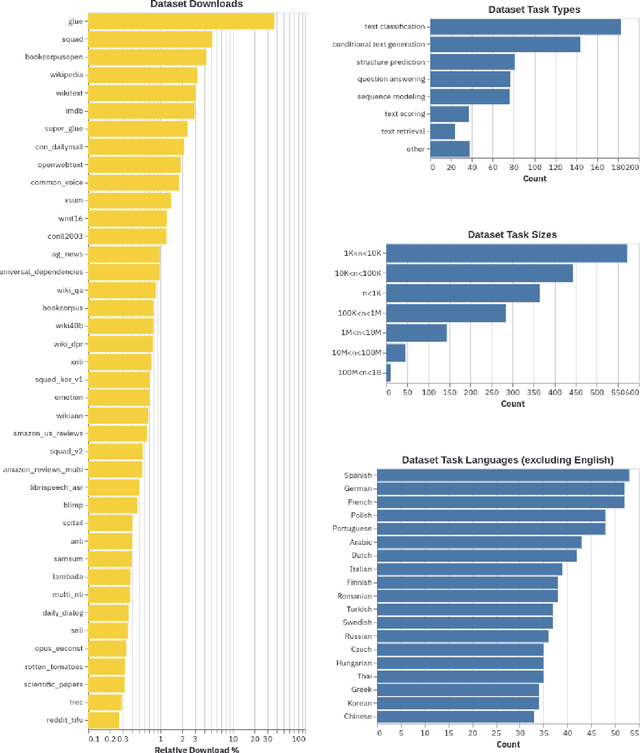
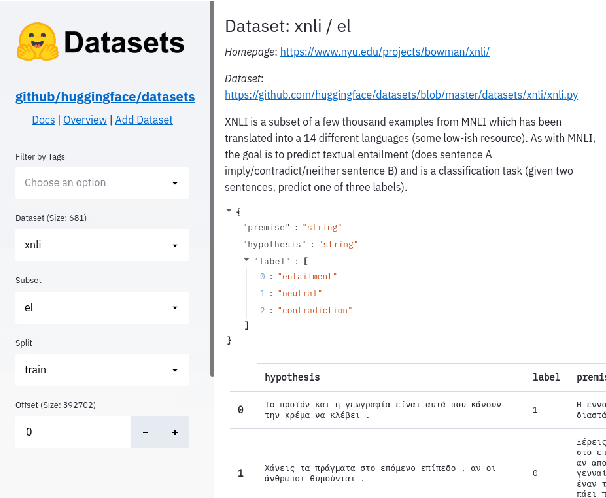
The scale, variety, and quantity of publicly-available NLP datasets has grown rapidly as researchers propose new tasks, larger models, and novel benchmarks. Datasets is a community library for contemporary NLP designed to support this ecosystem. Datasets aims to standardize end-user interfaces, versioning, and documentation, while providing a lightweight front-end that behaves similarly for small datasets as for internet-scale corpora. The design of the library incorporates a distributed, community-driven approach to adding datasets and documenting usage. After a year of development, the library now includes more than 650 unique datasets, has more than 250 contributors, and has helped support a variety of novel cross-dataset research projects and shared tasks. The library is available at https://github.com/huggingface/datasets.
How Many Data Points is a Prompt Worth?
Apr 06, 2021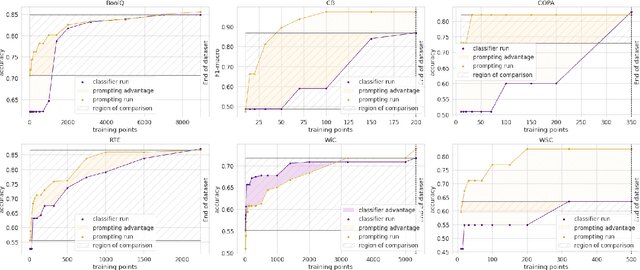

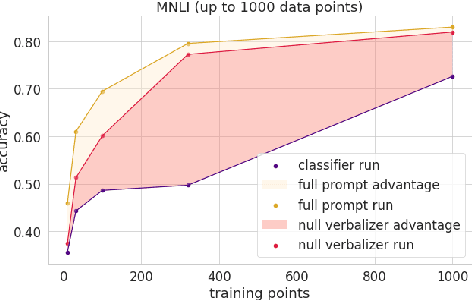

When fine-tuning pretrained models for classification, researchers either use a generic model head or a task-specific prompt for prediction. Proponents of prompting have argued that prompts provide a method for injecting task-specific guidance, which is beneficial in low-data regimes. We aim to quantify this benefit through rigorous testing of prompts in a fair setting: comparing prompted and head-based fine-tuning in equal conditions across many tasks and data sizes. By controlling for many sources of advantage, we find that prompting does indeed provide a benefit, and that this benefit can be quantified per task. Results show that prompting is often worth 100s of data points on average across classification tasks.
Neural Differential Equations for Single Image Super-resolution
May 02, 2020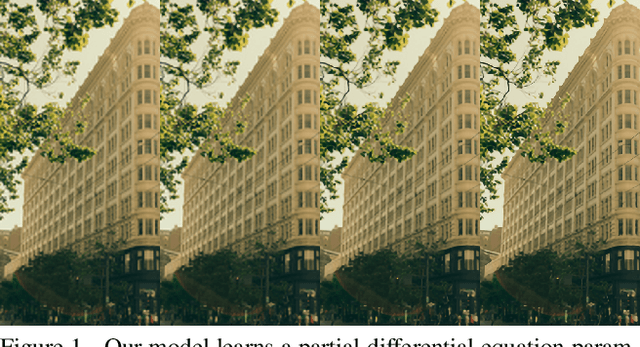
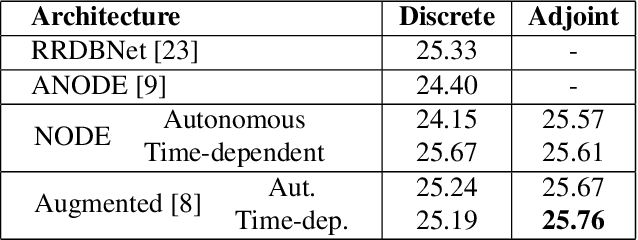
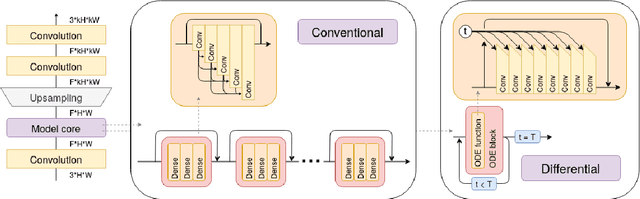

Although Neural Differential Equations have shown promise on toy problems such as MNIST, they have yet to be successfully applied to more challenging tasks. Inspired by variational methods for image restoration relying on partial differential equations, we choose to benchmark several forms of Neural DEs and backpropagation methods on single image super-resolution. The adjoint method previously proposed for gradient estimation has no theoretical stability guarantees; we find a practical case where this makes it unusable, and show that discrete sensitivity analysis has better stability. In our experiments, differential models match the performance of a state-of-the art super-resolution model.