 Add to Chrome
 Add to Firefox
 Add to Edge
FiCA: Feed-forward instant Gaussian Codec Avatars from a Single Portrait Image
Jun 23, 2026
We introduce FiCA, a Feed-forward, instant Gaussian Codec Avatar generation pipeline that creates lifelike avatars from a single portrait image. Generating a photorealistic and drivable avatar from just a single image is significantly challenging due to the limited visual information available to accurately infer the 3D appearance and geometry of human heads. To address this, we develop a novel system that combines human-centric vision foundation models with a diffusion model. This system is designed to fully exploit partial visual observations to generate lifelike human avatars. Our proposed diffusion model learns a generative mapping from these partial observations to complete and authentic 3D mesh reconstruction. Additionally, we introduce a feed-forward mesh refinement network that enhances the fidelity and identity preservation of the generated avatars, eliminating the need for person-specific test-time optimization. By leveraging a universal prior model that decodes a generated mesh into a set of 3D Gaussians, we generate a photorealistic 3D Gaussian avatar, capable of being driven with novel expressions in real-time. Our experiments demonstrate that the avatars generated by our feed-forward approach faithfully represent diverse identities and surpass the visual quality of avatars produced by recent competing methods.

Large-scale Codec Avatars: The Unreasonable Effectiveness of Large-scale Avatar Pretraining
Apr 02, 2026High-quality 3D avatar modeling faces a critical trade-off between fidelity and generalization. On the one hand, multi-view studio data enables high-fidelity modeling of humans with precise control over expressions and poses, but it struggles to generalize to real-world data due to limited scale and the domain gap between the studio environment and the real world. On the other hand, recent large-scale avatar models trained on millions of in-the-wild samples show promise for generalization across a wide range of identities, yet the resulting avatars are often of low-quality due to inherent 3D ambiguities. To address this, we present Large-Scale Codec Avatars (LCA), a high-fidelity, full-body 3D avatar model that generalizes to world-scale populations in a feedforward manner, enabling efficient inference. Inspired by the success of large language models and vision foundation models, we present, for the first time, a pre/post-training paradigm for 3D avatar modeling at scale: we pretrain on 1M in-the-wild videos to learn broad priors over appearance and geometry, then post-train on high-quality curated data to enhance expressivity and fidelity. LCA generalizes across hair styles, clothing, and demographics while providing precise, fine-grained facial expressions and finger-level articulation control, with strong identity preservation. Notably, we observe emergent generalization to relightability and loose garment support to unconstrained inputs, and zero-shot robustness to stylized imagery, despite the absence of direct supervision.
LUCAS: Layered Universal Codec Avatars
Feb 27, 2025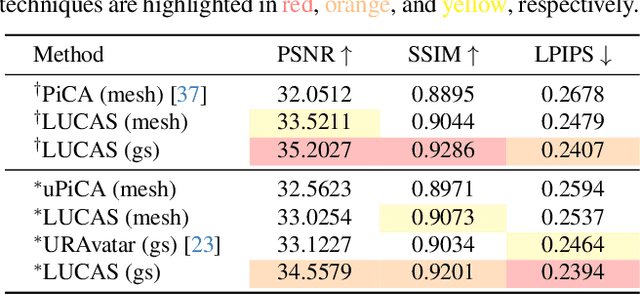
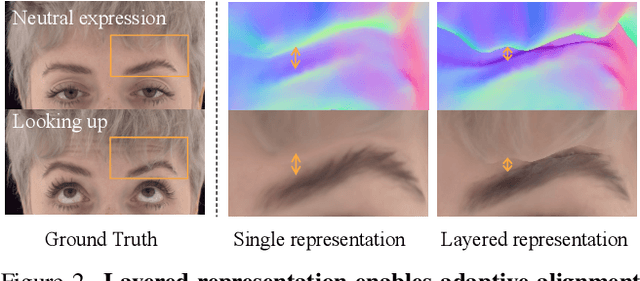
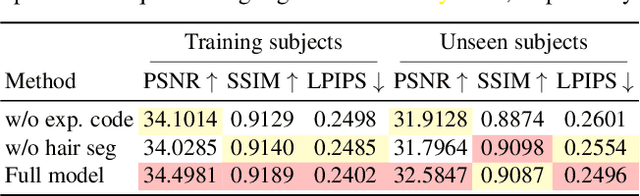
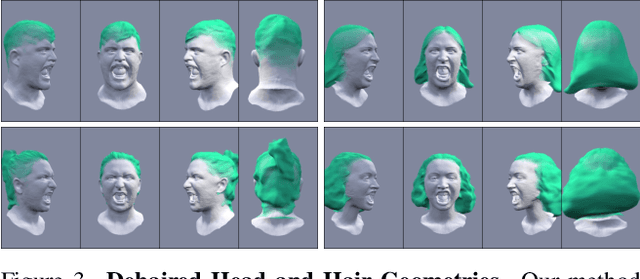
Photorealistic 3D head avatar reconstruction faces critical challenges in modeling dynamic face-hair interactions and achieving cross-identity generalization, particularly during expressions and head movements. We present LUCAS, a novel Universal Prior Model (UPM) for codec avatar modeling that disentangles face and hair through a layered representation. Unlike previous UPMs that treat hair as an integral part of the head, our approach separates the modeling of the hairless head and hair into distinct branches. LUCAS is the first to introduce a mesh-based UPM, facilitating real-time rendering on devices. Our layered representation also improves the anchor geometry for precise and visually appealing Gaussian renderings. Experimental results indicate that LUCAS outperforms existing single-mesh and Gaussian-based avatar models in both quantitative and qualitative assessments, including evaluations on held-out subjects in zero-shot driving scenarios. LUCAS demonstrates superior dynamic performance in managing head pose changes, expression transfer, and hairstyle variations, thereby advancing the state-of-the-art in 3D head avatar reconstruction.