 Add to Chrome
 Add to Firefox
 Add to Edge
Where Does Social Reasoning Come From? Capability Provenance in Language Models
Jun 17, 2026
We use training-data attribution as an interpretable tool for capability discovery, mapping which regions of the pretraining corpus support social-reasoning versus STEM-reasoning in OLMo3-7B. Training-data attribution measures how strongly each training document influences a model's predictions on a benchmark, but document-level scores are too noisy to identify which corpus regions support which capabilities, and prior work has emphasized factual knowledge rather than reasoning. We compute gradient-based attribution (TrackStar via Bergson) over a working set drawn from the de-duplicated Dolma3 mix, aggregate influence across WebOrganizer's 24-format x 24-topic taxonomy (576 bins), and contrast benchmark pairs in a 2x2 design that varies domain (social vs. STEM) and capability type (reasoning vs. knowledge): SocialIQA and MMLU Social Sciences against ARC-Challenge and MMLU STEM. Social and STEM reasoning draw on qualitatively distinct corpus regions, and the contrast is sharper at the reasoning level than at the knowledge level. Targeted machine unlearning provides partial causal validation: forgetting high-attribution topic bins (e.g., Literature for SocialIQA) degrades the aligned benchmark more than within-bin random baselines, and we open-source all code, sampling manifests, the bin-level influence matrix, and unlearning checkpoints.

Building Comparative Motivation Profiles with Instrumental Interventions
Jun 06, 2026Safety evaluations often infer latent motivations from behavioral patterns, but the construct validity of these inferences is unclear. We study this problem in alignment faking, where models comply with training objectives more often when they infer training pressure. This behavior is commonly interpreted as strategic self-preservation, but it may also reflect sensitivity to the model's inference about the expectation of researchers conducting the evaluation. We introduce a symmetric intervention framework for distinguishing these competing hypotheses. Instead of directly intervening on "scheming" or "sycophancy", we target instrumental processes entailed by each hypothesis: consequence-tracking and researcher-expectation tracking. We then compare how interventions on these processes affect the alignment faking. We study four openweight model organisms using synthetic document fine-tuning, activation steering, and prompting. Under synthetic document fine-tuning, Llama-3.1-70B, Llama3.1-405B, and Qwen-2.5-72B are more sensitive to expectation-tracking than consequence-tracking interventions. Activation steering on Llama-3.1- 70B supports the same broad picture, and prompt interventions broadly align with SDF profiles. Overall, alignment-faking behavior can be causally sensitive to evaluation-context expectations despite scheming-consistent scratchpads. Scheming and strategic-deception evaluations therefore need construct-validity checks, and symmetric instrumental interventions provide one such test.
Quality over Quantity: Demonstration Curation via Influence Functions for Data-Centric Robot Learning
Mar 10, 2026Learning from demonstrations has emerged as a promising paradigm for end-to-end robot control, particularly when scaled to diverse and large datasets. However, the quality of demonstration data, often collected through human teleoperation, remains a critical bottleneck for effective data-driven robot learning. Human errors, operational constraints, and teleoperator variability introduce noise and suboptimal behaviors, making data curation essential yet largely manual and heuristic-driven. In this work, we propose Quality over Quantity (QoQ), a grounded and systematic approach to identifying high-quality data by defining data quality as the contribution of each training sample to reducing loss on validation demonstrations. To efficiently estimate this contribution, we leverage influence functions, which quantify the impact of individual training samples on model performance. We further introduce two key techniques to adapt influence functions for robot demonstrations: (i) using maximum influence across validation samples to capture the most relevant state-action pairs, and (ii) aggregating influence scores of state-action pairs within the same trajectory to reduce noise and improve data coverage. Experiments in both simulated and real-world settings show that QoQ consistently improves policy performances over prior data selection methods.
Understanding Impact of Human Feedback via Influence Functions
Jan 10, 2025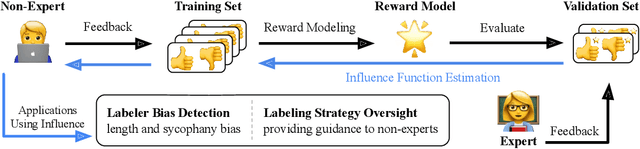
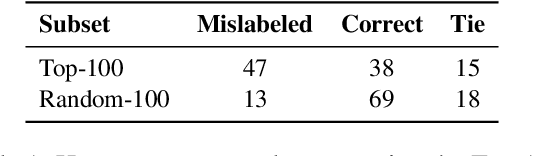
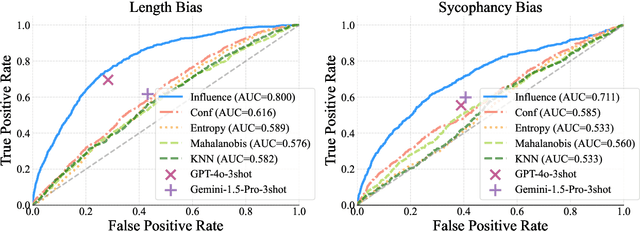
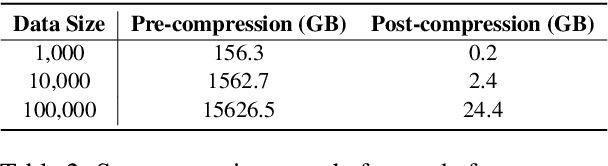
In Reinforcement Learning from Human Feedback (RLHF), it is crucial to learn suitable reward models from human feedback to align large language models (LLMs) with human intentions. However, human feedback can often be noisy, inconsistent, or biased, especially when evaluating complex responses. Such feedback can lead to misaligned reward signals, potentially causing unintended side effects during the RLHF process. To address these challenges, we explore the use of influence functions to measure the impact of human feedback on the performance of reward models. We propose a compute-efficient approximation method that enables the application of influence functions to LLM-based reward models and large-scale preference datasets. In our experiments, we demonstrate two key applications of influence functions: (1) detecting common forms of labeler bias in human feedback datasets and (2) guiding labelers to refine their strategies to align more closely with expert feedback. By quantifying the impact of human feedback on reward models, we believe that influence functions can enhance feedback interpretability and contribute to scalable oversight in RLHF, helping labelers provide more accurate and consistent feedback. Source code is available at https://github.com/mintaywon/IF_RLHF
Benchmarking Mobile Device Control Agents across Diverse Configurations
Apr 25, 2024Developing autonomous agents for mobile devices can significantly enhance user interactions by offering increased efficiency and accessibility. However, despite the growing interest in mobile device control agents, the absence of a commonly adopted benchmark makes it challenging to quantify scientific progress in this area. In this work, we introduce B-MoCA: a novel benchmark designed specifically for evaluating mobile device control agents. To create a realistic benchmark, we develop B-MoCA based on the Android operating system and define 60 common daily tasks. Importantly, we incorporate a randomization feature that changes various aspects of mobile devices, including user interface layouts and language settings, to assess generalization performance. We benchmark diverse agents, including agents employing large language models (LLMs) or multi-modal LLMs as well as agents trained from scratch using human expert demonstrations. While these agents demonstrate proficiency in executing straightforward tasks, their poor performance on complex tasks highlights significant opportunities for future research to enhance their effectiveness. Our source code is publicly available at https://b-moca.github.io.