 Add to Chrome
 Add to Firefox
 Add to Edge
RA-ClipScore: Making Generative Model Evaluation More Interpretable
Aug 12, 2026
Generative models can produce images nearly indistinguishable from real data, yet rigorous and interpretable evaluation remains challenging. Conventional metrics such as FID provide only scalar scores with limited diagnostic insight. Widely adopted CLIP-based metrics enable semantic evaluation beyond simple training class labels, but inherit limitations from CLIP's training paradigm that restrict attribute-wise analysis. We propose RA-CLIPScore, a novel metric that mitigates these issues and extends CLIP-based evaluation to spatial distribution alignment, measuring whether generated objects adhere to the positional priors found in the training data. RA-CLIPScore introduces dual prompts to decouple competing attributes and leverages local patch tokens to capture fine-grained regional semantics. We evaluate image generative models on their ability to match both attribute and spatial distributions of the training data. Extensive experiments show that RA-CLIPScore provides more robust and interpretable evaluations than prior methods, particularly under distribution misalignment or partially irrelevant textual attributes. We further demonstrate how it reveals spatial biases in generative models. User evaluations confirm that Regional Single Attribute Divergence based on our RA-CLIPScore aligns more closely with human perception of visual diversity than existing semantic metrics.

The GENEA Challenge 2026: A Large-Scale Disentangled Evaluation of Speech-Driven Gesture Generation on the Seamless Interaction Dataset
Aug 11, 2026This preprint presents the results of the fourth GENEA Challenge, a large-scale human evaluation of five speech-driven gesture-generation systems trained by participating teams on the Seamless Interaction dataset of dyadic conversations. As in the 2023 GENEA Challenge, we used a disentangled evaluation methodology to assess motion quality and speech alignment without confounding between the two, and performed a dyadic mismatching study to isolate the effect of listening and reacting to the interlocutor. We additionally introduce a new semantic gesture-generation task and a text-mismatching evaluation methodology using the Grounded Gestures subset of the data. In total, we ran four large-scale user studies, collecting over 23,000 votes from 869 test-takers. In the motion-realism study, the dataset's filtered segments had substantially higher motion quality than all challenge submissions (68-95% pairwise winrate). In the speech-alignment study, the motion-capture segments provided a conceptual ceiling at 62% alignment score, with the top submission significantly behind at 32% and the rest only slightly above the 0% expected of an input-independent system. In the dyadic study, motion capture again set the ceiling at 65% appropriateness score, but no submission scored substantially above chance, indicating that the systems could not yet respond to the interlocutor. Finally, the semantic mismatching evaluation found highly expressive gestures in the dataset (test-takers identified the matching transcript 79% of the time), yet almost all submissions failed to generate semantically expressive motion, with the best achieving only an 8% appropriateness score. The collected votes and outputs will be made publicly available at https://genea-workshop.github.io/2026/challenge/ to facilitate reproducibility and further research.
Evaluating the evaluators: Towards human-aligned metrics for missing markers reconstruction
Oct 18, 2024Animation data is often obtained through optical motion capture systems, which utilize a multitude of cameras to establish the position of optical markers. However, system errors or occlusions can result in missing markers, the manual cleaning of which can be time-consuming. This has sparked interest in machine learning-based solutions for missing marker reconstruction in the academic community. Most academic papers utilize a simplistic mean square error as the main metric. In this paper, we show that this metric does not correlate with subjective perception of the fill quality. We introduce and evaluate a set of better-correlated metrics that can drive progress in the field.
Towards a GENEA Leaderboard -- an Extended, Living Benchmark for Evaluating and Advancing Conversational Motion Synthesis
Oct 08, 2024


Current evaluation practices in speech-driven gesture generation lack standardisation and focus on aspects that are easy to measure over aspects that actually matter. This leads to a situation where it is impossible to know what is the state of the art, or to know which method works better for which purpose when comparing two publications. In this position paper, we review and give details on issues with existing gesture-generation evaluation, and present a novel proposal for remedying them. Specifically, we announce an upcoming living leaderboard to benchmark progress in conversational motion synthesis. Unlike earlier gesture-generation challenges, the leaderboard will be updated with large-scale user studies of new gesture-generation systems multiple times per year, and systems on the leaderboard can be submitted to any publication venue that their authors prefer. By evolving the leaderboard evaluation data and tasks over time, the effort can keep driving progress towards the most important end goals identified by the community. We actively seek community involvement across the entire evaluation pipeline: from data and tasks for the evaluation, via tooling, to the systems evaluated. In other words, our proposal will not only make it easier for researchers to perform good evaluations, but their collective input and contributions will also help drive the future of gesture-generation research.
The GENEA Challenge 2023: A large scale evaluation of gesture generation models in monadic and dyadic settings
Aug 24, 2023This paper reports on the GENEA Challenge 2023, in which participating teams built speech-driven gesture-generation systems using the same speech and motion dataset, followed by a joint evaluation. This year's challenge provided data on both sides of a dyadic interaction, allowing teams to generate full-body motion for an agent given its speech (text and audio) and the speech and motion of the interlocutor. We evaluated 12 submissions and 2 baselines together with held-out motion-capture data in several large-scale user studies. The studies focused on three aspects: 1) the human-likeness of the motion, 2) the appropriateness of the motion for the agent's own speech whilst controlling for the human-likeness of the motion, and 3) the appropriateness of the motion for the behaviour of the interlocutor in the interaction, using a setup that controls for both the human-likeness of the motion and the agent's own speech. We found a large span in human-likeness between challenge submissions, with a few systems rated close to human mocap. Appropriateness seems far from being solved, with most submissions performing in a narrow range slightly above chance, far behind natural motion. The effect of the interlocutor is even more subtle, with submitted systems at best performing barely above chance. Interestingly, a dyadic system being highly appropriate for agent speech does not necessarily imply high appropriateness for the interlocutor. Additional material is available via the project website at https://svito-zar.github.io/GENEAchallenge2023/ .
Evaluating gesture-generation in a large-scale open challenge: The GENEA Challenge 2022
Mar 15, 2023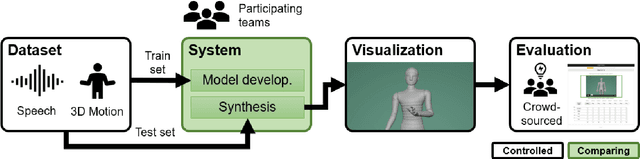
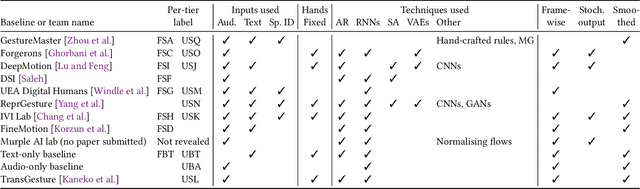
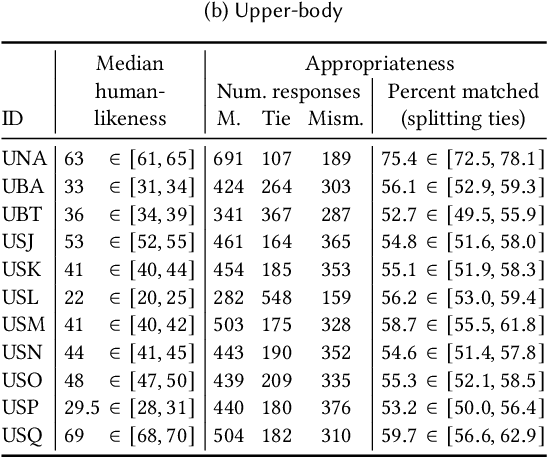
This paper reports on the second GENEA Challenge to benchmark data-driven automatic co-speech gesture generation. Participating teams used the same speech and motion dataset to build gesture-generation systems. Motion generated by all these systems was rendered to video using a standardised visualisation pipeline and evaluated in several large, crowdsourced user studies. Unlike when comparing different research papers, differences in results are here only due to differences between methods, enabling direct comparison between systems. The dataset was based on 18 hours of full-body motion capture, including fingers, of different persons engaging in a dyadic conversation. Ten teams participated in the challenge across two tiers: full-body and upper-body gesticulation. For each tier, we evaluated both the human-likeness of the gesture motion and its appropriateness for the specific speech signal. Our evaluations decouple human-likeness from gesture appropriateness, which has been a difficult problem in the field. The evaluation results are a revolution, and a revelation. Some synthetic conditions are rated as significantly more human-like than human motion capture. To the best of our knowledge, this has never been shown before on a high-fidelity avatar. On the other hand, all synthetic motion is found to be vastly less appropriate for the speech than the original motion-capture recordings. We also find that conventional objective metrics do not correlate well with subjective human-likeness ratings in this large evaluation. The one exception is the Fr\'echet gesture distance (FGD), which achieves a Kendall's tau rank correlation of around -0.5. Based on the challenge results we formulate numerous recommendations for system building and evaluation.
A Comprehensive Review of Data-Driven Co-Speech Gesture Generation
Jan 13, 2023Gestures that accompany speech are an essential part of natural and efficient embodied human communication. The automatic generation of such co-speech gestures is a long-standing problem in computer animation and is considered an enabling technology in film, games, virtual social spaces, and for interaction with social robots. The problem is made challenging by the idiosyncratic and non-periodic nature of human co-speech gesture motion, and by the great diversity of communicative functions that gestures encompass. Gesture generation has seen surging interest recently, owing to the emergence of more and larger datasets of human gesture motion, combined with strides in deep-learning-based generative models, that benefit from the growing availability of data. This review article summarizes co-speech gesture generation research, with a particular focus on deep generative models. First, we articulate the theory describing human gesticulation and how it complements speech. Next, we briefly discuss rule-based and classical statistical gesture synthesis, before delving into deep learning approaches. We employ the choice of input modalities as an organizing principle, examining systems that generate gestures from audio, text, and non-linguistic input. We also chronicle the evolution of the related training data sets in terms of size, diversity, motion quality, and collection method. Finally, we identify key research challenges in gesture generation, including data availability and quality; producing human-like motion; grounding the gesture in the co-occurring speech in interaction with other speakers, and in the environment; performing gesture evaluation; and integration of gesture synthesis into applications. We highlight recent approaches to tackling the various key challenges, as well as the limitations of these approaches, and point toward areas of future development.
The GENEA Challenge 2022: A large evaluation of data-driven co-speech gesture generation
Aug 22, 2022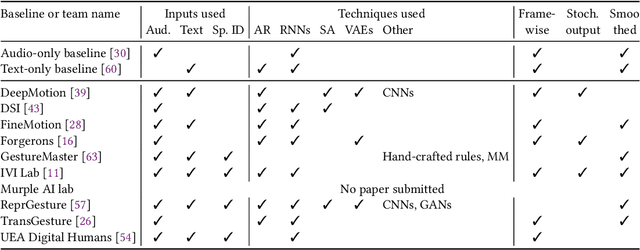
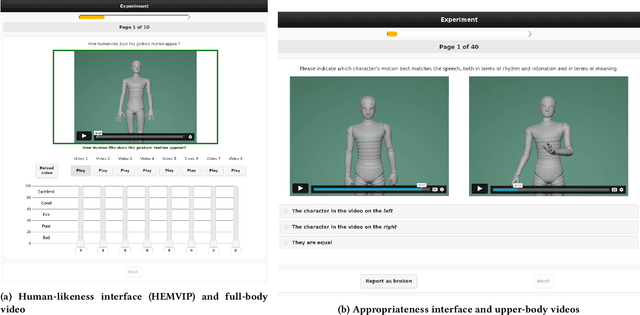
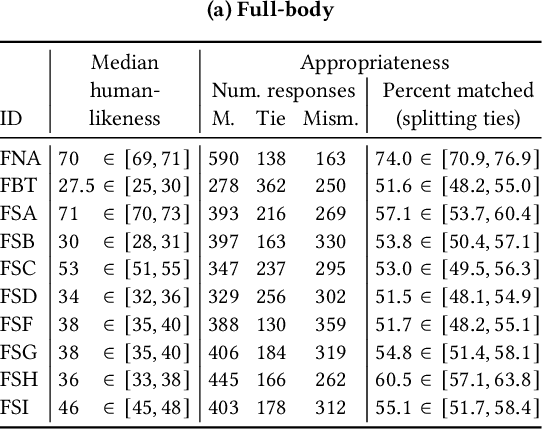
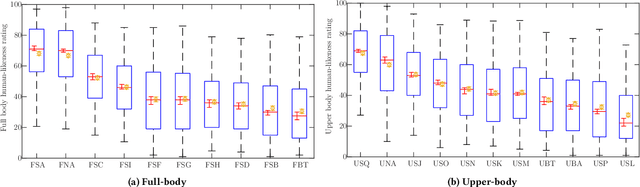
This paper reports on the second GENEA Challenge to benchmark data-driven automatic co-speech gesture generation. Participating teams used the same speech and motion dataset to build gesture-generation systems. Motion generated by all these systems was rendered to video using a standardised visualisation pipeline and evaluated in several large, crowdsourced user studies. Unlike when comparing different research papers, differences in results are here only due to differences between methods, enabling direct comparison between systems. This year's dataset was based on 18 hours of full-body motion capture, including fingers, of different persons engaging in dyadic conversation. Ten teams participated in the challenge across two tiers: full-body and upper-body gesticulation. For each tier we evaluated both the human-likeness of the gesture motion and its appropriateness for the specific speech signal. Our evaluations decouple human-likeness from gesture appropriateness, which previously was a major challenge in the field. The evaluation results are a revolution, and a revelation. Some synthetic conditions are rated as significantly more human-like than human motion capture. To the best of our knowledge, this has never been shown before on a high-fidelity avatar. On the other hand, all synthetic motion is found to be vastly less appropriate for the speech than the original motion-capture recordings. Additional material is available via the project website at https://youngwoo-yoon.github.io/GENEAchallenge2022/
Multimodal analysis of the predictability of hand-gesture properties
Aug 12, 2021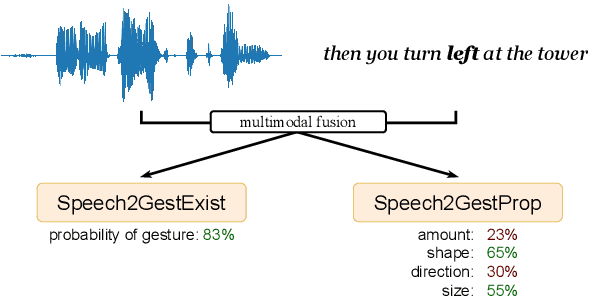
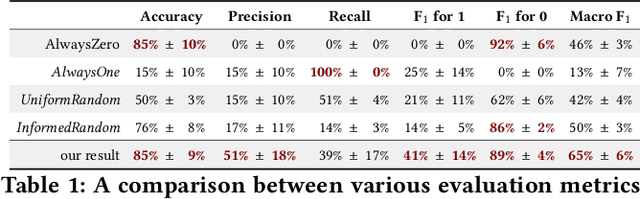
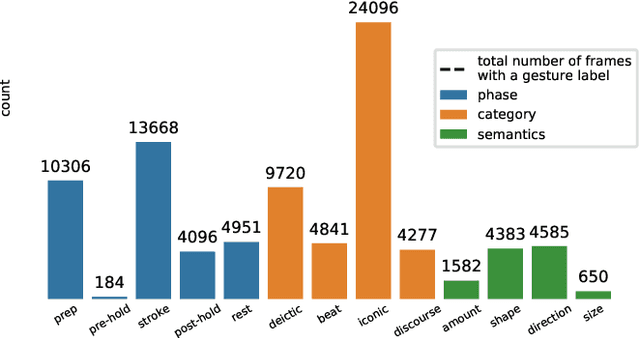
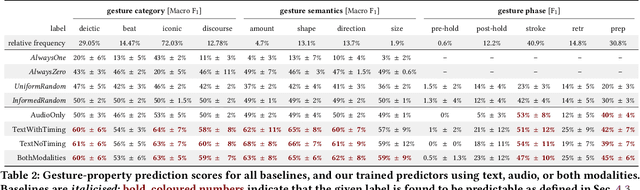
Embodied conversational agents benefit from being able to accompany their speech with gestures. Although many data-driven approaches to gesture generation have been proposed in recent years, it is still unclear whether such systems can consistently generate gestures that convey meaning. We investigate which gesture properties (phase, category, and semantics) can be predicted from speech text and/or audio using contemporary deep learning. In extensive experiments, we show that gesture properties related to gesture meaning (semantics and category) are predictable from text features (time-aligned BERT embeddings) alone, but not from prosodic audio features, while rhythm-related gesture properties (phase) on the other hand can be predicted from either audio, text (with word-level timing information), or both. These results are encouraging as they indicate that it is possible to equip an embodied agent with content-wise meaningful co-speech gestures using a machine-learning model.
Speech2Properties2Gestures: Gesture-Property Prediction as a Tool for Generating Representational Gestures from Speech
Jun 28, 2021
We propose a new framework for gesture generation, aiming to allow data-driven approaches to produce more semantically rich gestures. Our approach first predicts whether to gesture, followed by a prediction of the gesture properties. Those properties are then used as conditioning for a modern probabilistic gesture-generation model capable of high-quality output. This empowers the approach to generate gestures that are both diverse and representational.