 Add to Chrome
 Add to Firefox
 Add to Edge
The GENEA Challenge 2026: A Large-Scale Disentangled Evaluation of Speech-Driven Gesture Generation on the Seamless Interaction Dataset
Aug 11, 2026
This preprint presents the results of the fourth GENEA Challenge, a large-scale human evaluation of five speech-driven gesture-generation systems trained by participating teams on the Seamless Interaction dataset of dyadic conversations. As in the 2023 GENEA Challenge, we used a disentangled evaluation methodology to assess motion quality and speech alignment without confounding between the two, and performed a dyadic mismatching study to isolate the effect of listening and reacting to the interlocutor. We additionally introduce a new semantic gesture-generation task and a text-mismatching evaluation methodology using the Grounded Gestures subset of the data. In total, we ran four large-scale user studies, collecting over 23,000 votes from 869 test-takers. In the motion-realism study, the dataset's filtered segments had substantially higher motion quality than all challenge submissions (68-95% pairwise winrate). In the speech-alignment study, the motion-capture segments provided a conceptual ceiling at 62% alignment score, with the top submission significantly behind at 32% and the rest only slightly above the 0% expected of an input-independent system. In the dyadic study, motion capture again set the ceiling at 65% appropriateness score, but no submission scored substantially above chance, indicating that the systems could not yet respond to the interlocutor. Finally, the semantic mismatching evaluation found highly expressive gestures in the dataset (test-takers identified the matching transcript 79% of the time), yet almost all submissions failed to generate semantically expressive motion, with the best achieving only an 8% appropriateness score. The collected votes and outputs will be made publicly available at https://genea-workshop.github.io/2026/challenge/ to facilitate reproducibility and further research.

The GENEA Challenge 2023: A large scale evaluation of gesture generation models in monadic and dyadic settings
Aug 24, 2023This paper reports on the GENEA Challenge 2023, in which participating teams built speech-driven gesture-generation systems using the same speech and motion dataset, followed by a joint evaluation. This year's challenge provided data on both sides of a dyadic interaction, allowing teams to generate full-body motion for an agent given its speech (text and audio) and the speech and motion of the interlocutor. We evaluated 12 submissions and 2 baselines together with held-out motion-capture data in several large-scale user studies. The studies focused on three aspects: 1) the human-likeness of the motion, 2) the appropriateness of the motion for the agent's own speech whilst controlling for the human-likeness of the motion, and 3) the appropriateness of the motion for the behaviour of the interlocutor in the interaction, using a setup that controls for both the human-likeness of the motion and the agent's own speech. We found a large span in human-likeness between challenge submissions, with a few systems rated close to human mocap. Appropriateness seems far from being solved, with most submissions performing in a narrow range slightly above chance, far behind natural motion. The effect of the interlocutor is even more subtle, with submitted systems at best performing barely above chance. Interestingly, a dyadic system being highly appropriate for agent speech does not necessarily imply high appropriateness for the interlocutor. Additional material is available via the project website at https://svito-zar.github.io/GENEAchallenge2023/ .
Evaluating gesture-generation in a large-scale open challenge: The GENEA Challenge 2022
Mar 15, 2023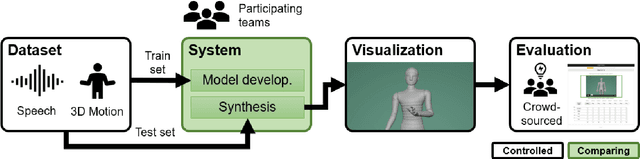
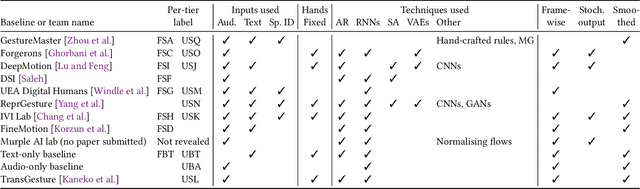
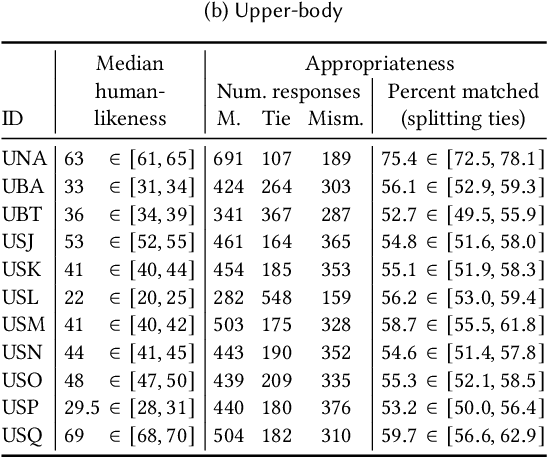
This paper reports on the second GENEA Challenge to benchmark data-driven automatic co-speech gesture generation. Participating teams used the same speech and motion dataset to build gesture-generation systems. Motion generated by all these systems was rendered to video using a standardised visualisation pipeline and evaluated in several large, crowdsourced user studies. Unlike when comparing different research papers, differences in results are here only due to differences between methods, enabling direct comparison between systems. The dataset was based on 18 hours of full-body motion capture, including fingers, of different persons engaging in a dyadic conversation. Ten teams participated in the challenge across two tiers: full-body and upper-body gesticulation. For each tier, we evaluated both the human-likeness of the gesture motion and its appropriateness for the specific speech signal. Our evaluations decouple human-likeness from gesture appropriateness, which has been a difficult problem in the field. The evaluation results are a revolution, and a revelation. Some synthetic conditions are rated as significantly more human-like than human motion capture. To the best of our knowledge, this has never been shown before on a high-fidelity avatar. On the other hand, all synthetic motion is found to be vastly less appropriate for the speech than the original motion-capture recordings. We also find that conventional objective metrics do not correlate well with subjective human-likeness ratings in this large evaluation. The one exception is the Fr\'echet gesture distance (FGD), which achieves a Kendall's tau rank correlation of around -0.5. Based on the challenge results we formulate numerous recommendations for system building and evaluation.
The GENEA Challenge 2022: A large evaluation of data-driven co-speech gesture generation
Aug 22, 2022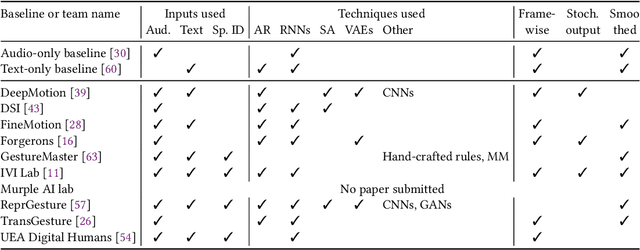
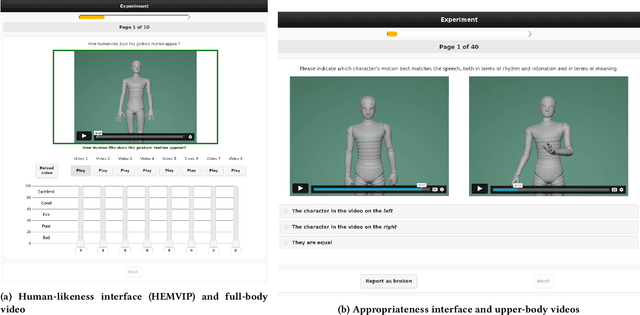
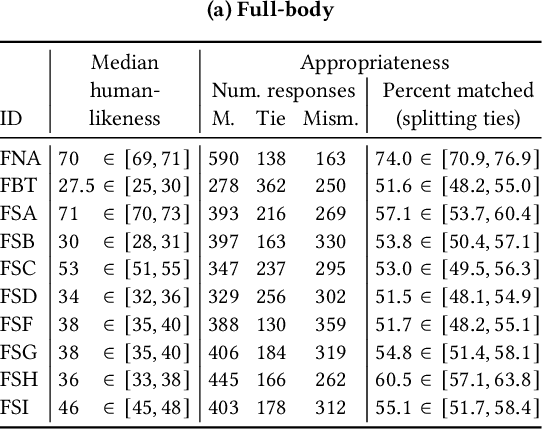
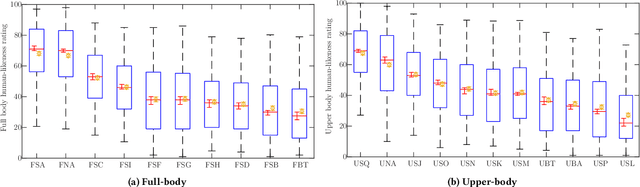
This paper reports on the second GENEA Challenge to benchmark data-driven automatic co-speech gesture generation. Participating teams used the same speech and motion dataset to build gesture-generation systems. Motion generated by all these systems was rendered to video using a standardised visualisation pipeline and evaluated in several large, crowdsourced user studies. Unlike when comparing different research papers, differences in results are here only due to differences between methods, enabling direct comparison between systems. This year's dataset was based on 18 hours of full-body motion capture, including fingers, of different persons engaging in dyadic conversation. Ten teams participated in the challenge across two tiers: full-body and upper-body gesticulation. For each tier we evaluated both the human-likeness of the gesture motion and its appropriateness for the specific speech signal. Our evaluations decouple human-likeness from gesture appropriateness, which previously was a major challenge in the field. The evaluation results are a revolution, and a revelation. Some synthetic conditions are rated as significantly more human-like than human motion capture. To the best of our knowledge, this has never been shown before on a high-fidelity avatar. On the other hand, all synthetic motion is found to be vastly less appropriate for the speech than the original motion-capture recordings. Additional material is available via the project website at https://youngwoo-yoon.github.io/GENEAchallenge2022/