 Add to Chrome
 Add to Firefox
 Add to Edge
Estimating Mixture Distributions via Stochastic Mirror Descent
May 24, 2026
We revisit the classical problem of estimating an unknown distribution from its samples by fitting a mixture model that minimizes cross-entropy loss. Framing the task as a stochastic convex optimization problem over the space of $ M $-component mixture distributions, we propose a family of estimators derived from the stochastic mirror descent (SMD) algorithm. This optimization-based approach provides a principled and flexible framework that generalizes traditional estimators and proposes a variety of novel estimators through the choice of Bregman divergences. A key advantage of our method is that it scales efficiently with the number of candidate components $ f_i $; that is, one can employ a large set of basis distributions in the mixture model without incurring significant computational overhead. This enables richer approximations and improved estimation accuracy. Moreover, in the case of categorical distribution (discrete outcomes) our estimators do not require a strict lower bound, in other words our framework does not require the precise knowledge of the support of the distribution. We demonstrate that, under mild conditions, the proposed $ \varphi $-SMD estimators achieve near-optimal convergence rates in both Kullback-Leibler (KL) divergence and $ \ell_2 $-norm and offer practical benefits when computation is expensive. Our numerical analysis highlights improved performance guaranties over classical estimators, particularly in terms of sample efficiency and scalability.

Evolutionary Multi-Task Optimization for LLM-Guided Program Discovery
May 21, 2026Recent LLM-guided evolutionary search methods have shown that iterative program mutation can discover strong algorithms, but they typically optimize each task independently, even when related tasks share reusable structure. We introduce Evolutionary Multi-Task Optimization (EMO) for LLM-guided program discovery, and propose EMO-STA (Shared-Then-Adapt), a two-stage framework that first evolves a shared archive of executable programs across a task family and then adapts selected shared candidates to each target task. Within EMO-STA, we explore multiple adaptation strategies, including warm-starting from the shared archive, adapting the best average shared program, and adapting the shared program that performs best on each target task. Across eight task families spanning continuous optimization, geometric construction, modeling, and algorithmic optimization, EMO-STA improves over matched-compute single-task evolution in most settings, with STA Best-Local providing the strongest in-distribution adaptation and STA Best-Shared yielding robust transfer to unseen tasks. Compute-allocation experiments show that allocating a substantial fraction of the family-level budget to shared evolution is consistently beneficial, with roughly balanced shared and adaptation budgets often being optimal. Beyond compute efficiency, we show that shared evolution can mitigate overfitting in low-evidence settings (e.g. few training data), including ARC tasks and time-series feature engineering, by favoring programs that generalize across all tasks rather than exploiting task-specific brittle artifacts.
Active Sampling for Ultra-Low-Bit-Rate Video Compression via Conditional Controlled Diffusion
May 04, 2026Diffusion models provide a powerful generative prior for perceptual reconstruction at ultra-low bitrates, but effective video compression requires controlling the generative process using highly compact conditioning signals. In this work, we present ActDiff-VC, a diffusion-based video compression framework for the ultra-low-bitrate regime. Our method partitions videos into variable-length segments, transmits keyframes only when needed, and summarizes temporal dynamics using a compact set of tracked point trajectories. Conditioned on these sparse signals, a conditional diffusion decoder synthesizes the remaining frames, enabling perceptually realistic reconstruction under severe rate constraints. To support this design, we introduce two mechanisms: content-adaptive keyframe selection and budget-aware sparse trajectory selection, which together enable compact yet effective conditioning for generative reconstruction. Experiments on the UVG and MCL-JCV benchmarks show that ActDiff-VC achieves up to 64.6\% bitrate reduction at matched NIQE, improves KID by up to 64.6\% and FID by up to 37.7\% at comparable bitrates against strong learned codecs, and delivers favorable perceptual rate--distortion trade-offs relative to learned and diffusion-based baselines in the ultra-low-bitrate regime.
CI-CBM: Class-Incremental Concept Bottleneck Model for Interpretable Continual Learning
Apr 16, 2026Catastrophic forgetting remains a fundamental challenge in continual learning, in which models often forget previous knowledge when fine-tuned on a new task. This issue is especially pronounced in class incremental learning (CIL), which is the most challenging setting in continual learning. Existing methods to address catastrophic forgetting often sacrifice either model interpretability or accuracy. To address this challenge, we introduce ClassIncremental Concept Bottleneck Model (CI-CBM), which leverage effective techniques, including concept regularization and pseudo-concept generation to maintain interpretable decision processes throughout incremental learning phases. Through extensive evaluation on seven datasets, CI-CBM achieves comparable performance to black-box models and outperforms previous interpretable approaches in CIL, with an average 36% accuracy gain. CICBM provides interpretable decisions on individual inputs and understandable global decision rules, as shown in our experiments, thereby demonstrating that human understandable concepts can be maintained during incremental learning without compromising model performance. Our approach is effective in both pretrained and non-pretrained scenarios; in the latter, the backbone is trained from scratch during the first learning phase. Code is publicly available at github.com/importAmir/CI-CBM.
* 31 pages, 6 figures. Published in Transactions on Machine Learning Research (TMLR), 04/2026
Convex and Non-convex Federated Learning with Stale Stochastic Gradients: Diminishing Step Size is All You Need
Mar 03, 2026We propose a general framework for distributed stochastic optimization under delayed gradient models. In this setting, $n$ local agents leverage their own data and computation to assist a central server in minimizing a global objective composed of agents' local cost functions. Each agent is allowed to transmit stochastic-potentially biased and delayed-estimates of its local gradient. While a prior work has advocated delay-adaptive step sizes for stochastic gradient descent (SGD) in the presence of delays, we demonstrate that a pre-chosen diminishing step size is sufficient and matches the performance of the adaptive scheme. Moreover, our analysis establishes that diminishing step sizes recover the optimal SGD rates for nonconvex and strongly convex objectives.
$κ$-Explorer: A Unified Framework for Active Model Estimation in MDPs
Feb 23, 2026In tabular Markov decision processes (MDPs) with perfect state observability, each trajectory provides active samples from the transition distributions conditioned on state-action pairs. Consequently, accurate model estimation depends on how the exploration policy allocates visitation frequencies in accordance with the intrinsic complexity of each transition distribution. Building on recent work on coverage-based exploration, we introduce a parameterized family of decomposable and concave objective functions $U_κ$ that explicitly incorporate both intrinsic estimation complexity and extrinsic visitation frequency. Moreover, the curvature $κ$ provides a unified treatment of various global objectives, such as the average-case and worst-case estimation error objectives. Using the closed-form characterization of the gradient of $U_κ$, we propose $κ$-Explorer, an active exploration algorithm that performs Frank-Wolfe-style optimization over state-action occupancy measures. The diminishing-returns structure of $U_κ$ naturally prioritizes underexplored and high-variance transitions, while preserving smoothness properties that enable efficient optimization. We establish tight regret guarantees for $κ$-Explorer and further introduce a fully online and computationally efficient surrogate algorithm for practical use. Experiments on benchmark MDPs demonstrate that $κ$-Explorer provides superior performance compared to existing exploration strategies.
3D Scene Rendering with Multimodal Gaussian Splatting
Feb 19, 20263D scene reconstruction and rendering are core tasks in computer vision, with applications spanning industrial monitoring, robotics, and autonomous driving. Recent advances in 3D Gaussian Splatting (GS) and its variants have achieved impressive rendering fidelity while maintaining high computational and memory efficiency. However, conventional vision-based GS pipelines typically rely on a sufficient number of camera views to initialize the Gaussian primitives and train their parameters, typically incurring additional processing cost during initialization while falling short in conditions where visual cues are unreliable, such as adverse weather, low illumination, or partial occlusions. To cope with these challenges, and motivated by the robustness of radio-frequency (RF) signals to weather, lighting, and occlusions, we introduce a multimodal framework that integrates RF sensing, such as automotive radar, with GS-based rendering as a more efficient and robust alternative to vision-only GS rendering. The proposed approach enables efficient depth prediction from only sparse RF-based depth measurements, yielding a high-quality 3D point cloud for initializing Gaussian functions across diverse GS architectures. Numerical tests demonstrate the merits of judiciously incorporating RF sensing into GS pipelines, achieving high-fidelity 3D scene rendering driven by RF-informed structural accuracy.
From Relative Entropy to Minimax: A Unified Framework for Coverage in MDPs
Jan 17, 2026Targeted and deliberate exploration of state--action pairs is essential in reward-free Markov Decision Problems (MDPs). More precisely, different state-action pairs exhibit different degree of importance or difficulty which must be actively and explicitly built into a controlled exploration strategy. To this end, we propose a weighted and parameterized family of concave coverage objectives, denoted by $U_ρ$, defined directly over state--action occupancy measures. This family unifies several widely studied objectives within a single framework, including divergence-based marginal matching, weighted average coverage, and worst-case (minimax) coverage. While the concavity of $U_ρ$ captures the diminishing return associated with over-exploration, the simple closed form of the gradient of $U_ρ$ enables an explicit control to prioritize under-explored state--action pairs. Leveraging this structure, we develop a gradient-based algorithm that actively steers the induced occupancy toward a desired coverage pattern. Moreover, we show that as $ρ$ increases, the resulting exploration strategy increasingly emphasizes the least-explored state--action pairs, recovering worst-case coverage behavior in the limit.
ActiveInitSplat: How Active Image Selection Helps Gaussian Splatting
Mar 10, 2025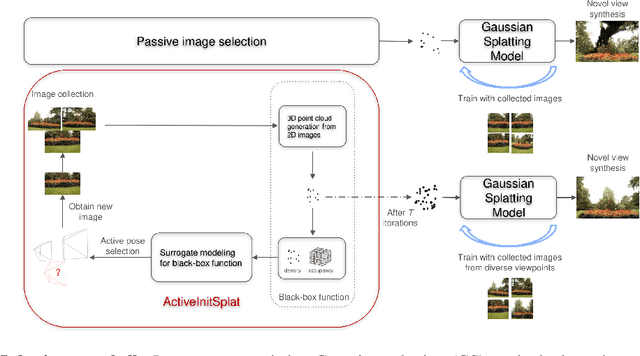
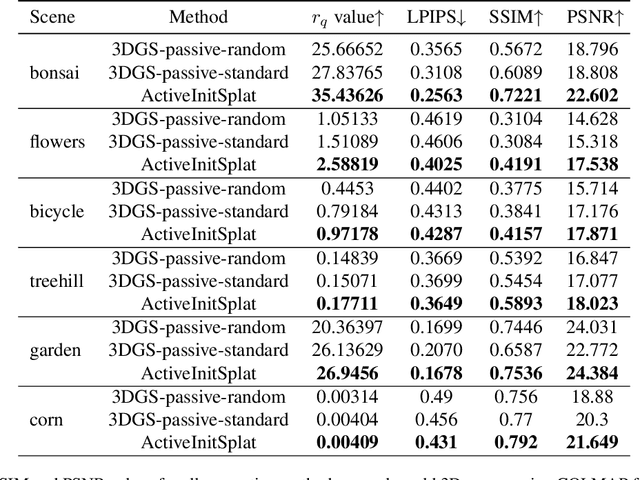
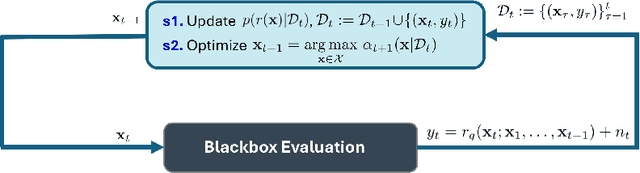
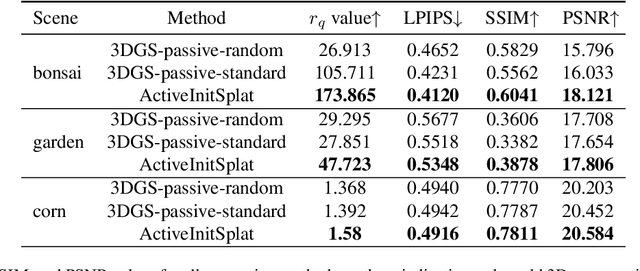
Gaussian splatting (GS) along with its extensions and variants provides outstanding performance in real-time scene rendering while meeting reduced storage demands and computational efficiency. While the selection of 2D images capturing the scene of interest is crucial for the proper initialization and training of GS, hence markedly affecting the rendering performance, prior works rely on passively and typically densely selected 2D images. In contrast, this paper proposes `ActiveInitSplat', a novel framework for active selection of training images for proper initialization and training of GS. ActiveInitSplat relies on density and occupancy criteria of the resultant 3D scene representation from the selected 2D images, to ensure that the latter are captured from diverse viewpoints leading to better scene coverage and that the initialized Gaussian functions are well aligned with the actual 3D structure. Numerical tests on well-known simulated and real environments demonstrate the merits of ActiveInitSplat resulting in significant GS rendering performance improvement over passive GS baselines, in the widely adopted LPIPS, SSIM, and PSNR metrics.
Active Sampling and Gaussian Reconstruction for Radio Frequency Radiance Field
Dec 11, 2024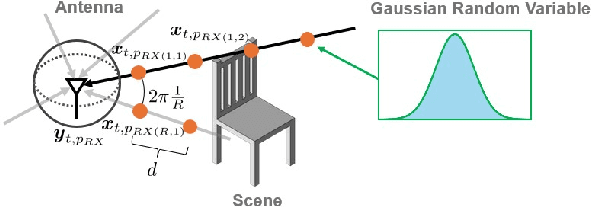
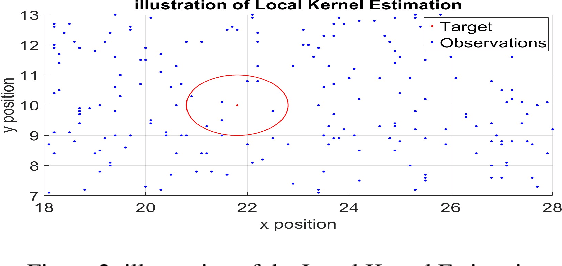
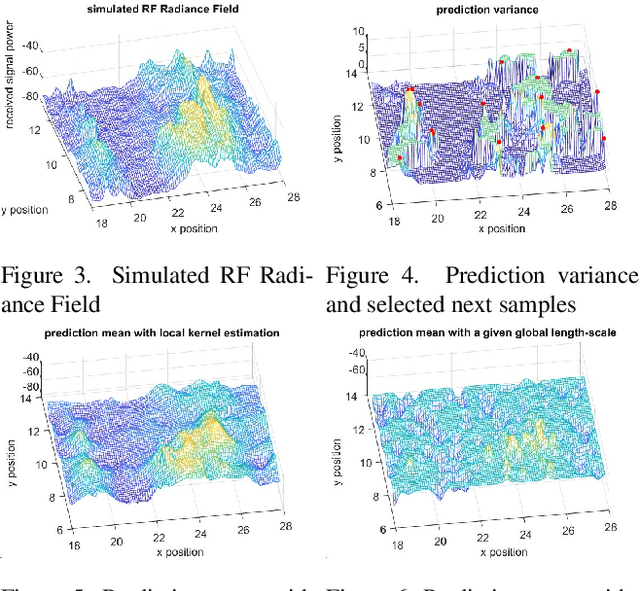
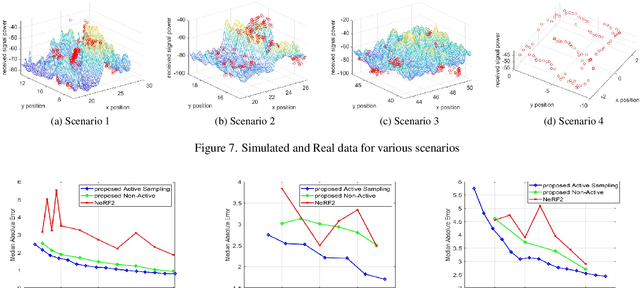
Radio-frequency (RF) Radiance Field reconstruction is a challenging problem. The difficulty lies in the interactions between the propagating signal and objects, such as reflections and diffraction, which are hard to model precisely, especially when the shapes and materials of the objects are unknown. Previously, a neural network-based method was proposed to reconstruct the RF Radiance Field, showing promising results. However, this neural network-based method has some limitations: it requires a large number of samples for training and is computationally expensive. Additionally, the neural network only provides the predicted mean of the RF Radiance Field and does not offer an uncertainty model. In this work, we propose a training-free Gaussian reconstruction method for RF Radiance Field. Our method demonstrates that the required number of samples is significantly smaller compared to the neural network-based approach. Furthermore, we introduce an uncertainty model that provides confidence estimates for predictions at any selected position in the scene. We also combine the Gaussian reconstruction method with active sampling, which further reduces the number of samples needed to achieve the same performance. Finally, we explore the potential benefits of our method in a quasi-dynamic setting, showcasing its ability to adapt to changes in the scene without requiring the entire process to be repeated.