 Add to Chrome
 Add to Firefox
 Add to Edge
Ego-1K -- A Large-Scale Multiview Video Dataset for Egocentric Vision
Mar 14, 2026
We present Ego-1K, a large-scale collection of time-synchronized egocentric multiview videos designed to advance neural 3D video synthesis and dynamic scene understanding. The dataset contains nearly 1,000 short egocentric videos captured with a custom rig with 12 synchronized cameras surrounding a 4-camera VR headset worn by the user. Scene content focuses on hand motions and hand-object interactions in different settings. We describe rig design, data processing, and calibration. Our dataset enables new ways to benchmark egocentric scene reconstruction methods, an important research area as smart glasses with multiple cameras become omnipresent. Our experiments demonstrate that our dataset presents unique challenges for existing 3D and 4D novel view synthesis methods due to large disparities and image motion caused by close dynamic objects and rig egomotion. Our dataset supports future research in this challenging domain. It is available at https://huggingface.co/datasets/facebook/ego-1k.

3D Scene Rendering with Multimodal Gaussian Splatting
Feb 19, 20263D scene reconstruction and rendering are core tasks in computer vision, with applications spanning industrial monitoring, robotics, and autonomous driving. Recent advances in 3D Gaussian Splatting (GS) and its variants have achieved impressive rendering fidelity while maintaining high computational and memory efficiency. However, conventional vision-based GS pipelines typically rely on a sufficient number of camera views to initialize the Gaussian primitives and train their parameters, typically incurring additional processing cost during initialization while falling short in conditions where visual cues are unreliable, such as adverse weather, low illumination, or partial occlusions. To cope with these challenges, and motivated by the robustness of radio-frequency (RF) signals to weather, lighting, and occlusions, we introduce a multimodal framework that integrates RF sensing, such as automotive radar, with GS-based rendering as a more efficient and robust alternative to vision-only GS rendering. The proposed approach enables efficient depth prediction from only sparse RF-based depth measurements, yielding a high-quality 3D point cloud for initializing Gaussian functions across diverse GS architectures. Numerical tests demonstrate the merits of judiciously incorporating RF sensing into GS pipelines, achieving high-fidelity 3D scene rendering driven by RF-informed structural accuracy.
ActiveInitSplat: How Active Image Selection Helps Gaussian Splatting
Mar 10, 2025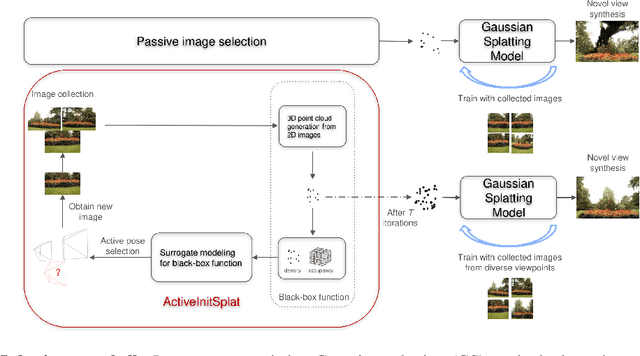
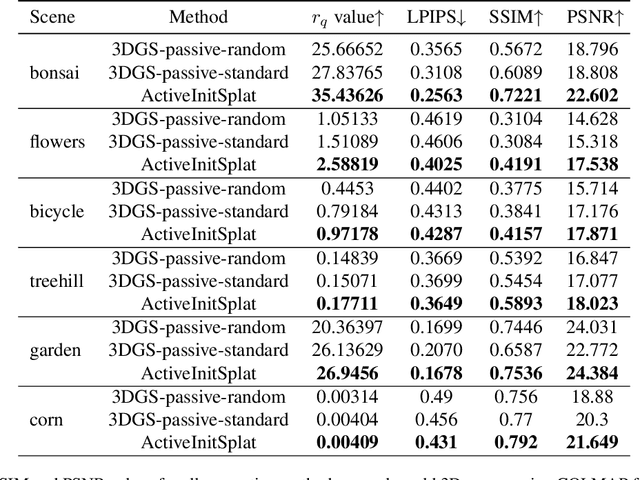
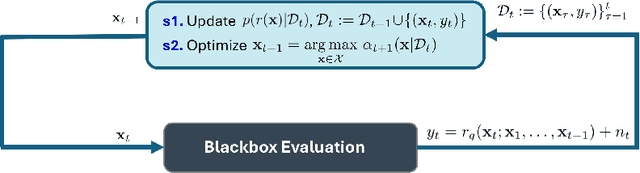
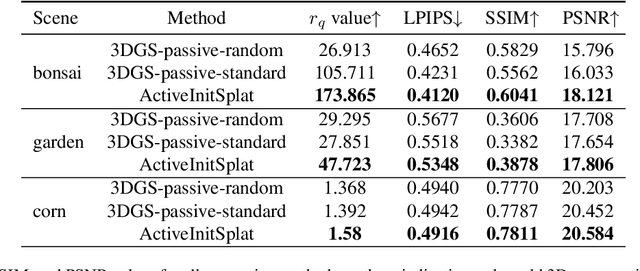
Gaussian splatting (GS) along with its extensions and variants provides outstanding performance in real-time scene rendering while meeting reduced storage demands and computational efficiency. While the selection of 2D images capturing the scene of interest is crucial for the proper initialization and training of GS, hence markedly affecting the rendering performance, prior works rely on passively and typically densely selected 2D images. In contrast, this paper proposes `ActiveInitSplat', a novel framework for active selection of training images for proper initialization and training of GS. ActiveInitSplat relies on density and occupancy criteria of the resultant 3D scene representation from the selected 2D images, to ensure that the latter are captured from diverse viewpoints leading to better scene coverage and that the initialized Gaussian functions are well aligned with the actual 3D structure. Numerical tests on well-known simulated and real environments demonstrate the merits of ActiveInitSplat resulting in significant GS rendering performance improvement over passive GS baselines, in the widely adopted LPIPS, SSIM, and PSNR metrics.