 Add to Chrome
 Add to Firefox
 Add to Edge
3D Scene Rendering with Multimodal Gaussian Splatting
Feb 19, 2026
3D scene reconstruction and rendering are core tasks in computer vision, with applications spanning industrial monitoring, robotics, and autonomous driving. Recent advances in 3D Gaussian Splatting (GS) and its variants have achieved impressive rendering fidelity while maintaining high computational and memory efficiency. However, conventional vision-based GS pipelines typically rely on a sufficient number of camera views to initialize the Gaussian primitives and train their parameters, typically incurring additional processing cost during initialization while falling short in conditions where visual cues are unreliable, such as adverse weather, low illumination, or partial occlusions. To cope with these challenges, and motivated by the robustness of radio-frequency (RF) signals to weather, lighting, and occlusions, we introduce a multimodal framework that integrates RF sensing, such as automotive radar, with GS-based rendering as a more efficient and robust alternative to vision-only GS rendering. The proposed approach enables efficient depth prediction from only sparse RF-based depth measurements, yielding a high-quality 3D point cloud for initializing Gaussian functions across diverse GS architectures. Numerical tests demonstrate the merits of judiciously incorporating RF sensing into GS pipelines, achieving high-fidelity 3D scene rendering driven by RF-informed structural accuracy.

Active Sampling and Gaussian Reconstruction for Radio Frequency Radiance Field
Dec 11, 2024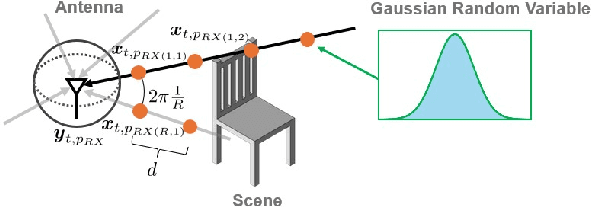
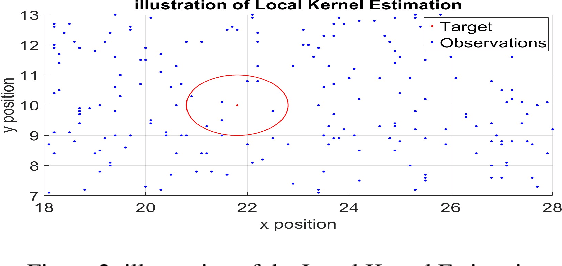
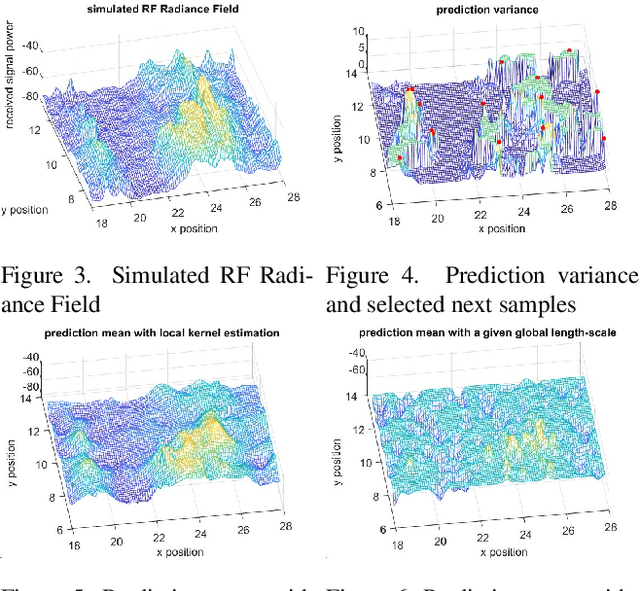
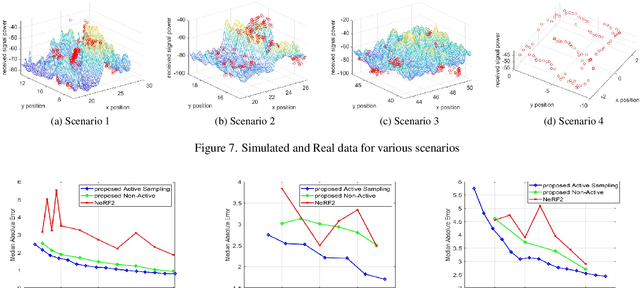
Radio-frequency (RF) Radiance Field reconstruction is a challenging problem. The difficulty lies in the interactions between the propagating signal and objects, such as reflections and diffraction, which are hard to model precisely, especially when the shapes and materials of the objects are unknown. Previously, a neural network-based method was proposed to reconstruct the RF Radiance Field, showing promising results. However, this neural network-based method has some limitations: it requires a large number of samples for training and is computationally expensive. Additionally, the neural network only provides the predicted mean of the RF Radiance Field and does not offer an uncertainty model. In this work, we propose a training-free Gaussian reconstruction method for RF Radiance Field. Our method demonstrates that the required number of samples is significantly smaller compared to the neural network-based approach. Furthermore, we introduce an uncertainty model that provides confidence estimates for predictions at any selected position in the scene. We also combine the Gaussian reconstruction method with active sampling, which further reduces the number of samples needed to achieve the same performance. Finally, we explore the potential benefits of our method in a quasi-dynamic setting, showcasing its ability to adapt to changes in the scene without requiring the entire process to be repeated.