 Add to Chrome
 Add to Firefox
 Add to Edge
Spatial Reasoning via Modality Switching Between Language and Symbolic Representation
Jun 30, 2026
Human reasoning is inherently multimodal: when problems become difficult, we rarely think in words alone. We often externalize our reasoning by sketching diagrams or drawing grids to understand the underlying conceptual structure and avoid mistakes. Building on this premise, our research investigates: (a) whether grounding multi-hop textual-spatial stories into geometry-aware modalities, such as layouts or grids, improves reasoning compared to natural language-based inference; and (b) whether a model can decide when to rely on natural language reasoning and when to switch to a structured modality. We address these questions by introducing a switching metric based on trustworthiness and complexity signals, which estimates when grounding a spatial story into structure is likely to improve performance. This takes a first step toward principled modality selection in Large Language Model (LLM) reasoning. Across our settings, switching from natural language-based reasoning to a grid-based representation improves LLM performance by up to 42\%, highlighting the importance of modality choice in shaping reasoning outcomes.

SATURN: Symbolic Spatial Reasoning for Multi-Perspective Grounding
Jun 21, 2026Vision-Language Models (VLMs) remain unreliable when spatial reasoning requires composing relations whose meanings depend on frames of reference. Existing neuro-symbolic methods make reasoning more explicit, but often depend on brittle geometric procedures and hard decisions over noisy perception. We propose SATURN, a neuro-symbolic framework for perspective-aware compositional spatial reasoning. SATURN reconstructs an approximate 3D scene, derives soft perspective-aware spatial predicates, and composes them with a training-free Pythonic symbolic executor, separating perception from reasoning while preserving uncertainty through multi-hop inference. We also introduce 3D FORCE, a diagnostic benchmark that controls reasoning depth, view, and perspective composition across spatial arrangement grounding (SAG) and referring expression grounding (REF). On 3D FORCE, VLMs and spatially trained models degrade sharply as depth and perspective complexity increase, whereas SATURN remains stable and outperforms strong baselines. On the real-world MindCube benchmark, SATURN achieves 78.57% overall accuracy, outperforming the strongest baseline by 14 pp.
Neuro-Symbolic Frameworks: Conceptual Characterization and Empirical Comparative Analysis
Sep 08, 2025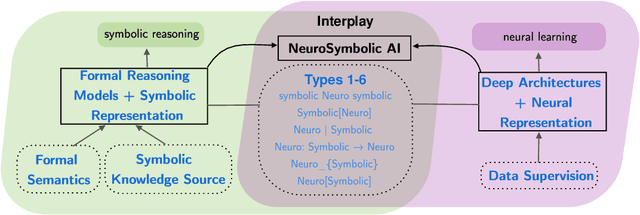

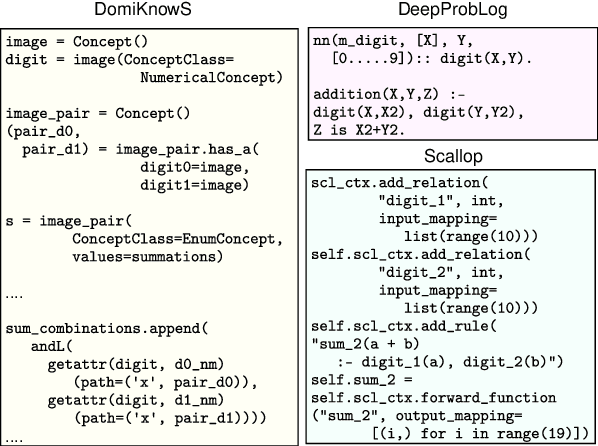
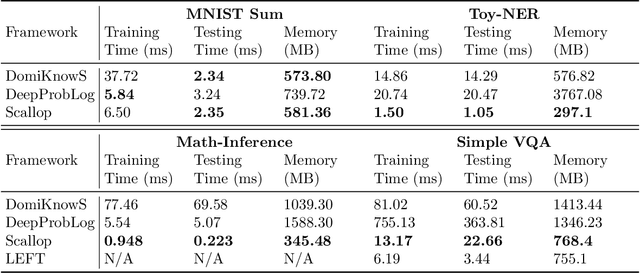
Neurosymbolic (NeSy) frameworks combine neural representations and learning with symbolic representations and reasoning. Combining the reasoning capacities, explainability, and interpretability of symbolic processing with the flexibility and power of neural computing allows us to solve complex problems with more reliability while being data-efficient. However, this recently growing topic poses a challenge to developers with its learning curve, lack of user-friendly tools, libraries, and unifying frameworks. In this paper, we characterize the technical facets of existing NeSy frameworks, such as the symbolic representation language, integration with neural models, and the underlying algorithms. A majority of the NeSy research focuses on algorithms instead of providing generic frameworks for declarative problem specification to leverage problem solving. To highlight the key aspects of Neurosymbolic modeling, we showcase three generic NeSy frameworks - \textit{DeepProbLog}, \textit{Scallop}, and \textit{DomiKnowS}. We identify the challenges within each facet that lay the foundation for identifying the expressivity of each framework in solving a variety of problems. Building on this foundation, we aim to spark transformative action and encourage the community to rethink this problem in novel ways.
FoREST: Frame of Reference Evaluation in Spatial Reasoning Tasks
Feb 25, 2025Spatial reasoning is a fundamental aspect of human intelligence. One key concept in spatial cognition is the Frame of Reference (FoR), which identifies the perspective of spatial expressions. Despite its significance, FoR has received limited attention in AI models that need spatial intelligence. There is a lack of dedicated benchmarks and in-depth evaluation of large language models (LLMs) in this area. To address this issue, we introduce the Frame of Reference Evaluation in Spatial Reasoning Tasks (FoREST) benchmark, designed to assess FoR comprehension in LLMs. We evaluate LLMs on answering questions that require FoR comprehension and layout generation in text-to-image models using FoREST. Our results reveal a notable performance gap across different FoR classes in various LLMs, affecting their ability to generate accurate layouts for text-to-image generation. This highlights critical shortcomings in FoR comprehension. To improve FoR understanding, we propose Spatial-Guided prompting, which improves LLMs ability to extract essential spatial concepts. Our proposed method improves overall performance across spatial reasoning tasks.
Neuro-symbolic Training for Reasoning over Spatial Language
Jun 19, 2024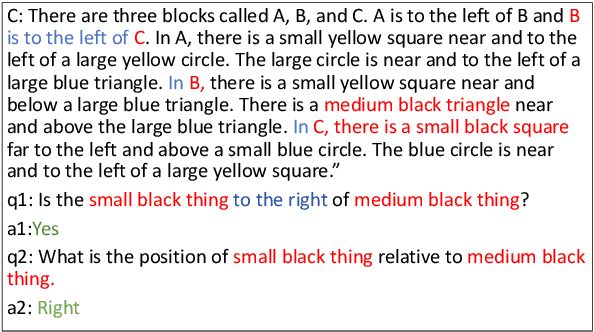
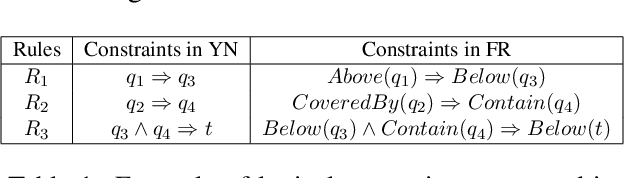
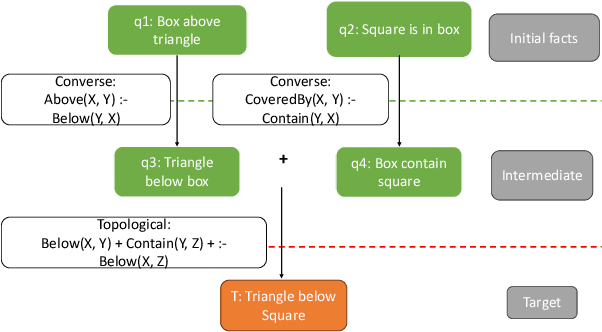

Recent research shows that more data and larger models can provide more accurate solutions to natural language problems requiring reasoning. However, models can easily fail to provide solutions in unobserved complex input compositions due to not achieving the level of abstraction required for generalizability. To alleviate this issue, we propose training the language models with neuro-symbolic techniques that can exploit the logical rules of reasoning as constraints and provide additional supervision sources to the model. Training models to adhere to the regulations of reasoning pushes them to make more effective abstractions needed for generalizability and transfer learning. We focus on a challenging problem of spatial reasoning over text. Our results on various benchmarks using multiple language models confirm our hypothesis of effective domain transfer based on neuro-symbolic training.
A Survey on Compositional Learning of AI Models: Theoretical and Experimetnal Practices
Jun 13, 2024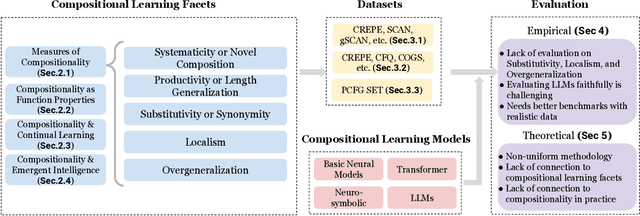
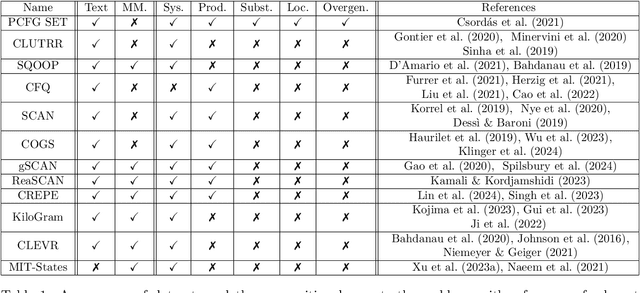
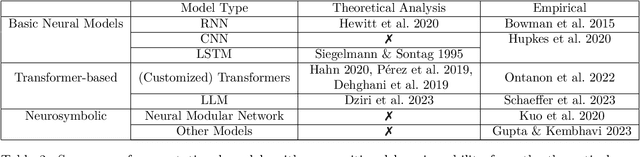
Compositional learning, mastering the ability to combine basic concepts and construct more intricate ones, is crucial for human cognition, especially in human language comprehension and visual perception. This notion is tightly connected to generalization over unobserved situations. Despite its integral role in intelligence, there is a lack of systematic theoretical and experimental research methodologies, making it difficult to analyze the compositional learning abilities of computational models. In this paper, we survey the literature on compositional learning of AI models and the connections made to cognitive studies. We identify abstract concepts of compositionality in cognitive and linguistic studies and connect these to the computational challenges faced by language and vision models in compositional reasoning. We overview the formal definitions, tasks, evaluation benchmarks, variety of computational models, and theoretical findings. We cover modern studies on large language models to provide a deeper understanding of the cutting-edge compositional capabilities exhibited by state-of-the-art AI models and pinpoint important directions for future research.
GLUECons: A Generic Benchmark for Learning Under Constraints
Feb 16, 2023Recent research has shown that integrating domain knowledge into deep learning architectures is effective -- it helps reduce the amount of required data, improves the accuracy of the models' decisions, and improves the interpretability of models. However, the research community is missing a convened benchmark for systematically evaluating knowledge integration methods. In this work, we create a benchmark that is a collection of nine tasks in the domains of natural language processing and computer vision. In all cases, we model external knowledge as constraints, specify the sources of the constraints for each task, and implement various models that use these constraints. We report the results of these models using a new set of extended evaluation criteria in addition to the task performances for a more in-depth analysis. This effort provides a framework for a more comprehensive and systematic comparison of constraint integration techniques and for identifying related research challenges. It will facilitate further research for alleviating some problems of state-of-the-art neural models.