 Add to Chrome
 Add to Firefox
 Add to Edge
Machine Learning Approaches to Decoding Topological Quantum Codes
Aug 16, 2026
Decoding is an essential component of quantum error correction (QEC), translating stabilizer measurement outcomes into corrective actions that suppress logical errors and preserve logical quantum information. Building fault-tolerant architectures requires increasing the code distance, which in turn places growing demands on decoding accuracy, scalability, and practical deployability. While a wide range of decoding algorithms have been proposed and demonstrated, achieving reliable, scalable, and real-time decoding remains a significant challenge. Machine-learning (ML) approaches are particularly well suited to this setting, as quantum error decoding is fundamentally a problem of processing large volumes of classical data with complex spatiotemporal correlations. This chapter surveys ML-based methods for quantum error decoding, with a focus on topological codes and an emphasis on architectural principles, practical performance, and real-time considerations. We first frame decoding as a learning problem and outline key paradigms, including discriminative, generative, and reinforcement-learning formulations. We then introduce the neural network building blocks that underpin most contemporary neural decoders and discuss how these components can be integrated to balance expressivity, scalability, and latency. Building on this architectural perspective, we review recent progress and benchmarks in neural decoding for memory experiments, and discuss real-time decoding, open challenges, and future directions toward scalable fault-tolerant quantum computing.

Generative Modeling of Quantum Distribution with Functional Flow Matching
Jul 01, 2026The emergence of powerful deep generative models based on diffusion and flow matching has enabled the learning and modeling of complex distributions. Learning quantum distributions, however, remains challenging due to the inherent difficulty of accurately modeling the meaningful physical properties of quantum states. We propose Quantum Flow Matching (QFM), a novel generative model designed to learn quantum distribution by utilizing spin Wigner function and flow matching. By converting density matrix into the spin Wigner function and leveraging functional flow matching to learn distributions in function space, QFM enables accurate and effective learning of multi-qubit quantum distributions. We demonstrate the effectiveness of our method by evaluating physical quantities such as trace, purity, and entanglement entropy of the generated quantum states, accurately capturing the underlying physics of the given quantum distributions.
Scalable Neural Decoders for Practical Real-Time Quantum Error Correction
Oct 26, 2025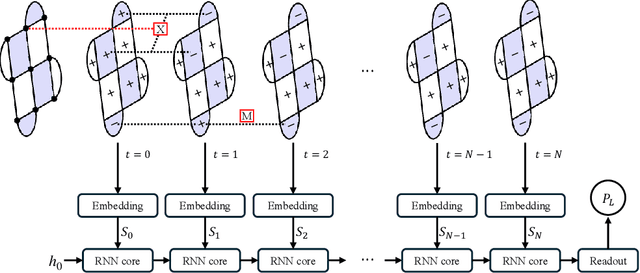
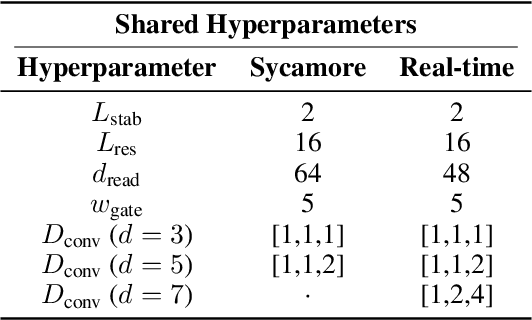
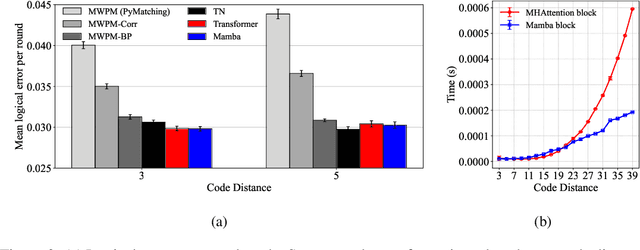
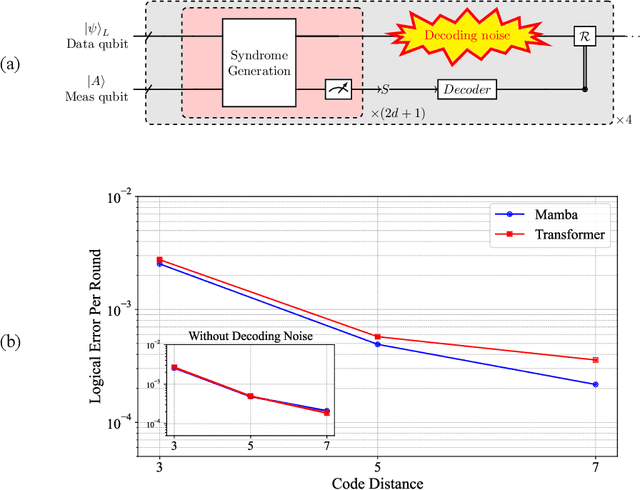
Real-time, scalable, and accurate decoding is a critical component for realizing a fault-tolerant quantum computer. While Transformer-based neural decoders such as \textit{AlphaQubit} have demonstrated high accuracy, the computational complexity of their core attention mechanism, which scales as $\mathcal{O}(d^4)$ with code distance $d$, results in decoding speeds insufficient for practical real-time applications. In this work, we introduce and evaluate a \textit{Mamba}-based decoder, a state-space model with $\mathcal{O}(d^2)$ complexity. In memory experiments using Sycamore hardware data, our Mamba decoder matches the performance of its Transformer-based counterpart, providing that its superior efficiency does not come at the cost of performance. Crucially, in simulated real-time scenarios that account for decoder-induced noise, the Mamba decoder significantly outperforms the Transformer, exhibiting a higher error threshold of $0.0104$ compared to $0.0097$. These results demonstrate that Mamba decoders offer a compelling balance between speed and accuracy, making them a promising architecture for scalable, real-time quantum error correction.
Multi-channel convolutional neural quantum embedding
Sep 26, 2025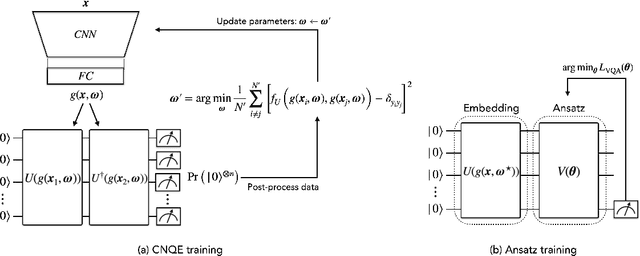
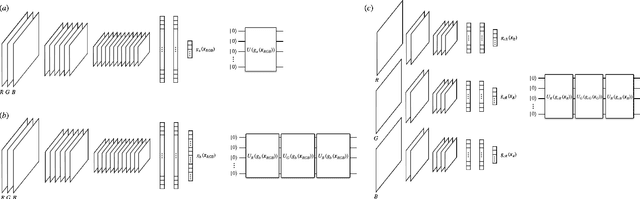
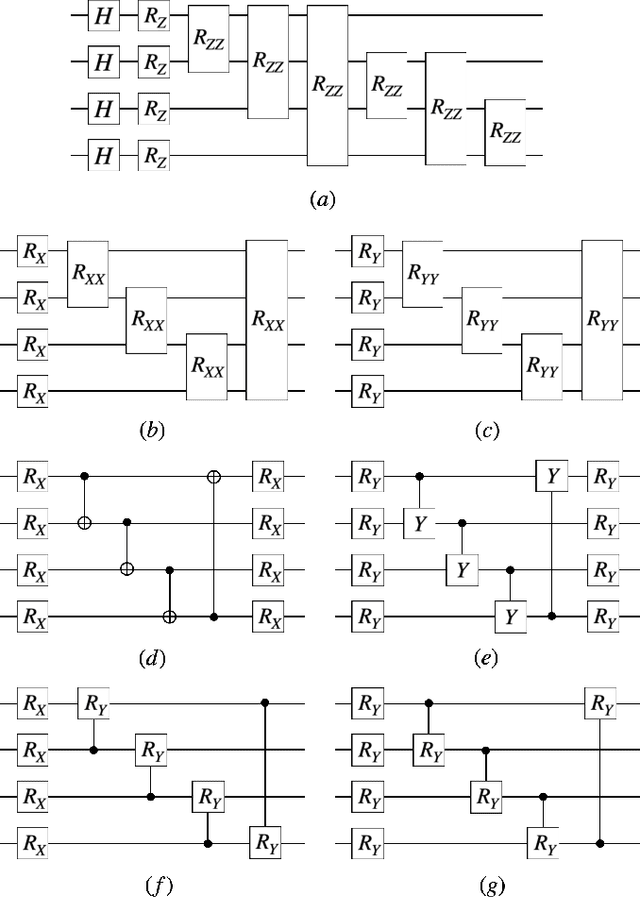
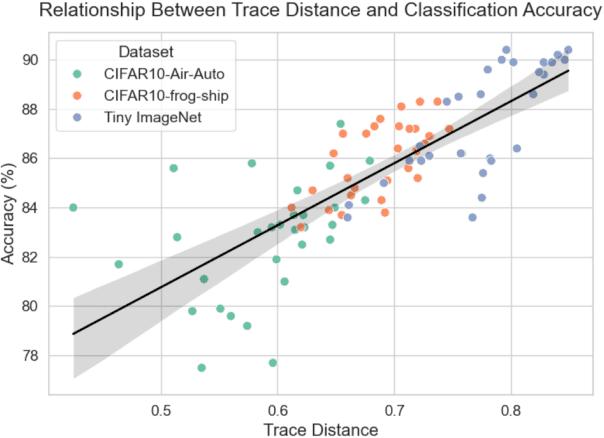
Classification using variational quantum circuits is a promising frontier in quantum machine learning. Quantum supervised learning (QSL) applied to classical data using variational quantum circuits involves embedding the data into a quantum Hilbert space and optimizing the circuit parameters to train the measurement process. In this context, the efficacy of QSL is inherently influenced by the selection of quantum embedding. In this study, we introduce a classical-quantum hybrid approach for optimizing quantum embedding beyond the limitations of the standard circuit model of quantum computation (i.e., completely positive and trace-preserving maps) for general multi-channel data. We benchmark the performance of various models in our framework using the CIFAR-10 and Tiny ImageNet datasets and provide theoretical analyses that guide model design and optimization.
Understanding Generalization in Quantum Machine Learning with Margins
Nov 11, 2024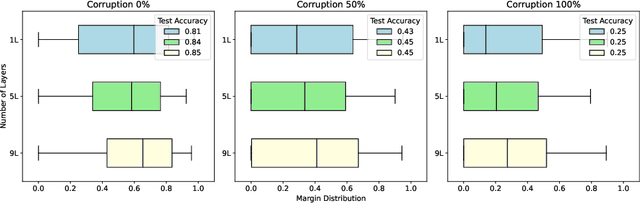
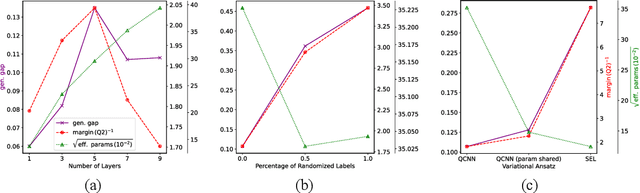
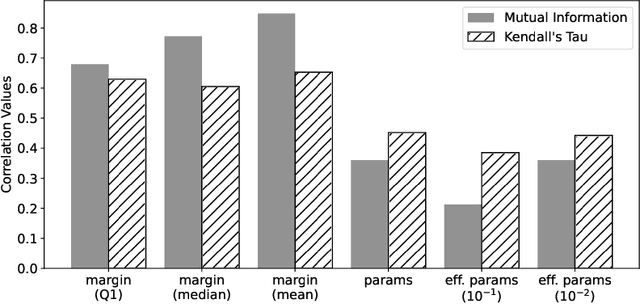
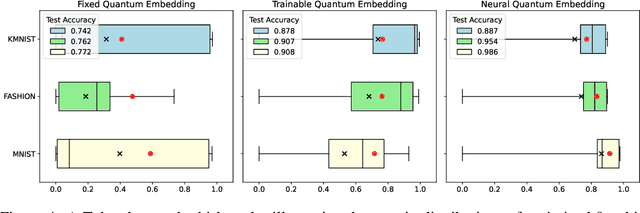
Understanding and improving generalization capabilities is crucial for both classical and quantum machine learning (QML). Recent studies have revealed shortcomings in current generalization theories, particularly those relying on uniform bounds, across both classical and quantum settings. In this work, we present a margin-based generalization bound for QML models, providing a more reliable framework for evaluating generalization. Our experimental studies on the quantum phase recognition (QPR) dataset demonstrate that margin-based metrics are strong predictors of generalization performance, outperforming traditional metrics like parameter count. By connecting this margin-based metric to quantum information theory, we demonstrate how to enhance the generalization performance of QML through a classical-quantum hybrid approach when applied to classical data.