 Add to Chrome
 Add to Firefox
 Add to Edge
Neural quantum support vector data description for one-class classification
Mar 03, 2026
One-class classification (OCC) is a fundamental problem in machine learning with numerous applications, such as anomaly detection and quality control. With the increasing complexity and dimensionality of modern datasets, there is a growing demand for advanced OCC techniques with better expressivity and efficiency. We introduce Neural Quantum Support Vector Data Description (NQSVDD), a classical-quantum hybrid framework for OCC that performs end-to-end optimized hierarchical representation learning. NQSVDD integrates a classical neural network with trainable quantum data encoding and a variational quantum circuit, enabling the model to learn nonlinear feature transformations tailored to the OCC objective. The hybrid architecture maps input data into an intermediate high-dimensional feature space and subsequently projects it into a compact latent space defined through quantum measurements. Importantly, both the feature embedding and the latent representation are jointly optimized such that normal data form a compact cluster, for which a minimum-volume enclosing hypersphere provides an effective decision boundary. Experimental evaluations on benchmark datasets demonstrate that NQSVDD achieves competitive or superior AUC performance compared to classical Deep SVDD and quantum baselines, while maintaining parameter efficiency and robustness under realistic noise conditions.

Multi-channel convolutional neural quantum embedding
Sep 26, 2025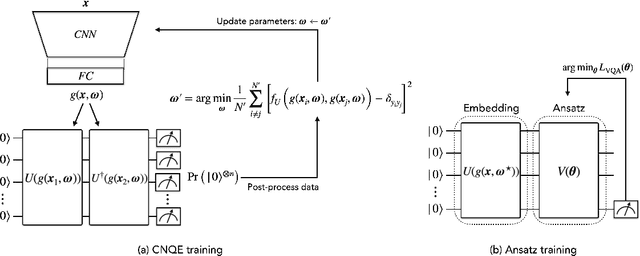
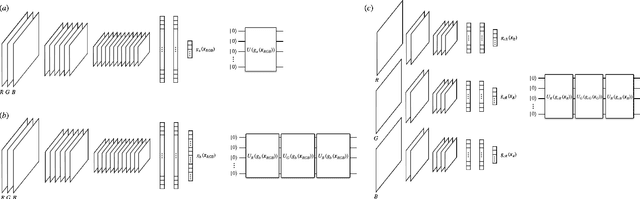
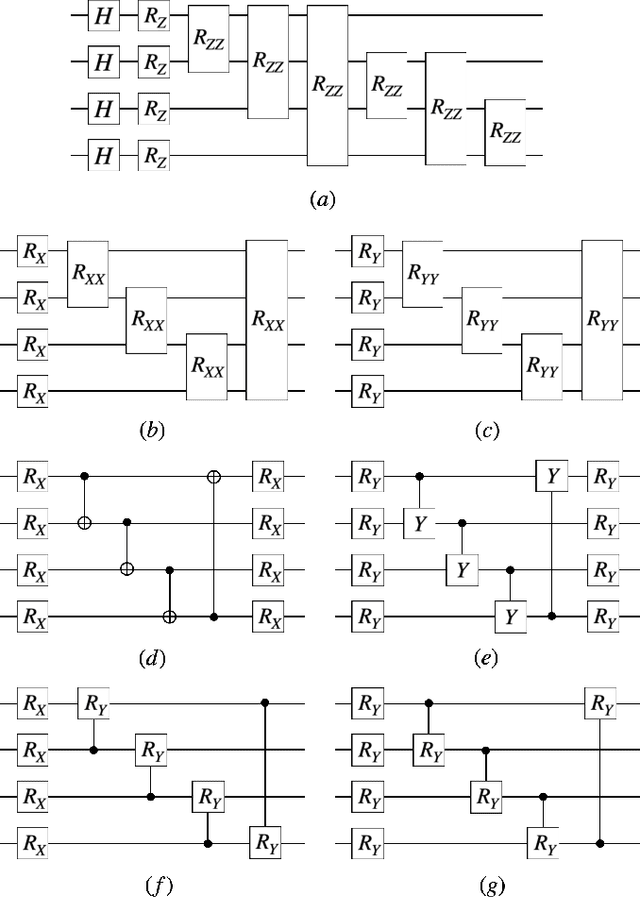
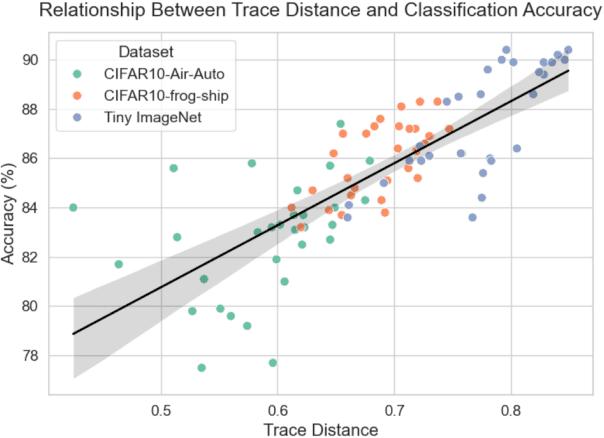
Classification using variational quantum circuits is a promising frontier in quantum machine learning. Quantum supervised learning (QSL) applied to classical data using variational quantum circuits involves embedding the data into a quantum Hilbert space and optimizing the circuit parameters to train the measurement process. In this context, the efficacy of QSL is inherently influenced by the selection of quantum embedding. In this study, we introduce a classical-quantum hybrid approach for optimizing quantum embedding beyond the limitations of the standard circuit model of quantum computation (i.e., completely positive and trace-preserving maps) for general multi-channel data. We benchmark the performance of various models in our framework using the CIFAR-10 and Tiny ImageNet datasets and provide theoretical analyses that guide model design and optimization.