 Add to Chrome
 Add to Firefox
 Add to Edge
ClinReadNet: A clinical reading-inspired network for low-dose abdominal CT image quality assessment
Jun 09, 2026
In abdominal CT imaging, developing a low-dose, no-reference image quality assessment (No-reference IQA) model that mimics doctors' reading habits for evaluating CT image quality has significant practical value. This paper proposes a novel deep learning-based framework, ClinReadNet, whose design aligns with the clinical reading logic of radiologists: first, it introduces the Sobel ordinal quality network (SOQN) module, which can simultaneously focus on edge details highly relevant to image quality and the quality distribution pattern of the entire image, accurately matching the clinical image-reading judgment habit of "considering both local details and overall context"; second, the framework integrates the (shifted) window multi-scale temperature multi-head self-attention ((S)W-MTMSA) module, which further replicates the radiologists' image-reading process of shifting from overall scanning to local focusing, and accurately locks in regions of interest through multi-sharpness attention; third, it designs the hierarchical ranked probability score (HRPS) loss function, which combines the dual logics of coarse classification and fine classification, while paying attention to the distance information between grading labels, effectively improving the performance of image quality assessment. Experiments conducted on the LDCTIQAG2023 dataset show that the proposed method achieves the current state-of-the-art (SOTA) performance: the values of Pearson's linear correlation coefficient (PLCC), Spearman's rank-order correlation coefficient (SROCC), and Kendall's rank-order correlation coefficient (KROCC) reach 0.9507, 0.9554, and 0.8629 respectively, with the sum of their absolute values (Score) being 2.7690, outperforming existing methods.

Radiomics-Informed Deep Learning for Classification of Atrial Fibrillation Sub-Types from Left-Atrium CT Volumes
Aug 14, 2023
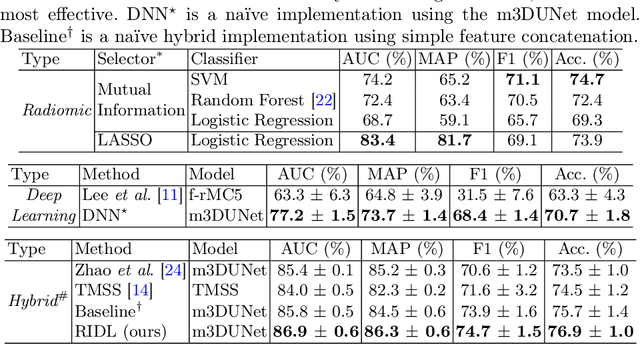
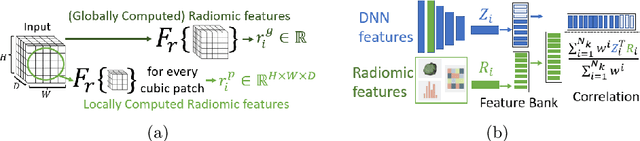
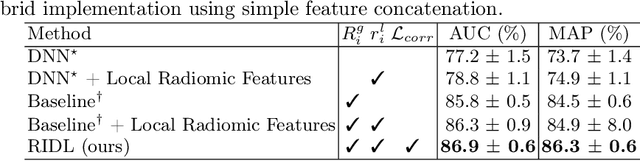
Atrial Fibrillation (AF) is characterized by rapid, irregular heartbeats, and can lead to fatal complications such as heart failure. The disease is divided into two sub-types based on severity, which can be automatically classified through CT volumes for disease screening of severe cases. However, existing classification approaches rely on generic radiomic features that may not be optimal for the task, whilst deep learning methods tend to over-fit to the high-dimensional volume inputs. In this work, we propose a novel radiomics-informed deep-learning method, RIDL, that combines the advantages of deep learning and radiomic approaches to improve AF sub-type classification. Unlike existing hybrid techniques that mostly rely on na\"ive feature concatenation, we observe that radiomic feature selection methods can serve as an information prior, and propose supplementing low-level deep neural network (DNN) features with locally computed radiomic features. This reduces DNN over-fitting and allows local variations between radiomic features to be better captured. Furthermore, we ensure complementary information is learned by deep and radiomic features by designing a novel feature de-correlation loss. Combined, our method addresses the limitations of deep learning and radiomic approaches and outperforms state-of-the-art radiomic, deep learning, and hybrid approaches, achieving 86.9% AUC for the AF sub-type classification task. Code is available at https://github.com/xmed-lab/RIDL.