 Add to Chrome
 Add to Firefox
 Add to Edge
Whose Is This?: Context-Aware Object Ownership Inference with Uncertainty-Guided Questioning
May 27, 2026
Service robots must infer object ownership to correctly interpret instructions such as "bring me my cup." However, ownership is a latent attribute that cannot be directly observed, and existing methods often rely on limited cues such as recent usage, making them unreliable in scenarios such as temporary sharing. We propose a framework for context-aware ownership inference with uncertainty-guided interaction (COIN). The method integrates user background information and object usage history using a large language model (LLM) to estimate ownership scores. To handle uncertainty, we apply conformal prediction to construct a set of plausible owners and selectively generate user queries when the prediction is uncertain. Experiments in a simulated home environment show that the proposed method consistently outperforms baseline approaches, achieving a Subset Accuracy of 0.988 and a Mean Jaccard index of 0.991. The method also maintains high performance in scenarios involving temporary use and shared ownership. The results demonstrate that combining contextual reasoning with uncertainty-aware interaction improves both estimation accuracy and robustness. The project page is available at https://emergentsystemlabstudent.github.io/COIN/.

Emergent Communication between Heterogeneous Visual Agents through Decentralized Learning
May 12, 2026Symbols are shared, but perception is private. We study emergent communication between heterogeneous visual agents through decentralized learning, asking what visual information can become shareable when agents have different visual representations. Instead of optimizing messages through a shared external communicative objective, our agents exchange only discrete token sequences and update their own models using local perceptual evidence. This setting focuses on an underexplored aspect of emergent communication, examining whether common symbols can arise without shared perceptual access, and how the similarity between private visual spaces constrains the content and symmetry of the resulting language. We instantiate this setting in the Metropolis-Hastings Captioning Game (MHCG), where two agents collaboratively form shared captions by exchanging proposed token sequences that a listener accepts or rejects using an MH-style criterion evaluated against its own visual features. We compare three pairings of frozen visual encoders, with agents starting from randomly initialized text modules. Experiments on MS-COCO show that MHCG produces visually informative shared token sequences that outperform a no-communication baseline in cross-agent alignment, visual-feature prediction, and image-text retrieval; all cross-agent metrics decline as encoder mismatch increases. Moderate encoder heterogeneity reduces the number of shared sequences while preserving per-sequence visual specificity, whereas stronger encoder heterogeneity yields fewer, coarser, and more asymmetric sequences. Ablations show that listener-side MH acceptance is critical for avoiding degenerate token formation. These results suggest that shared symbols can arise from local perceptual evaluation alone, with visual representational similarity across encoders shaping both the content and symmetry of the resulting language.
Reducing Mental Workload through On-Demand Human Assistance for Physical Action Failures in LLM-based Multi-Robot Coordination
Mar 30, 2026Multi-robot coordination based on large language models (LLMs) has attracted growing attention, since LLMs enable the direct translation of natural language instructions into robot action plans by decomposing tasks and generating high-level plans. However, recovering from physical execution failures remains difficult, and tasks often stagnate due to the repetition of the same unsuccessful actions. While frameworks for remote robot operation using Mixed Reality were proposed, there have been few attempts to implement remote error resolution specifically for physical failures in multi-robot environments. In this study, we propose REPAIR (Robot Execution with Planned And Interactive Recovery), a human-in-the-loop framework that integrates remote error resolution into LLM-based multi-robot planning. In this method, robots execute tasks autonomously; however, when an irrecoverable failure occurs, the LLM requests assistance from an operator, enabling task continuity through remote intervention. Evaluations using a multi-robot trash collection task in a real-world environment confirmed that REPAIR significantly improves task progress (the number of items cleared within a time limit) compared to fully autonomous methods. Furthermore, for easily collectable items, it achieved task progress equivalent to full remote control. The results also suggested that the mental workload on the operator may differ in terms of physical demand and effort. The project website is https://emergentsystemlabstudent.github.io/REPAIR/.
EasyControlEdge: A Foundation-Model Fine-Tuning for Edge Detection
Feb 18, 2026We propose EasyControlEdge, adapting an image-generation foundation model to edge detection. In real-world edge detection (e.g., floor-plan walls, satellite roads/buildings, and medical organ boundaries), crispness and data efficiency are crucial, yet producing crisp raw edge maps with limited training samples remains challenging. Although image-generation foundation models perform well on many downstream tasks, their pretrained priors for data-efficient transfer and iterative refinement for high-frequency detail preservation remain underexploited for edge detection. To enable crisp and data-efficient edge detection using these capabilities, we introduce an edge-specialized adaptation of image-generation foundation models. To better specialize the foundation model for edge detection, we incorporate an edge-oriented objective with an efficient pixel-space loss. At inference, we introduce guidance based on unconditional dynamics, enabling a single model to control the edge density through a guidance scale. Experiments on BSDS500, NYUDv2, BIPED, and CubiCasa compare against state-of-the-art methods and show consistent gains, particularly under no-post-processing crispness evaluation and with limited training data.
Multi-Robot Task Planning for Multi-Object Retrieval Tasks with Distributed On-Site Knowledge via Large Language Models
Sep 16, 2025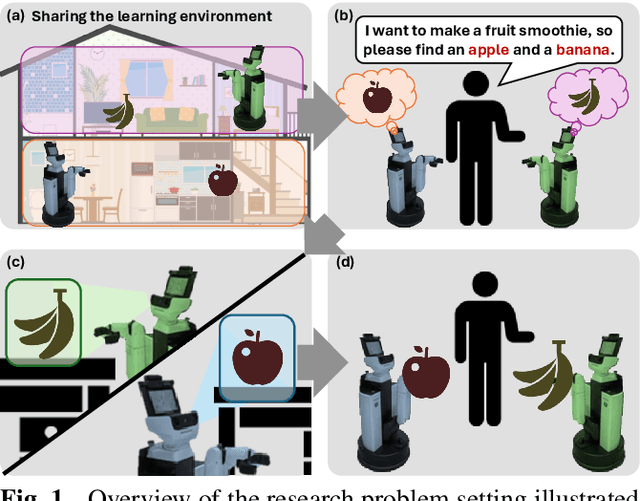
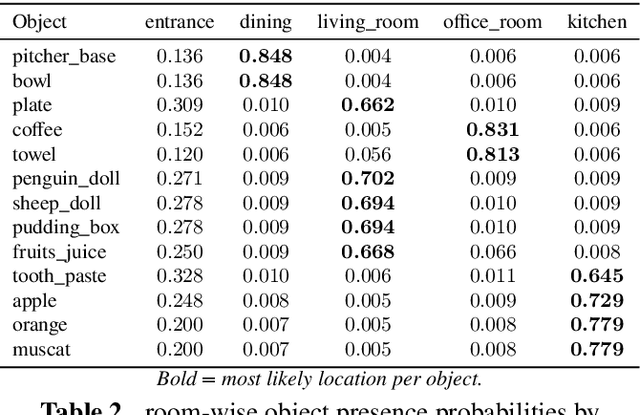
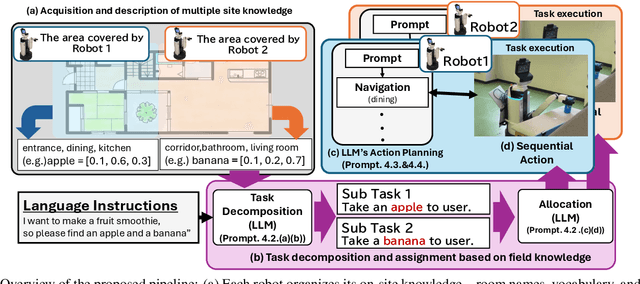
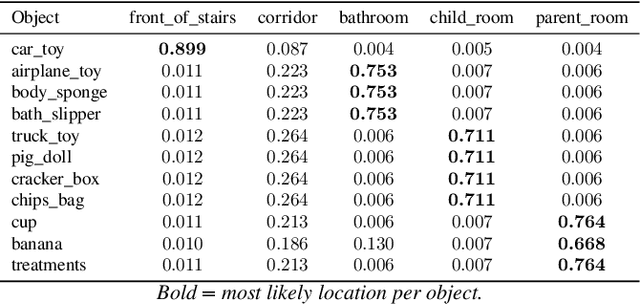
It is crucial to efficiently execute instructions such as "Find an apple and a banana" or "Get ready for a field trip," which require searching for multiple objects or understanding context-dependent commands. This study addresses the challenging problem of determining which robot should be assigned to which part of a task when each robot possesses different situational on-site knowledge-specifically, spatial concepts learned from the area designated to it by the user. We propose a task planning framework that leverages large language models (LLMs) and spatial concepts to decompose natural language instructions into subtasks and allocate them to multiple robots. We designed a novel few-shot prompting strategy that enables LLMs to infer required objects from ambiguous commands and decompose them into appropriate subtasks. In our experiments, the proposed method achieved 47/50 successful assignments, outperforming random (28/50) and commonsense-based assignment (26/50). Furthermore, we conducted qualitative evaluations using two actual mobile manipulators. The results demonstrated that our framework could handle instructions, including those involving ad hoc categories such as "Get ready for a field trip," by successfully performing task decomposition, assignment, sequential planning, and execution.
Toward Ownership Understanding of Objects: Active Question Generation with Large Language Model and Probabilistic Generative Model
Sep 16, 2025Robots operating in domestic and office environments must understand object ownership to correctly execute instructions such as ``Bring me my cup.'' However, ownership cannot be reliably inferred from visual features alone. To address this gap, we propose Active Ownership Learning (ActOwL), a framework that enables robots to actively generate and ask ownership-related questions to users. ActOwL employs a probabilistic generative model to select questions that maximize information gain, thereby acquiring ownership knowledge efficiently to improve learning efficiency. Additionally, by leveraging commonsense knowledge from Large Language Models (LLM), objects are pre-classified as either shared or owned, and only owned objects are targeted for questioning. Through experiments in a simulated home environment and a real-world laboratory setting, ActOwL achieved significantly higher ownership clustering accuracy with fewer questions than baseline methods. These findings demonstrate the effectiveness of combining active inference with LLM-guided commonsense reasoning, advancing the capability of robots to acquire ownership knowledge for practical and socially appropriate task execution.
Co-Creative Learning via Metropolis-Hastings Interaction between Humans and AI
Jun 18, 2025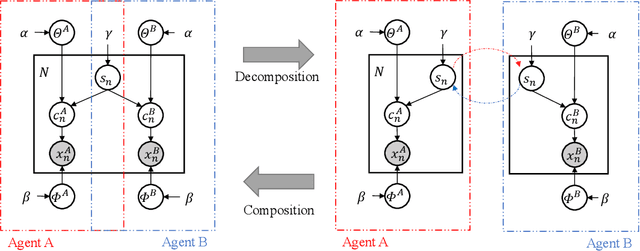
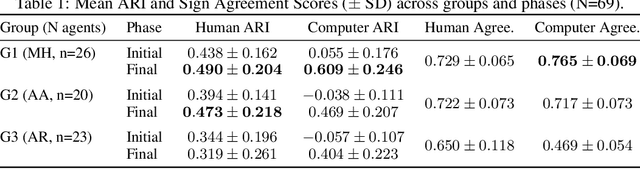

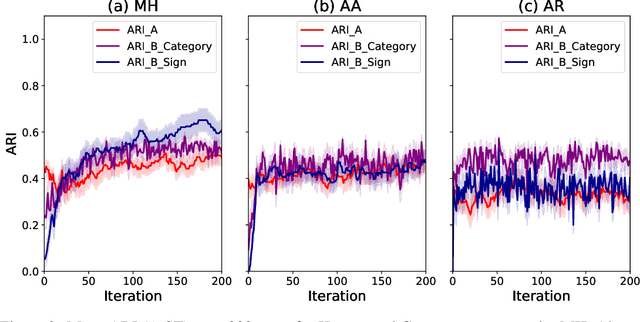
We propose co-creative learning as a novel paradigm where humans and AI, i.e., biological and artificial agents, mutually integrate their partial perceptual information and knowledge to construct shared external representations, a process we interpret as symbol emergence. Unlike traditional AI teaching based on unilateral knowledge transfer, this addresses the challenge of integrating information from inherently different modalities. We empirically test this framework using a human-AI interaction model based on the Metropolis-Hastings naming game (MHNG), a decentralized Bayesian inference mechanism. In an online experiment, 69 participants played a joint attention naming game (JA-NG) with one of three computer agent types (MH-based, always-accept, or always-reject) under partial observability. Results show that human-AI pairs with an MH-based agent significantly improved categorization accuracy through interaction and achieved stronger convergence toward a shared sign system. Furthermore, human acceptance behavior aligned closely with the MH-derived acceptance probability. These findings provide the first empirical evidence for co-creative learning emerging in human-AI dyads via MHNG-based interaction. This suggests a promising path toward symbiotic AI systems that learn with humans, rather than from them, by dynamically aligning perceptual experiences, opening a new venue for symbiotic AI alignment.
Reward-Independent Messaging for Decentralized Multi-Agent Reinforcement Learning
May 28, 2025In multi-agent reinforcement learning (MARL), effective communication improves agent performance, particularly under partial observability. We propose MARL-CPC, a framework that enables communication among fully decentralized, independent agents without parameter sharing. MARL-CPC incorporates a message learning model based on collective predictive coding (CPC) from emergent communication research. Unlike conventional methods that treat messages as part of the action space and assume cooperation, MARL-CPC links messages to state inference, supporting communication in non-cooperative, reward-independent settings. We introduce two algorithms -Bandit-CPC and IPPO-CPC- and evaluate them in non-cooperative MARL tasks. Benchmarks show that both outperform standard message-as-action approaches, establishing effective communication even when messages offer no direct benefit to the sender. These results highlight MARL-CPC's potential for enabling coordination in complex, decentralized environments.
Metropolis-Hastings Captioning Game: Knowledge Fusion of Vision Language Models via Decentralized Bayesian Inference
Apr 13, 2025We propose the Metropolis-Hastings Captioning Game (MHCG), a method to fuse knowledge of multiple vision-language models (VLMs) by learning from each other. Although existing methods that combine multiple models suffer from inference costs and architectural constraints, MHCG avoids these problems by performing decentralized Bayesian inference through a process resembling a language game. The knowledge fusion process establishes communication between two VLM agents alternately captioning images and learning from each other. We conduct two image-captioning experiments with two VLMs, each pre-trained on a different dataset. The first experiment demonstrates that MHCG achieves consistent improvement in reference-free evaluation metrics. The second experiment investigates how MHCG contributes to sharing VLMs' category-level vocabulary by observing the occurrence of the vocabulary in the generated captions.
Decentralized Collective World Model for Emergent Communication and Coordination
Apr 04, 2025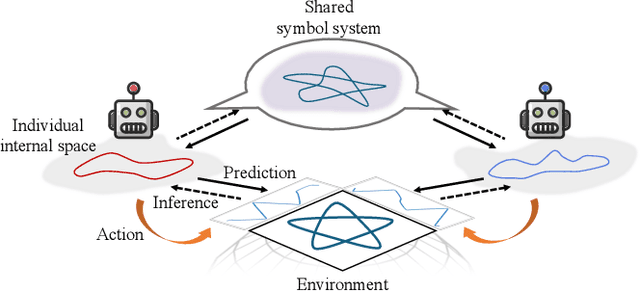
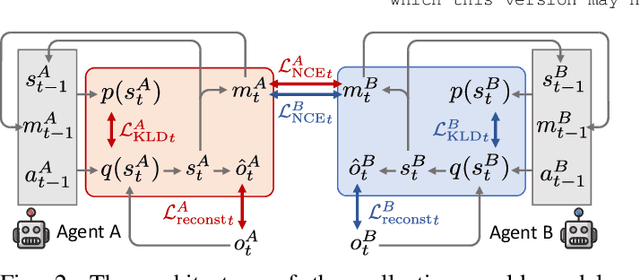
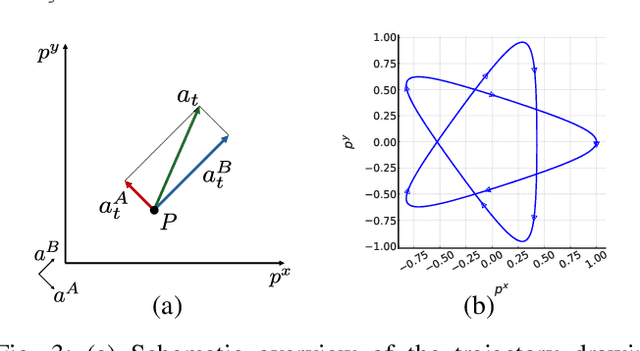
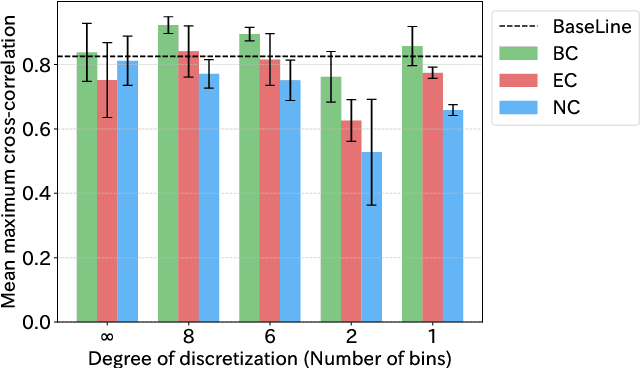
We propose a fully decentralized multi-agent world model that enables both symbol emergence for communication and coordinated behavior through temporal extension of collective predictive coding. Unlike previous research that focuses on either communication or coordination separately, our approach achieves both simultaneously. Our method integrates world models with communication channels, enabling agents to predict environmental dynamics, estimate states from partial observations, and share critical information through bidirectional message exchange with contrastive learning for message alignment. Using a two-agent trajectory drawing task, we demonstrate that our communication-based approach outperforms non-communicative models when agents have divergent perceptual capabilities, achieving the second-best coordination after centralized models. Importantly, our distributed approach with constraints preventing direct access to other agents' internal states facilitates the emergence of more meaningful symbol systems that accurately reflect environmental states. These findings demonstrate the effectiveness of decentralized communication for supporting coordination while developing shared representations of the environment.