 Add to Chrome
 Add to Firefox
 Add to Edge
Social Reality Construction via Active Inference: Modeling the Dialectic of Conformity and Creativity
Apr 10, 2026
Social agents both internalize collective norms and reshape them through creative action, yet computational models have not captured this bidirectional process within a unified framework. We propose a multi-agent simulation model grounded in active inference that formalizes the dialectical constitution of social reality on a structured social network. Each agent maintains an internal generative model, communicates with neighbors to form social priors, creates novel observations, and selectively incorporates others' creations into memory. Simulation experiments demonstrate three main findings. First, informationally cohesive social groups emerge endogenously, with representational alignment mirroring the cluster topology of the underlying network. Second, a circular mutual constitution arises between social representations and the observation distribution, maintained through agents' creative acts that project representational structure onto the external world. Third, the propagation of creations exhibits selective, heterogeneous patterns distinct from the stable diffusion of social representations, indicating that agents construct cultural niches through local interaction dynamics. These results suggest that the interplay between social conformity and creative deviation can give rise to the endogenous formation and differentiation of shared social reality.

Decentralized Collective World Model for Emergent Communication and Coordination
Apr 04, 2025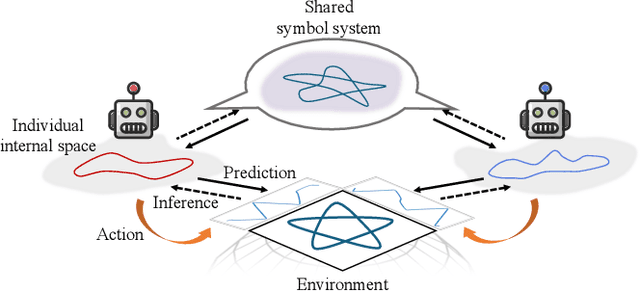
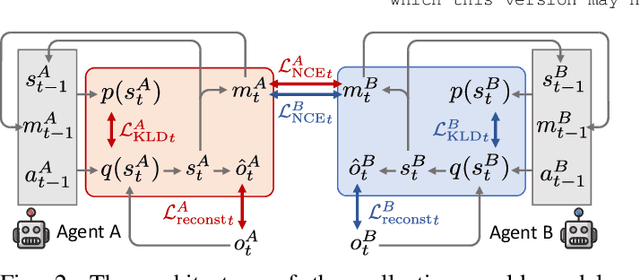
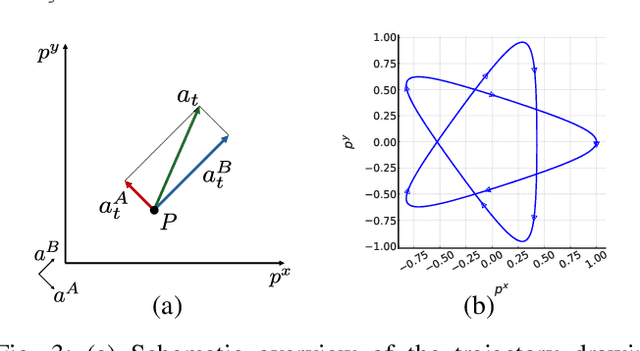
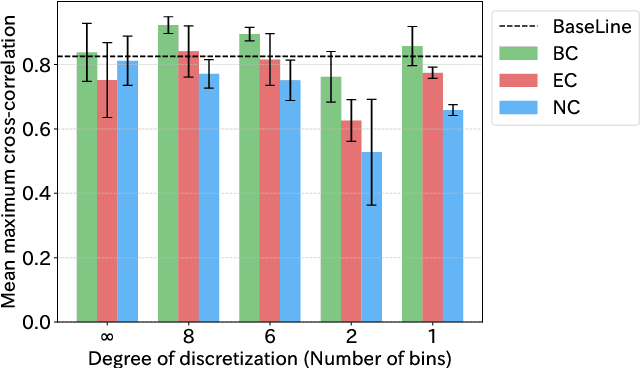
We propose a fully decentralized multi-agent world model that enables both symbol emergence for communication and coordinated behavior through temporal extension of collective predictive coding. Unlike previous research that focuses on either communication or coordination separately, our approach achieves both simultaneously. Our method integrates world models with communication channels, enabling agents to predict environmental dynamics, estimate states from partial observations, and share critical information through bidirectional message exchange with contrastive learning for message alignment. Using a two-agent trajectory drawing task, we demonstrate that our communication-based approach outperforms non-communicative models when agents have divergent perceptual capabilities, achieving the second-best coordination after centralized models. Importantly, our distributed approach with constraints preventing direct access to other agents' internal states facilitates the emergence of more meaningful symbol systems that accurately reflect environmental states. These findings demonstrate the effectiveness of decentralized communication for supporting coordination while developing shared representations of the environment.