 Add to Chrome
 Add to Firefox
 Add to Edge
Reducing Mental Workload through On-Demand Human Assistance for Physical Action Failures in LLM-based Multi-Robot Coordination
Mar 30, 2026
Multi-robot coordination based on large language models (LLMs) has attracted growing attention, since LLMs enable the direct translation of natural language instructions into robot action plans by decomposing tasks and generating high-level plans. However, recovering from physical execution failures remains difficult, and tasks often stagnate due to the repetition of the same unsuccessful actions. While frameworks for remote robot operation using Mixed Reality were proposed, there have been few attempts to implement remote error resolution specifically for physical failures in multi-robot environments. In this study, we propose REPAIR (Robot Execution with Planned And Interactive Recovery), a human-in-the-loop framework that integrates remote error resolution into LLM-based multi-robot planning. In this method, robots execute tasks autonomously; however, when an irrecoverable failure occurs, the LLM requests assistance from an operator, enabling task continuity through remote intervention. Evaluations using a multi-robot trash collection task in a real-world environment confirmed that REPAIR significantly improves task progress (the number of items cleared within a time limit) compared to fully autonomous methods. Furthermore, for easily collectable items, it achieved task progress equivalent to full remote control. The results also suggested that the mental workload on the operator may differ in terms of physical demand and effort. The project website is https://emergentsystemlabstudent.github.io/REPAIR/.

Multi-View Inpainting for RGB-D Sequence
Nov 22, 2018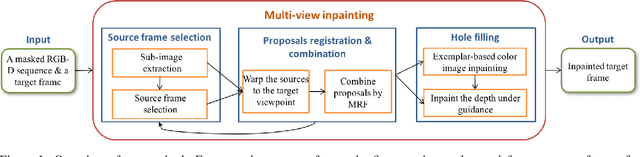
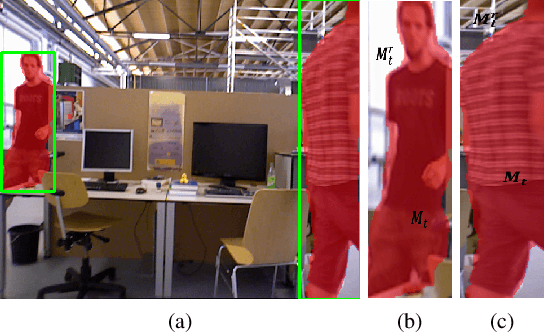
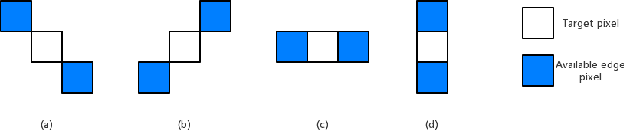
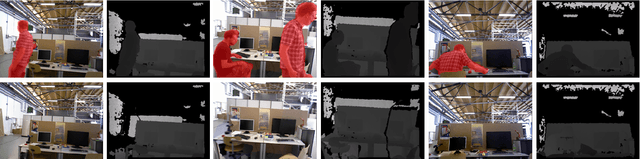
In this work we propose a novel approach to remove undesired objects from RGB-D sequences captured with freely moving cameras, which enables static 3D reconstruction. Our method jointly uses existing information from multiple frames as well as generates new one via inpainting techniques. We use balanced rules to select source frames; local homography based image warping method for alignment and Markov random field (MRF) based approach for combining existing information. For the left holes, we employ exemplar based multi-view inpainting method to deal with the color image and coherently use it as guidance to complete the depth correspondence. Experiments show that our approach is qualified for removing the undesired objects and inpainting the holes.
* 10 pages