 Add to Chrome
 Add to Firefox
 Add to Edge
BenHalluEval: A Multi-Task Hallucination Evaluation Framework for Large Language Models on Bengali
May 29, 2026
Despite Bengali being the sixth most spoken language in the world, no prior work has systematically evaluated hallucination in large language models (LLMs) for Bengali. We introduce BenHalluEval, a fine-grained hallucination evaluation framework for Bengali covering four tasks: Generative Question Answering (GQA), Bangla-English Code-Mixed QA, Summarization, and Reasoning. We construct 12,000 hallucinated candidates using GPT-5.4 across twelve task-specific hallucination types, drawn from three existing Bengali datasets, and evaluate seven LLMs spanning reasoning-oriented, multilingual, and Bengali-centric categories under a dual-track protocol that independently measures false-positive rate on ground-truth instances (Track A) and hallucination detection rate on hallucinated candidates (Track B). To jointly penalise both failure modes and prevent inflated scores from uniform response bias, we propose BenHalluScore, a dual-track calibration metric that ranges from 7.72% to 55.42% across models and tasks, revealing substantial variation in hallucination calibration. Chain-of-thought prompting, applied as a mitigation strategy, shifts response distributions without consistently improving hallucination discrimination. BenHalluEval establishes the first dedicated hallucination benchmark for Bengali and highlights the inadequacy of single-track and prompting-only evaluation approaches for low-resource language settings. The dataset and code are available at https://anonymous.4open.science/r/BanglaHalluEval-EB77.

When Not to Answer: Evaluating Prompts on GPT Models for Effective Abstention in Unanswerable Math Word Problems
Oct 16, 2024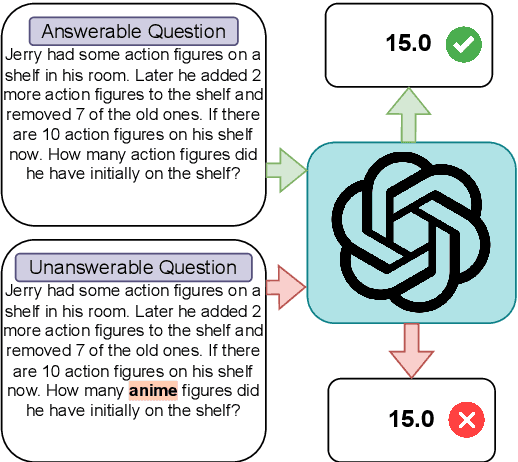
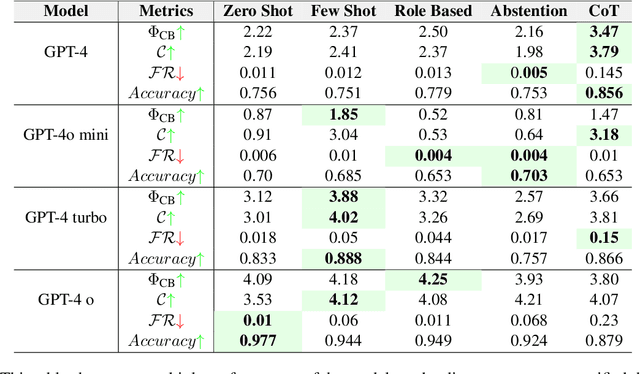
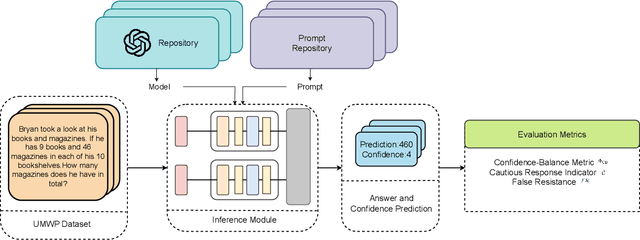

Large language models (LLMs) are increasingly relied upon to solve complex mathematical word problems. However, being susceptible to hallucination, they may generate inaccurate results when presented with unanswerable questions, raising concerns about their potential harm. While GPT models are now widely used and trusted, the exploration of how they can effectively abstain from answering unanswerable math problems and the enhancement of their abstention capabilities has not been rigorously investigated. In this paper, we investigate whether GPTs can appropriately respond to unanswerable math word problems by applying prompts typically used in solvable mathematical scenarios. Our experiments utilize the Unanswerable Word Math Problem (UWMP) dataset, directly leveraging GPT model APIs. Evaluation metrics are introduced, which integrate three key factors: abstention, correctness and confidence. Our findings reveal critical gaps in GPT models and the hallucination it suffers from for unsolvable problems, highlighting the need for improved models capable of better managing uncertainty and complex reasoning in math word problem-solving contexts.