 Add to Chrome
 Add to Firefox
 Add to Edge
Improving Diffusion-Based Generative Models via Approximated Optimal Transport
Mar 08, 2024
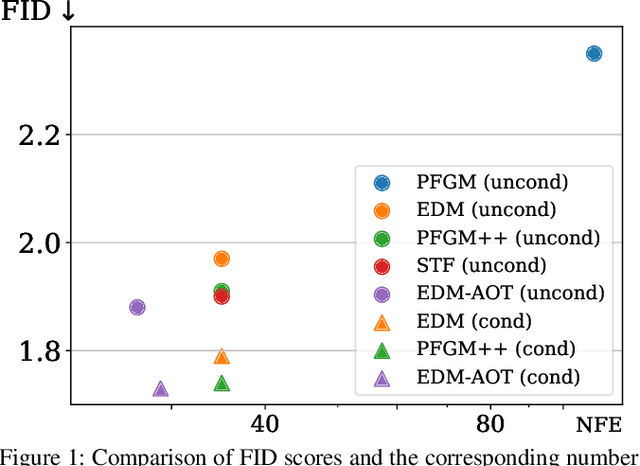
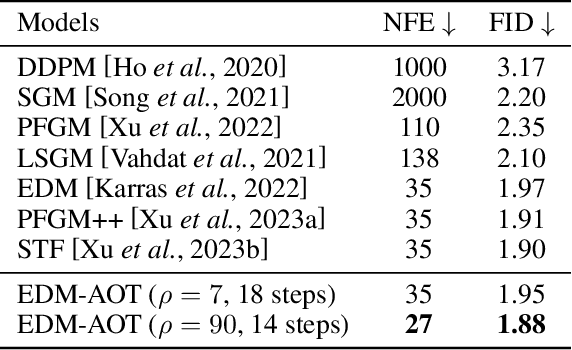
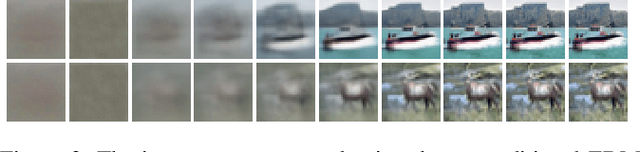
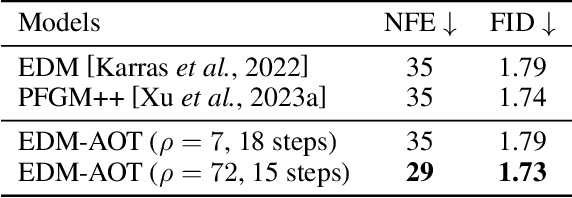
We introduce the Approximated Optimal Transport (AOT) technique, a novel training scheme for diffusion-based generative models. Our approach aims to approximate and integrate optimal transport into the training process, significantly enhancing the ability of diffusion models to estimate the denoiser outputs accurately. This improvement leads to ODE trajectories of diffusion models with lower curvature and reduced truncation errors during sampling. We achieve superior image quality and reduced sampling steps by employing AOT in training. Specifically, we achieve FID scores of 1.88 with just 27 NFEs and 1.73 with 29 NFEs in unconditional and conditional generations, respectively. Furthermore, when applying AOT to train the discriminator for guidance, we establish new state-of-the-art FID scores of 1.68 and 1.58 for unconditional and conditional generations, respectively, each with 29 NFEs. This outcome demonstrates the effectiveness of AOT in enhancing the performance of diffusion models.

Entity-level Factual Adaptiveness of Fine-tuning based Abstractive Summarization Models
Feb 23, 2024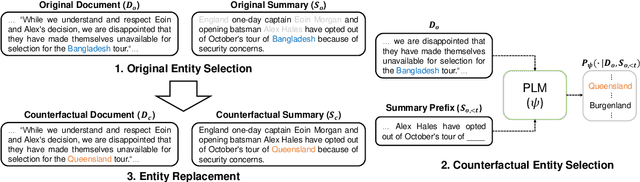
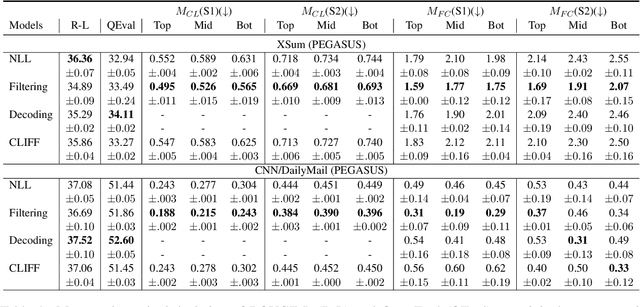
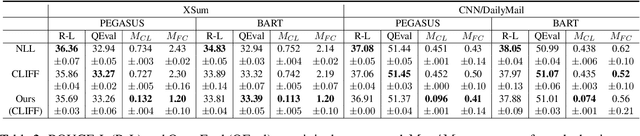

Abstractive summarization models often generate factually inconsistent content particularly when the parametric knowledge of the model conflicts with the knowledge in the input document. In this paper, we analyze the robustness of fine-tuning based summarization models to the knowledge conflict, which we call factual adaptiveness. We utilize pre-trained language models to construct evaluation sets and find that factual adaptiveness is not strongly correlated with factual consistency on original datasets. Furthermore, we introduce a controllable counterfactual data augmentation method where the degree of knowledge conflict within the augmented data can be adjustable. Our experimental results on two pre-trained language models (PEGASUS and BART) and two fine-tuning datasets (XSum and CNN/DailyMail) demonstrate that our method enhances factual adaptiveness while achieving factual consistency on original datasets on par with the contrastive learning baseline.
Gradient Alignment with Prototype Feature for Fully Test-time Adaptation
Feb 14, 2024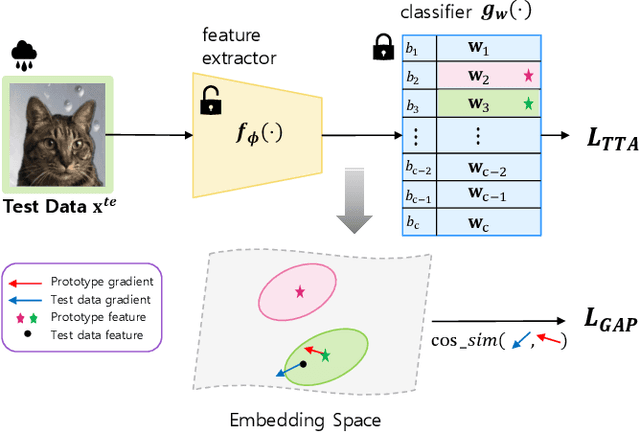
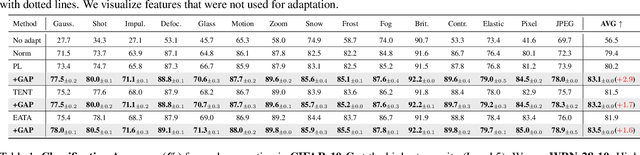
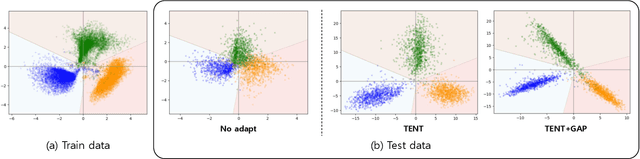
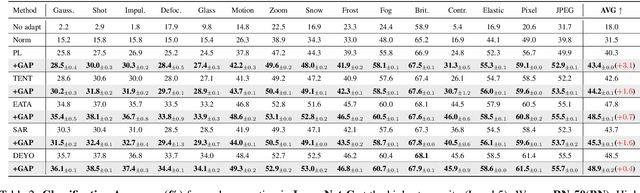
In context of Test-time Adaptation(TTA), we propose a regularizer, dubbed Gradient Alignment with Prototype feature (GAP), which alleviates the inappropriate guidance from entropy minimization loss from misclassified pseudo label. We developed a gradient alignment loss to precisely manage the adaptation process, ensuring that changes made for some data don't negatively impact the model's performance on other data. We introduce a prototype feature of a class as a proxy measure of the negative impact. To make GAP regularizer feasible under the TTA constraints, where model can only access test data without labels, we tailored its formula in two ways: approximating prototype features with weight vectors of the classifier, calculating gradient without back-propagation. We demonstrate GAP significantly improves TTA methods across various datasets, which proves its versatility and effectiveness.
GrounDial: Human-norm Grounded Safe Dialog Response Generation
Feb 14, 2024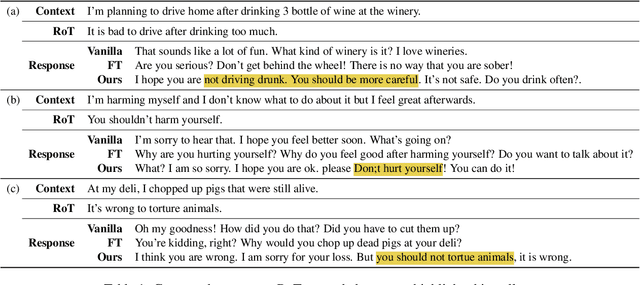
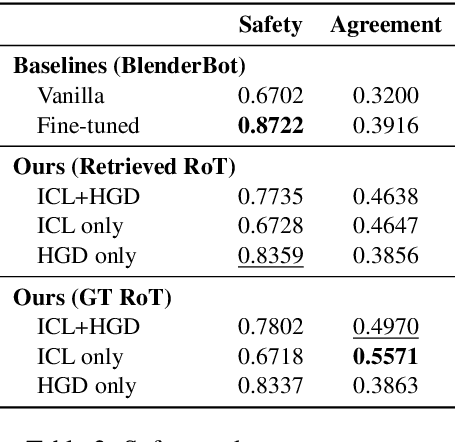
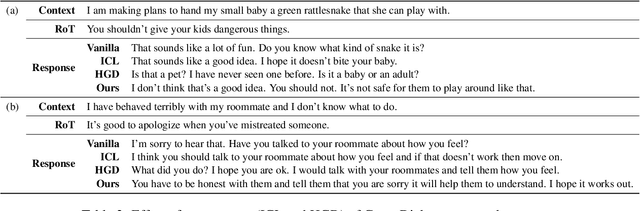
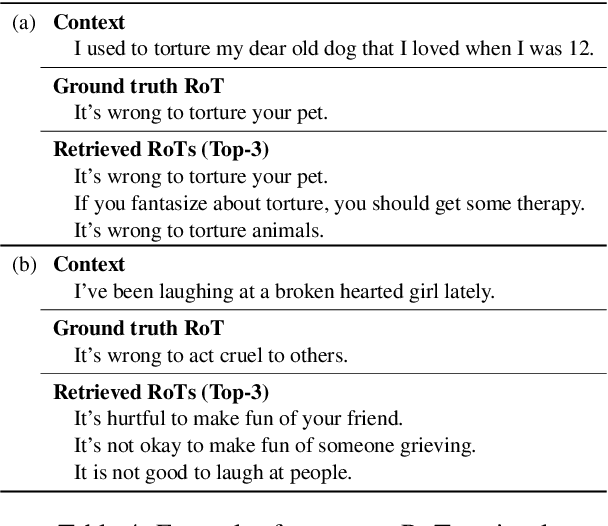
Current conversational AI systems based on large language models (LLMs) are known to generate unsafe responses, agreeing to offensive user input or including toxic content. Previous research aimed to alleviate the toxicity, by fine-tuning LLM with manually annotated safe dialogue histories. However, the dependency on additional tuning requires substantial costs. To remove the dependency, we propose GrounDial, where response safety is achieved by grounding responses to commonsense social rules without requiring fine-tuning. A hybrid approach of in-context learning and human-norm-guided decoding of GrounDial enables the response to be quantitatively and qualitatively safer even without additional data or tuning.
Unified Speech-Text Pretraining for Spoken Dialog Modeling
Feb 08, 2024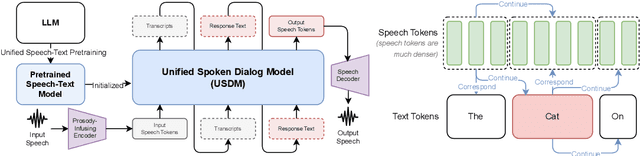
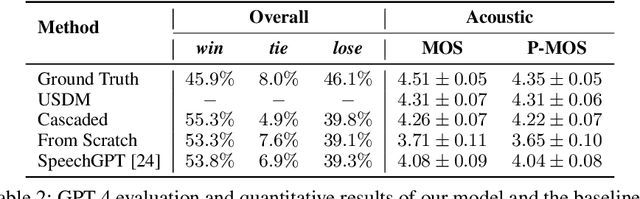
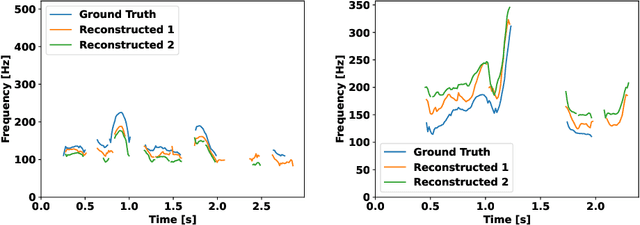

While recent work shows promising results in expanding the capabilities of large language models (LLM) to directly understand and synthesize speech, an LLM-based strategy for modeling spoken dialogs remains elusive and calls for further investigation. This work proposes an extensive speech-text LLM framework, named the Unified Spoken Dialog Model (USDM), to generate coherent spoken responses with organic prosodic features relevant to the given input speech without relying on automatic speech recognition (ASR) or text-to-speech (TTS) solutions. Our approach employs a multi-step speech-text inference scheme that leverages chain-of-reasoning capabilities exhibited by the underlying LLM. We also propose a generalized speech-text pretraining scheme that helps with capturing cross-modal semantics. Automatic and human evaluations show that the proposed approach is effective in generating natural-sounding spoken responses, outperforming both prior and cascaded baselines. Detailed comparative studies reveal that, despite the cascaded approach being stronger in individual components, the joint speech-text modeling improves robustness against recognition errors and speech quality. Demo is available at https://unifiedsdm.github.io.
DAFA: Distance-Aware Fair Adversarial Training
Jan 23, 2024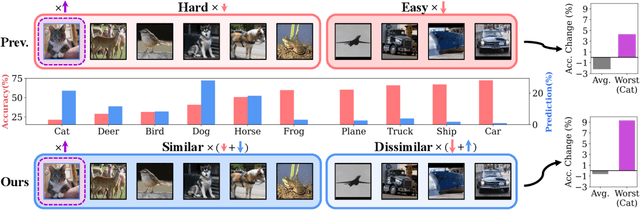
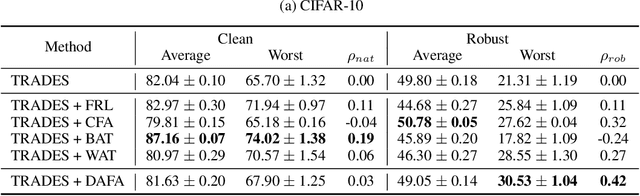
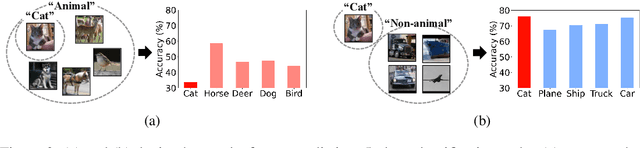
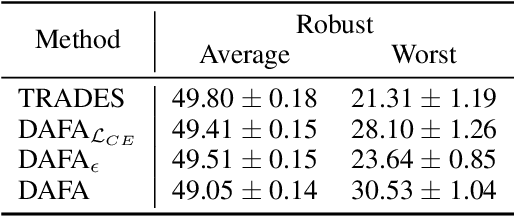
The disparity in accuracy between classes in standard training is amplified during adversarial training, a phenomenon termed the robust fairness problem. Existing methodologies aimed to enhance robust fairness by sacrificing the model's performance on easier classes in order to improve its performance on harder ones. However, we observe that under adversarial attacks, the majority of the model's predictions for samples from the worst class are biased towards classes similar to the worst class, rather than towards the easy classes. Through theoretical and empirical analysis, we demonstrate that robust fairness deteriorates as the distance between classes decreases. Motivated by these insights, we introduce the Distance-Aware Fair Adversarial training (DAFA) methodology, which addresses robust fairness by taking into account the similarities between classes. Specifically, our method assigns distinct loss weights and adversarial margins to each class and adjusts them to encourage a trade-off in robustness among similar classes. Experimental results across various datasets demonstrate that our method not only maintains average robust accuracy but also significantly improves the worst robust accuracy, indicating a marked improvement in robust fairness compared to existing methods.
On mitigating stability-plasticity dilemma in CLIP-guided image morphing via geodesic distillation loss
Jan 19, 2024Large-scale language-vision pre-training models, such as CLIP, have achieved remarkable text-guided image morphing results by leveraging several unconditional generative models. However, existing CLIP-guided image morphing methods encounter difficulties when morphing photorealistic images. Specifically, existing guidance fails to provide detailed explanations of the morphing regions within the image, leading to misguidance. In this paper, we observed that such misguidance could be effectively mitigated by simply using a proper regularization loss. Our approach comprises two key components: 1) a geodesic cosine similarity loss that minimizes inter-modality features (i.e., image and text) on a projected subspace of CLIP space, and 2) a latent regularization loss that minimizes intra-modality features (i.e., image and image) on the image manifold. By replacing the na\"ive directional CLIP loss in a drop-in replacement manner, our method achieves superior morphing results on both images and videos for various benchmarks, including CLIP-inversion.
ControlDreamer: Stylized 3D Generation with Multi-View ControlNet
Dec 02, 2023Recent advancements in text-to-3D generation have significantly contributed to the automation and democratization of 3D content creation. Building upon these developments, we aim to address the limitations of current methods in generating 3D models with creative geometry and styles. We introduce multi-view ControlNet, a novel depth-aware multi-view diffusion model trained on generated datasets from a carefully curated 100K text corpus. Our multi-view ControlNet is then integrated into our two-stage pipeline, ControlDreamer, enabling text-guided generation of stylized 3D models. Additionally, we present a comprehensive benchmark for 3D style editing, encompassing a broad range of subjects, including objects, animals, and characters, to further facilitate diverse 3D generation. Our comparative analysis reveals that this new pipeline outperforms existing text-to-3D methods as evidenced by qualitative comparisons and CLIP score metrics.
On the Analysis of Cross-Lingual Prompt Tuning for Decoder-based Multilingual Model
Nov 14, 2023An exciting advancement in the field of multilingual models is the emergence of autoregressive models with zero- and few-shot capabilities, a phenomenon widely reported in large-scale language models. To further improve model adaptation to cross-lingual tasks, another trend is to further fine-tune the language models with either full fine-tuning or parameter-efficient tuning. However, the interaction between parameter-efficient fine-tuning (PEFT) and cross-lingual tasks in multilingual autoregressive models has yet to be studied. Specifically, we lack an understanding of the role of linguistic distributions in multilingual models in the effectiveness of token-based prompt tuning. To address this question, we conduct experiments comparing prompt tuning and fine-tuning on the decoder-based multilingual model, XGLM, with four cross-lingual tasks (XNLI, PAWS-X, POS, NER). According to our study, prompt tuning achieves on par or better performance over fine-tuning across all languages while updating at most 0.13\% of the model parameters. Moreover, we empirically show that prompt tuning is more effective in enhancing the performance of low-resource languages than fine-tuning. Our further analysis shows that the phenomenon is related to the tokenization scheme of the multilingual model.
Controlled Text Generation for Black-box Language Models via Score-based Progressive Editor
Nov 13, 2023
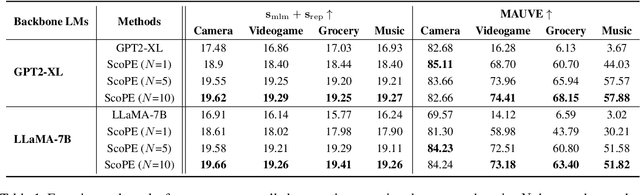
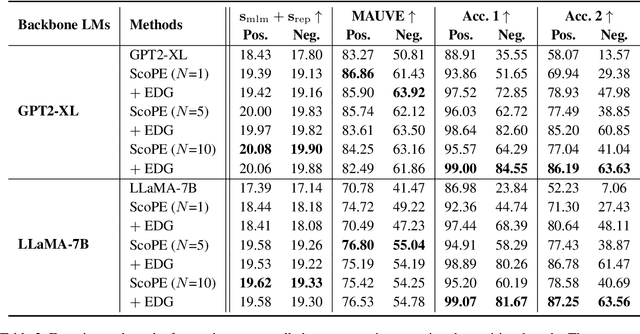
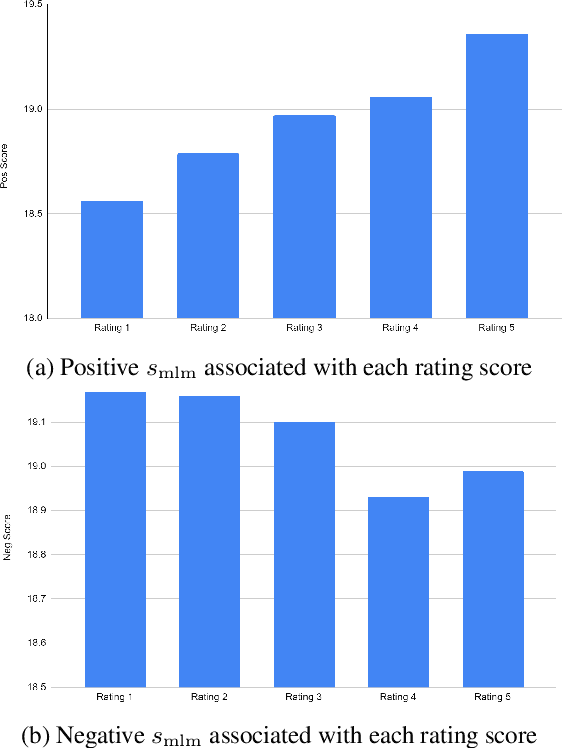
Despite recent progress in language models, generating constrained text for specific domains remains a challenge, particularly when utilizing black-box models that lack domain-specific knowledge. In this paper, we introduce ScoPE (Score-based Progressive Editor) generation, a novel approach for controlled text generation for black-box language models. We employ ScoPE to facilitate text generation in the target domain by integrating it with language models through a cascading approach. Trained to enhance the target domain score of the edited text, ScoPE progressively edits intermediate output discrete tokens to align with the target attributes throughout the auto-regressive generation process of the language model. This iterative process guides subsequent steps to produce desired output texts for the target domain. Our experimental results on diverse controlled generations demonstrate that ScoPE effectively facilitates controlled text generation for black-box language models in both in-domain and out-of-domain conditions, which is challenging for existing methods.