 Add to Chrome
 Add to Firefox
 Add to Edge
SUN: Shared Use of Next-token Prediction for Efficient Multi-LLM Disaggregated Serving
Mar 03, 2026
In multi-model LLM serving, decode execution remains inefficient due to model-specific resource partitioning: since cross-model batching is not possible, memory-bound decoding often suffers from severe GPU underutilization, especially under skewed workloads. We propose Shared Use of Next-token Prediction (SUN), the first approach that enables cross-model sharing of decode execution in disaggregated multi-LLM serving. SUN decomposes a decoder-only Transformer into a prefill module and a decode module, and fine-tunes only the task-specific prefill module, enabling a frozen decode module to be shared across models. This design enables a model-agnostic decode routing policy that balances decode requests across shared workers to maximize utilization. Across diverse tasks and model families, SUN achieves accuracy comparable to full fine-tuning while maintaining system throughput with fewer decode workers. In particular, SUN improves throughput per GPU by up to 2.0x over conventional disaggregation while keeping time-per-output-token (TPOT) within 5%. SUN inherently enables and facilitates low-bit decoding; with Quantized SUN (QSUN), it achieves a 45% speedup with comparable accuracy to SUN while preserving the benefits of shared decoding.

Affine-Scaled Attention: Towards Flexible and Stable Transformer Attention
Feb 26, 2026Transformer attention is typically implemented using softmax normalization, which enforces attention weights with unit sum normalization. While effective in many settings, this constraint can limit flexibility in controlling attention magnitudes and may contribute to overly concentrated or unstable attention patterns during training. Prior work has explored modifications such as attention sinks or gating mechanisms, but these approaches provide only limited or indirect control over attention reweighting. We propose Affine-Scaled Attention, a simple extension to standard attention that introduces input-dependent scaling and a corresponding bias term applied to softmax-normalized attention weights. This design relaxes the strict normalization constraint while maintaining aggregation of value representations, allowing the model to adjust both the relative distribution and the scale of attention in a controlled manner. We empirically evaluate Affine-Scaled Attention in large-scale language model pretraining across multiple model sizes. Experimental results show consistent improvements in training stability, optimization behavior, and downstream task performance compared to standard softmax attention and attention sink baselines. These findings suggest that modest reweighting of attention outputs provides a practical and effective way to improve attention behavior in Transformer models.
PrefillShare: A Shared Prefill Module for KV Reuse in Multi-LLM Disaggregated Serving
Feb 12, 2026Multi-agent systems increasingly orchestrate multiple specialized language models to solve complex real-world problems, often invoking them over a shared context. This execution pattern repeatedly processes the same prompt prefix across models. Consequently, each model redundantly executes the prefill stage and maintains its own key-value (KV) cache, increasing aggregate prefill load and worsening tail latency by intensifying prefill-decode interference in existing LLM serving stacks. Disaggregated serving reduces such interference by placing prefill and decode on separate GPUs, but disaggregation does not fundamentally eliminate inter-model redundancy in computation and KV storage for the same prompt. To address this issue, we propose PrefillShare, a novel algorithm that enables sharing the prefill stage across multiple models in a disaggregated setting. PrefillShare factorizes the model into prefill and decode modules, freezes the prefill module, and fine-tunes only the decode module. This design allows multiple task-specific models to share a prefill module and the KV cache generated for the same prompt. We further introduce a routing mechanism that enables effective prefill sharing across heterogeneous models in a vLLM-based disaggregated system. PrefillShare not only matches full fine-tuning accuracy on a broad range of tasks and models, but also delivers 4.5x lower p95 latency and 3.9x higher throughput in multi-model agent workloads.
DropBP: Accelerating Fine-Tuning of Large Language Models by Dropping Backward Propagation
Feb 27, 2024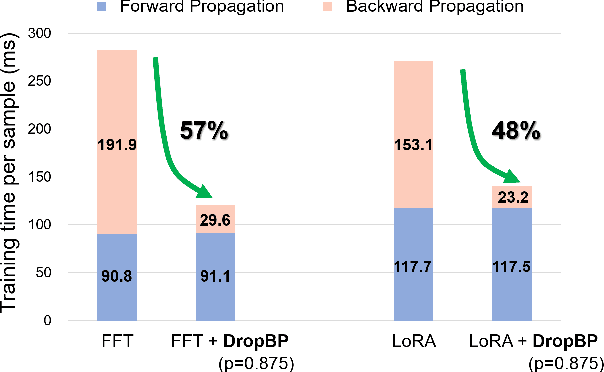
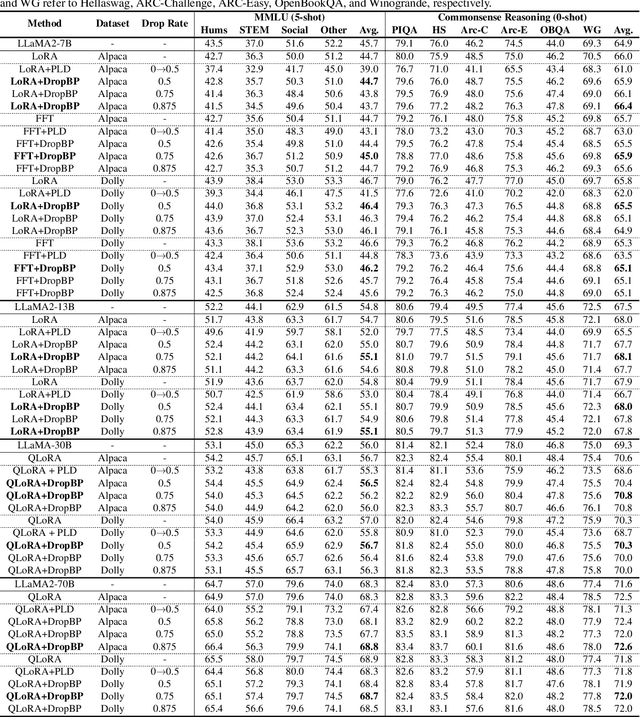

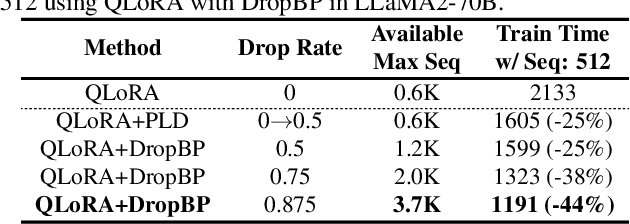
Training deep neural networks typically involves substantial computational costs during both forward and backward propagation. The conventional layer dropping techniques drop certain layers during training for reducing the computations burden. However, dropping layers during forward propagation adversely affects the training process by degrading accuracy. In this paper, we propose Dropping Backward Propagation (DropBP), a novel approach designed to reduce computational costs while maintaining accuracy. DropBP randomly drops layers during the backward propagation, which does not deviate forward propagation. Moreover, DropBP calculates the sensitivity of each layer to assign appropriate drop rate, thereby stabilizing the training process. DropBP is designed to enhance the efficiency of the training process with backpropagation, thereby enabling the acceleration of both full fine-tuning and parameter-efficient fine-tuning using backpropagation. Specifically, utilizing DropBP in QLoRA reduces training time by 44%, increases the convergence speed to the identical loss level by 1.5$\times$, and enables training with a 6.2$\times$ larger sequence length on a single NVIDIA-A100 80GiB GPU in LLaMA2-70B. The code is available at https://github.com/WooSunghyeon/dropbp.