 Add to Chrome
 Add to Firefox
 Add to Edge
Answer-Conditioned Chains of Thought Degrade Verifiable-Reasoning Distillation in Large Language Models
Jul 16, 2026
A standard recipe for distilling the reasoning ability of large language models (LLMs) is to sample chains of thought from the model, keep those that reach the correct final answer, and fine-tune on the survivors. When sampling fails, a common fix shows the generator the gold answer and asks it to write a chain that reaches that answer. We show that this second step degrades the training data in a way that correctness filtering cannot catch. We run a controlled experiment that fixes the generator, the problem set, and the correctness filter, and varies only whether the chain is generated under answer-conditioning, the gold answer shown with a request to reach it. Training a strong instruction-tuned reasoning model on its own answer-conditioned chains sharply lowers its verifiable-reasoning accuracy. The loss grows with difficulty, reaching as much as about 27 points on the hardest competition problems. The mechanism is legible in the chains themselves, which rationalize backward from the shown answer instead of deriving it, with the early final-answer statement as the measurable symptom. The harm is a property of the data rather than the generator, read off unlabeled generations before any fine-tuning, ordering the penalty across eight thinking models from four families, and transferring across teacher families. A prompt ablation localizes it to the rationalize-toward instruction rather than the answer's bare visibility. The practical takeaway is to generate answer-blind, because no correctness filter can see this damage in the data.

DART: Draft-Agreement Routing for Training-Free Adaptive Thinking Budgets in Hybrid Reasoning Models
Jun 22, 2026Hybrid reasoning models can answer directly or spend extra tokens on extended thinking. A practical router should choose between these modes for each query, so easy problems avoid unnecessary reasoning and hard problems receive enough budget to finish the answer. Existing routers move in this direction, but they typically require labeled training data or fix thinking budgets up front, ignoring answer-level evidence from the model itself. We introduce DART, a training-free routing framework that samples two cheap no-think drafts, accepts direct answering when the drafts agree, and predicts a thinking budget from draft entropy when they disagree. Across the main comparisons, DART preserves or improves always-thinking accuracy in most settings while reducing thinking-token use. On math reasoning, accuracy improves by up to $+$9.0 points on Olympiad-level problems while thinking tokens drop 15-69%. On code reasoning under execution-based equivalence, accuracy improves by up to +22.5 points while thinking tokens drop 51-63%. The Stage~1 signal extends across model scales (0.6B-32B), model families, and API-only hosted settings, with no labeled data and no gradient updates required.
Skin-Deep: A Geometric Diagnostic for Alignment Fragility in Large Language Model Representations
Jun 21, 2026Alignment tuning is meant to make harmful-request refusal robust, yet this safety behavior can be erased by a small set of benign fine-tuning examples. This is a deployment risk for open-weight models because a checkpoint can pass refusal tests at release time and later lose refusal under low-cost downstream fine-tuning. Prior work has established these refusal failures, but existing studies do not show how to detect this fragility in the aligned model itself before an attack or fine-tuning intervention is run. We introduce Skin-Deep, a geometric diagnostic that detects alignment fragility directly from the aligned model's hidden-state activations before such an intervention is run and compresses the layer-wise safety geometry into a single scalar, the Geometric Fragility Score (GFS). Applied to twenty-one instruction-tuned models spanning six alignment recipes and 3B--32B parameters, Skin-Deep reveals a recurring low-rank safety subspace across model families. Direction ablations show that removing directions in this subspace weakens harmful-request refusal, providing causal evidence that the recovered geometry underlies refusal behavior. Crucially, GFS identifies, before any fine-tuning, the initially safe model that retains the most refusal after small-scale LoRA fine-tuning. These results establish GFS as a practical pre-deployment diagnostic for flagging fragile refusal behavior without running an attack.
Unveiling the Limits of Large Language Models in Inferring Pragmatic Meaning from Non-Verbal Responses
Jun 01, 2026Although large language models (LLMs) have shown considerable progress in pragmatic language understanding, prior research has focused mainly on their comprehension of verbal behavior. Nonetheless, non-verbal behavior remains a fundamental component of human communication, especially when deliberately utilized in isolation to convey indirect meanings. In this work, we present the first systematic evaluation of LLMs' ability to infer pragmatic meaning in dialogue consisting solely of non-verbal responses. We explore three research questions: (1) Can LLMs recognize indirect intent conveyed through non-verbal responses? (2) When and how do LLMs fail to capture non-verbal intent? (3) How can we improve LLMs' ability to interpret non-verbal intent?. Through the evaluation, we observe that LLMs struggle to infer underlying meaning from non-verbal responses, with accuracy dropping by up to 60% points compared to verbal ones. Further extensive analysis reveals a behavioral pattern in LLMs' interpretations of non-verbal behavior and demonstrates that in-context learning facilitates pragmatic inference.
Debate Only When Necessary: Adaptive Multiagent Collaboration for Efficient LLM Reasoning
Apr 07, 2025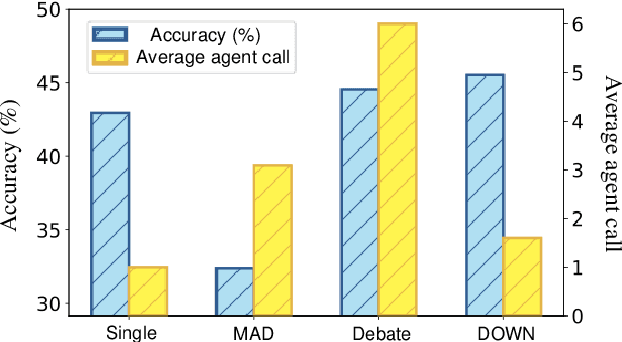
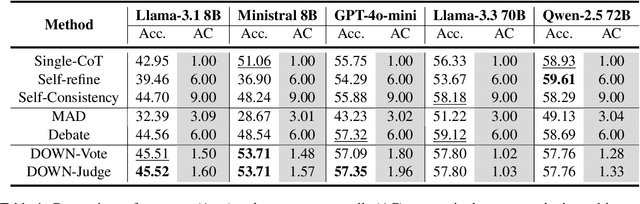
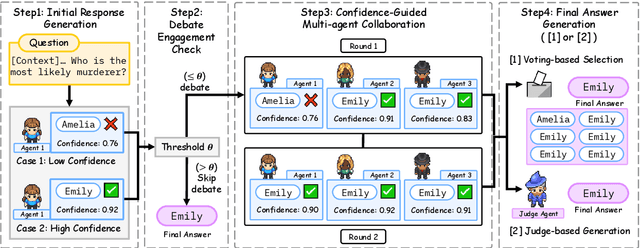
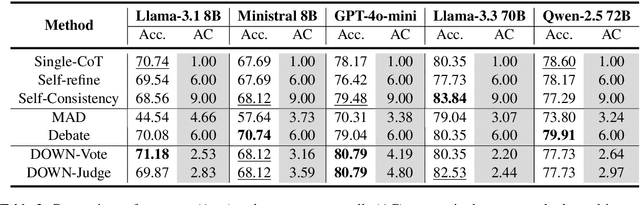
Multiagent collaboration has emerged as a promising framework for enhancing the reasoning capabilities of large language models (LLMs). While this approach improves reasoning capability, it incurs substantial computational overhead due to iterative agent interactions. Furthermore, engaging in debates for queries that do not necessitate collaboration amplifies the risk of error generation. To address these challenges, we propose Debate Only When Necessary (DOWN), an adaptive multiagent debate framework that selectively activates the debate process based on the confidence score of the agent's initial response. For queries where debate is triggered, agents refine their outputs using responses from participating agents and their confidence scores. Experimental results demonstrate that this mechanism significantly improves efficiency while maintaining or even surpassing the performance of existing multiagent debate systems. We also find that confidence-guided debate mitigates error propagation and enhances the selective incorporation of reliable responses. These results establish DOWN as an optimization strategy for efficient and effective multiagent reasoning, facilitating the practical deployment of LLM-based collaboration.
Toward Practical Automatic Speech Recognition and Post-Processing: a Call for Explainable Error Benchmark Guideline
Jan 26, 2024Automatic speech recognition (ASR) outcomes serve as input for downstream tasks, substantially impacting the satisfaction level of end-users. Hence, the diagnosis and enhancement of the vulnerabilities present in the ASR model bear significant importance. However, traditional evaluation methodologies of ASR systems generate a singular, composite quantitative metric, which fails to provide comprehensive insight into specific vulnerabilities. This lack of detail extends to the post-processing stage, resulting in further obfuscation of potential weaknesses. Despite an ASR model's ability to recognize utterances accurately, subpar readability can negatively affect user satisfaction, giving rise to a trade-off between recognition accuracy and user-friendliness. To effectively address this, it is imperative to consider both the speech-level, crucial for recognition accuracy, and the text-level, critical for user-friendliness. Consequently, we propose the development of an Error Explainable Benchmark (EEB) dataset. This dataset, while considering both speech- and text-level, enables a granular understanding of the model's shortcomings. Our proposition provides a structured pathway for a more `real-world-centric' evaluation, a marked shift away from abstracted, traditional methods, allowing for the detection and rectification of nuanced system weaknesses, ultimately aiming for an improved user experience.
Synthetic Alone: Exploring the Dark Side of Synthetic Data for Grammatical Error Correction
Jun 26, 2023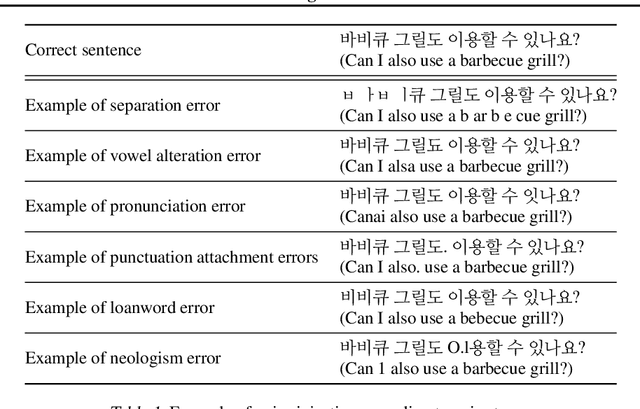
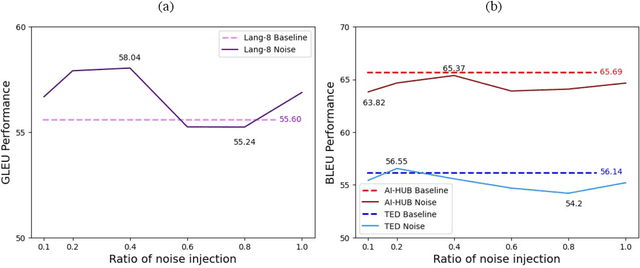

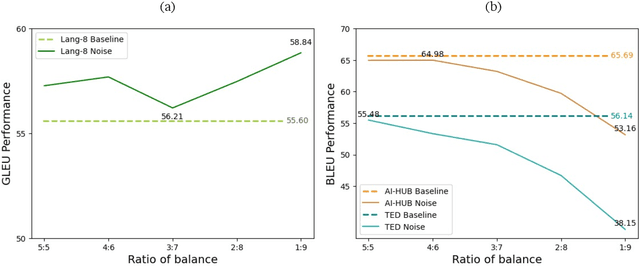
Data-centric AI approach aims to enhance the model performance without modifying the model and has been shown to impact model performance positively. While recent attention has been given to data-centric AI based on synthetic data, due to its potential for performance improvement, data-centric AI has long been exclusively validated using real-world data and publicly available benchmark datasets. In respect of this, data-centric AI still highly depends on real-world data, and the verification of models using synthetic data has not yet been thoroughly carried out. Given the challenges above, we ask the question: Does data quality control (noise injection and balanced data), a data-centric AI methodology acclaimed to have a positive impact, exhibit the same positive impact in models trained solely with synthetic data? To address this question, we conducted comparative analyses between models trained on synthetic and real-world data based on grammatical error correction (GEC) task. Our experimental results reveal that the data quality control method has a positive impact on models trained with real-world data, as previously reported in existing studies, while a negative impact is observed in models trained solely on synthetic data.
Towards Diverse and Effective Question-Answer Pair Generation from Children Storybooks
Jun 11, 2023Recent advances in QA pair generation (QAG) have raised interest in applying this technique to the educational field. However, the diversity of QA types remains a challenge despite its contributions to comprehensive learning and assessment of children. In this paper, we propose a QAG framework that enhances QA type diversity by producing different interrogative sentences and implicit/explicit answers. Our framework comprises a QFS-based answer generator, an iterative QA generator, and a relevancy-aware ranker. The two generators aim to expand the number of candidates while covering various types. The ranker trained on the in-context negative samples clarifies the top-N outputs based on the ranking score. Extensive evaluations and detailed analyses demonstrate that our approach outperforms previous state-of-the-art results by significant margins, achieving improved diversity and quality. Our task-oriented processes are consistent with real-world demand, which highlights our system's high applicability.
Self-Improving-Leaderboard: A Call for Real-World Centric Natural Language Processing Leaderboards
Mar 20, 2023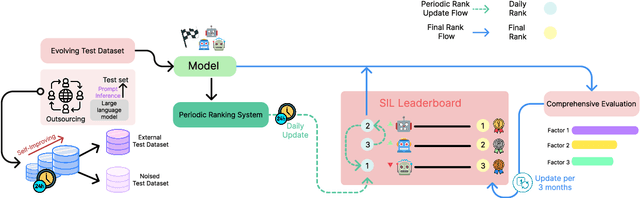
Leaderboard systems allow researchers to objectively evaluate Natural Language Processing (NLP) models and are typically used to identify models that exhibit superior performance on a given task in a predetermined setting. However, we argue that evaluation on a given test dataset is just one of many performance indications of the model. In this paper, we claim leaderboard competitions should also aim to identify models that exhibit the best performance in a real-world setting. We highlight three issues with current leaderboard systems: (1) the use of a single, static test set, (2) discrepancy between testing and real-world application (3) the tendency for leaderboard-centric competition to be biased towards the test set. As a solution, we propose a new paradigm of leaderboard systems that addresses these issues of current leaderboard system. Through this study, we hope to induce a paradigm shift towards more real -world-centric leaderboard competitions.
QUAK: A Synthetic Quality Estimation Dataset for Korean-English Neural Machine Translation
Sep 30, 2022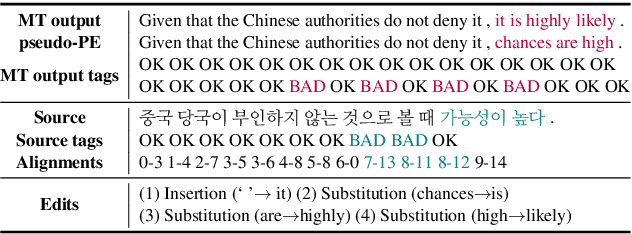
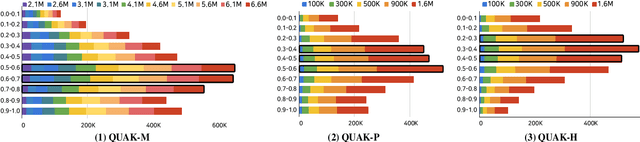
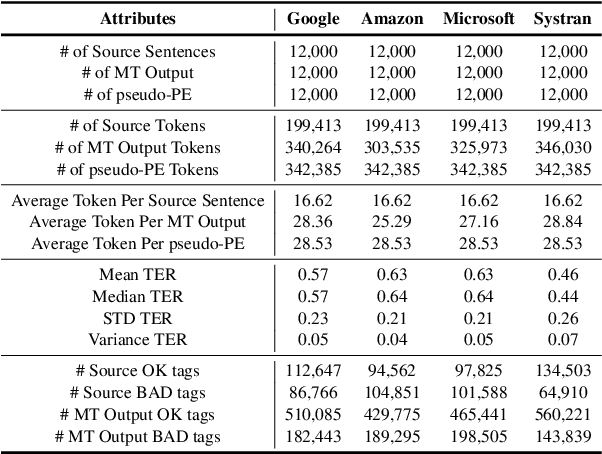
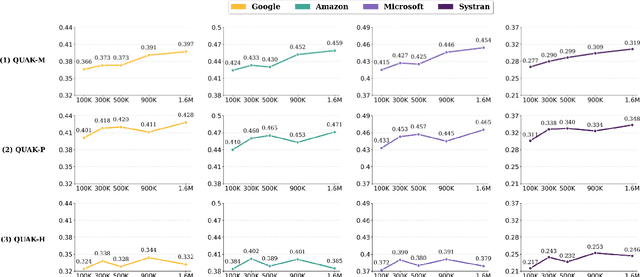
With the recent advance in neural machine translation demonstrating its importance, research on quality estimation (QE) has been steadily progressing. QE aims to automatically predict the quality of machine translation (MT) output without reference sentences. Despite its high utility in the real world, there remain several limitations concerning manual QE data creation: inevitably incurred non-trivial costs due to the need for translation experts, and issues with data scaling and language expansion. To tackle these limitations, we present QUAK, a Korean-English synthetic QE dataset generated in a fully automatic manner. This consists of three sub-QUAK datasets QUAK-M, QUAK-P, and QUAK-H, produced through three strategies that are relatively free from language constraints. Since each strategy requires no human effort, which facilitates scalability, we scale our data up to 1.58M for QUAK-P, H and 6.58M for QUAK-M. As an experiment, we quantitatively analyze word-level QE results in various ways while performing statistical analysis. Moreover, we show that datasets scaled in an efficient way also contribute to performance improvements by observing meaningful performance gains in QUAK-M, P when adding data up to 1.58M.