 Add to Chrome
 Add to Firefox
 Add to Edge
FiCA: Feed-forward instant Gaussian Codec Avatars from a Single Portrait Image
Jun 23, 2026
We introduce FiCA, a Feed-forward, instant Gaussian Codec Avatar generation pipeline that creates lifelike avatars from a single portrait image. Generating a photorealistic and drivable avatar from just a single image is significantly challenging due to the limited visual information available to accurately infer the 3D appearance and geometry of human heads. To address this, we develop a novel system that combines human-centric vision foundation models with a diffusion model. This system is designed to fully exploit partial visual observations to generate lifelike human avatars. Our proposed diffusion model learns a generative mapping from these partial observations to complete and authentic 3D mesh reconstruction. Additionally, we introduce a feed-forward mesh refinement network that enhances the fidelity and identity preservation of the generated avatars, eliminating the need for person-specific test-time optimization. By leveraging a universal prior model that decodes a generated mesh into a set of 3D Gaussians, we generate a photorealistic 3D Gaussian avatar, capable of being driven with novel expressions in real-time. Our experiments demonstrate that the avatars generated by our feed-forward approach faithfully represent diverse identities and surpass the visual quality of avatars produced by recent competing methods.

Sapiens2
Apr 23, 2026We present Sapiens2, a model family of high-resolution transformers for human-centric vision focused on generalization, versatility, and high-fidelity outputs. Our model sizes range from 0.4 to 5 billion parameters, with native 1K resolution and hierarchical variants that support 4K. Sapiens2 substantially improves over its predecessor in both pretraining and post-training. First, to learn features that capture low-level details (for dense prediction) and high-level semantics (for zero-shot or few-label settings), we combine masked image reconstruction with self-distilled contrastive objectives. Our evaluations show that this unified pretraining objective is better suited for a wider range of downstream tasks. Second, along the data axis, we pretrain on a curated dataset of 1 billion high-quality human images and improve the quality and quantity of task annotations. Third, architecturally, we incorporate advances from frontier models that enable longer training schedules with improved stability. Our 4K models adopt windowed attention to reason over longer spatial context and are pretrained with 2K output resolution. Sapiens2 sets a new state-of-the-art and improves over the first generation on pose (+4 mAP), body-part segmentation (+24.3 mIoU), normal estimation (45.6% lower angular error) and extends to new tasks such as pointmap and albedo estimation. Code: https://github.com/facebookresearch/sapiens2
Pippo: High-Resolution Multi-View Humans from a Single Image
Feb 11, 2025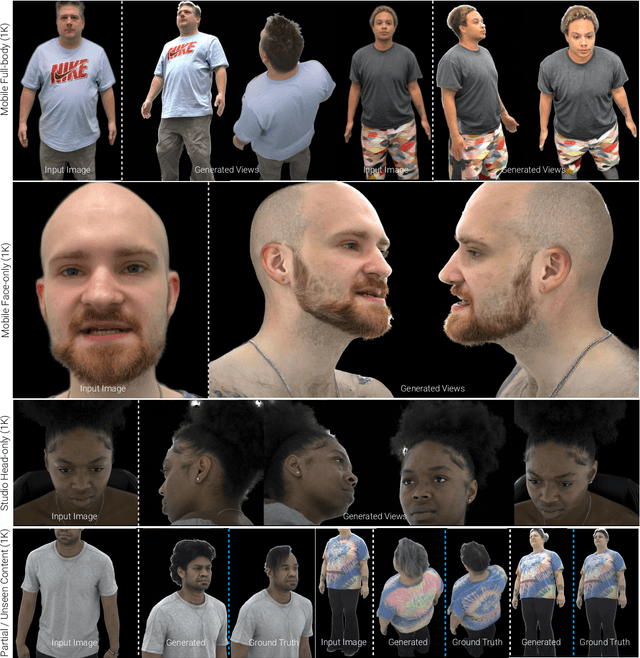
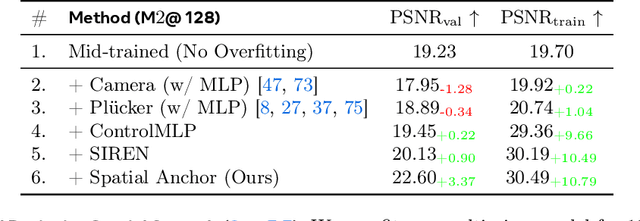
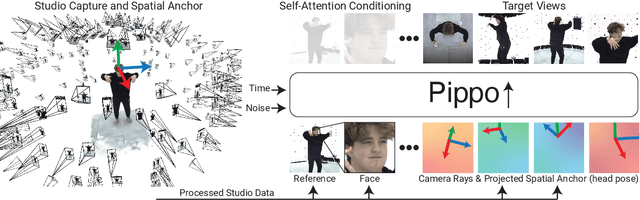
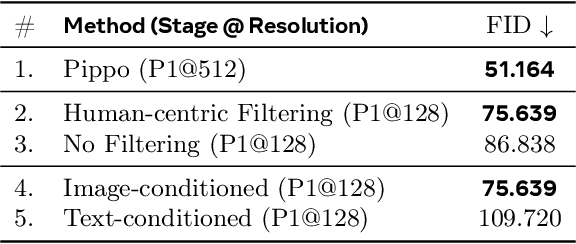
We present Pippo, a generative model capable of producing 1K resolution dense turnaround videos of a person from a single casually clicked photo. Pippo is a multi-view diffusion transformer and does not require any additional inputs - e.g., a fitted parametric model or camera parameters of the input image. We pre-train Pippo on 3B human images without captions, and conduct multi-view mid-training and post-training on studio captured humans. During mid-training, to quickly absorb the studio dataset, we denoise several (up to 48) views at low-resolution, and encode target cameras coarsely using a shallow MLP. During post-training, we denoise fewer views at high-resolution and use pixel-aligned controls (e.g., Spatial anchor and Plucker rays) to enable 3D consistent generations. At inference, we propose an attention biasing technique that allows Pippo to simultaneously generate greater than 5 times as many views as seen during training. Finally, we also introduce an improved metric to evaluate 3D consistency of multi-view generations, and show that Pippo outperforms existing works on multi-view human generation from a single image.
Sapiens: Foundation for Human Vision Models
Aug 22, 2024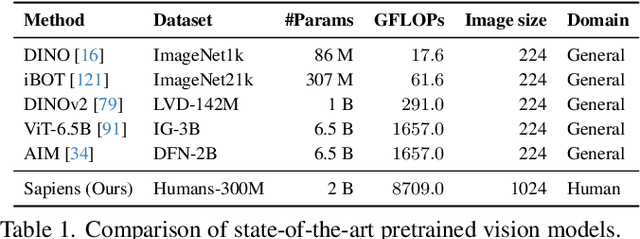
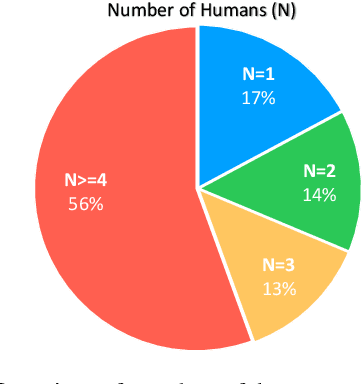
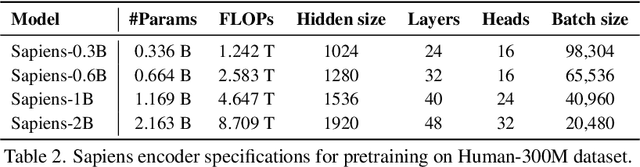
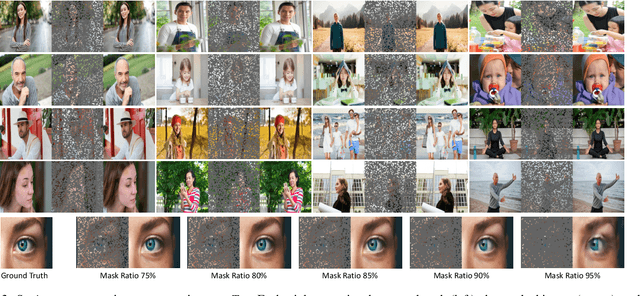
We present Sapiens, a family of models for four fundamental human-centric vision tasks - 2D pose estimation, body-part segmentation, depth estimation, and surface normal prediction. Our models natively support 1K high-resolution inference and are extremely easy to adapt for individual tasks by simply fine-tuning models pretrained on over 300 million in-the-wild human images. We observe that, given the same computational budget, self-supervised pretraining on a curated dataset of human images significantly boosts the performance for a diverse set of human-centric tasks. The resulting models exhibit remarkable generalization to in-the-wild data, even when labeled data is scarce or entirely synthetic. Our simple model design also brings scalability - model performance across tasks improves as we scale the number of parameters from 0.3 to 2 billion. Sapiens consistently surpasses existing baselines across various human-centric benchmarks. We achieve significant improvements over the prior state-of-the-art on Humans-5K (pose) by 7.6 mAP, Humans-2K (part-seg) by 17.1 mIoU, Hi4D (depth) by 22.4% relative RMSE, and THuman2 (normal) by 53.5% relative angular error.