 Add to Chrome
 Add to Firefox
 Add to Edge
MoralityGym: A Benchmark for Evaluating Hierarchical Moral Alignment in Sequential Decision-Making Agents
Feb 13, 2026
Evaluating moral alignment in agents navigating conflicting, hierarchically structured human norms is a critical challenge at the intersection of AI safety, moral philosophy, and cognitive science. We introduce Morality Chains, a novel formalism for representing moral norms as ordered deontic constraints, and MoralityGym, a benchmark of 98 ethical-dilemma problems presented as trolley-dilemma-style Gymnasium environments. By decoupling task-solving from moral evaluation and introducing a novel Morality Metric, MoralityGym allows the integration of insights from psychology and philosophy into the evaluation of norm-sensitive reasoning. Baseline results with Safe RL methods reveal key limitations, underscoring the need for more principled approaches to ethical decision-making. This work provides a foundation for developing AI systems that behave more reliably, transparently, and ethically in complex real-world contexts.

XAMI -- A Benchmark Dataset for Artefact Detection in XMM-Newton Optical Images
Jun 25, 2024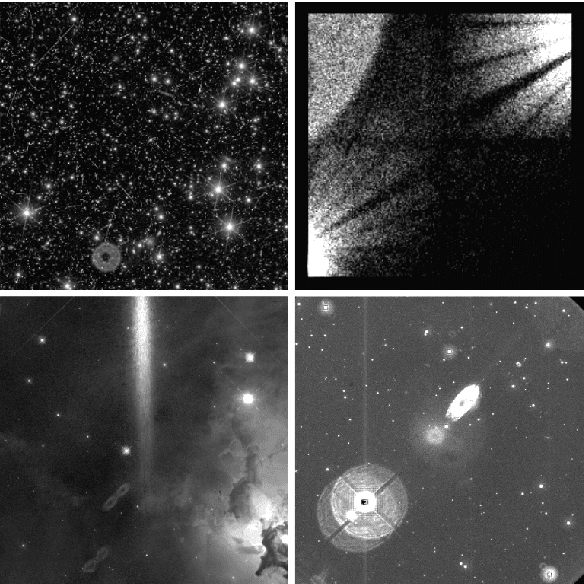
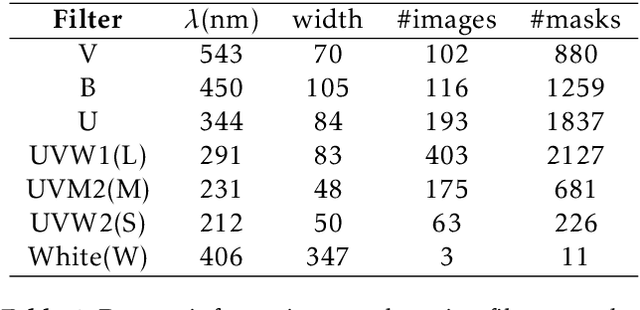
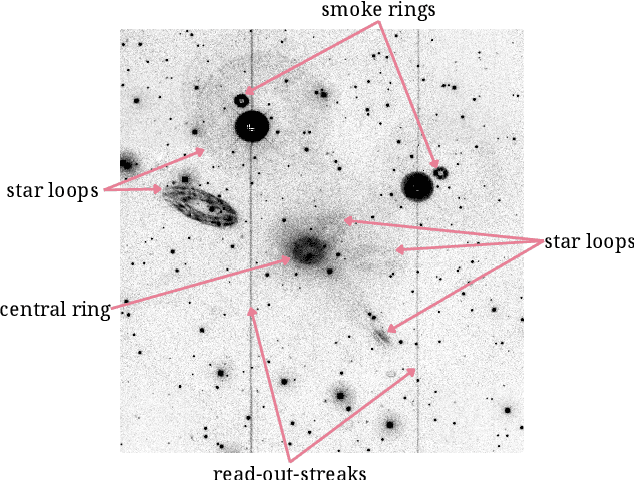
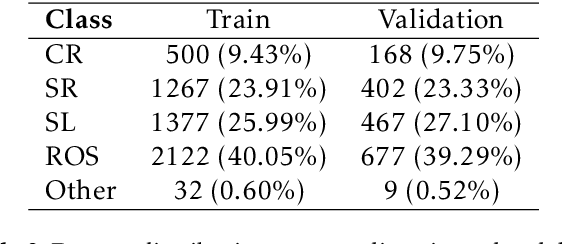
Reflected or scattered light produce artefacts in astronomical observations that can negatively impact the scientific study. Hence, automated detection of these artefacts is highly beneficial, especially with the increasing amounts of data gathered. Machine learning methods are well-suited to this problem, but currently there is a lack of annotated data to train such approaches to detect artefacts in astronomical observations. In this work, we present a dataset of images from the XMM-Newton space telescope Optical Monitoring camera showing different types of artefacts. We hand-annotated a sample of 1000 images with artefacts which we use to train automated ML methods. We further demonstrate techniques tailored for accurate detection and masking of artefacts using instance segmentation. We adopt a hybrid approach, combining knowledge from both convolutional neural networks (CNNs) and transformer-based models and use their advantages in segmentation. The presented method and dataset will advance artefact detection in astronomical observations by providing a reproducible baseline. All code and data are made available (https://github.com/ESA-Datalabs/XAMI-model and https://github.com/ESA-Datalabs/XAMI-dataset).