 Add to Chrome
 Add to Firefox
 Add to Edge
The Interplay of Data Structure and Imbalance in the Learning Dynamics of Diffusion Models
May 07, 2026
Real-world datasets are inherently heterogeneous, yet how per-class structural differences and sampling imbalance shape the training dynamics of diffusion models-and potentially exacerbate disparities-remains poorly understood. While models typically transition from an initial phase of generalization to memorizing the training set, existing theory assumes homogeneous data, leaving open how class imbalance and heterogeneity reshape these dynamics. In this work, we develop a high-dimensional analytical framework to study class-dependent learning in score-based diffusion models. Analyzing a random-features model trained on Gaussian mixtures, we derive the feature-covariance spectrum to characterize per-class generalization and memorization times. We reveal the explicit hierarchy governing these dynamics: class variance is the primary determinant of learning order-consistently favoring higher-variance classes-while centroid geometry plays a secondary role. Sampling imbalance acts as a modulator that can reverse this ordering and, under strong imbalance, forces minority classes to acquire distinct, delayed speciation times during backward diffusion. Together, these results suggest that diffusion models can memorize some classes while others remain insufficiently learned. We validate our theoretical predictions empirically using U-Net models trained on Fashion MNIST.

Position: the Stochastic Parrot in the Coal Mine. Model Collapse is a Threat to Low-Resource Communities
May 05, 2026Model collapse, the degradation in performance that arises when generative models are trained on the outputs of prior models, is an increasing concern as artificially generated content proliferates. Related critiques of large language models have highlighted their tendency to reproduce frequent patterns in training data, their reliance on vast datasets, and their substantial environmental cost. Together, these factors contribute to data degradation, the reinforcement of cultural biases, and inefficient resource use. In this position paper we aim to combine these views and argue that model collapse threatens current efforts to democratize AI. By reducing training efficiency and skewing data distributions away from the tails of their support, model collapse disproportionately impacts low-resource and marginalized communities. We examine both the environmental and cultural implications of this phenomenon, situate our position within recent position papers on model collapse, and conclude with a call to action. Finally, we outline initial directions for mitigating these effects.
Sharp description of local minima in the loss landscape of high-dimensional two-layer ReLU neural networks
Apr 10, 2026We study the population loss landscape of two-layer ReLU networks of the form $\sum_{k=1}^K \mathrm{ReLU}(w_k^\top x)$ in a realisable teacher-student setting with Gaussian covariates. We show that local minima admit an exact low-dimensional representation in terms of summary statistics, yielding a sharp and interpretable characterisation of the landscape. We further establish a direct link with one-pass SGD: local minima correspond to attractive fixed points of the dynamics in summary statistics space. This perspective reveals a hierarchical structure of minima: they are typically isolated in the well-specified regime, but become connected by flat directions as network width increases. In this overparameterised regime, global minima become increasingly accessible, attracting the dynamics and reducing convergence to spurious solutions. Overall, our results reveal intrinsic limitations of common simplifying assumptions, which may miss essential features of the loss landscape even in minimal neural network models.
A Theory of Initialisation's Impact on Specialisation
Mar 04, 2025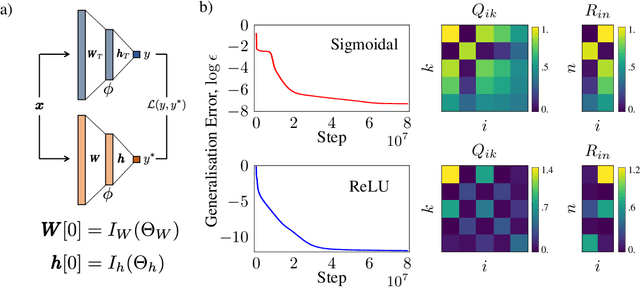
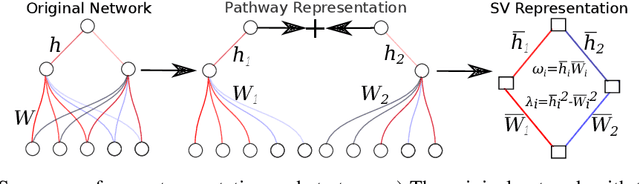
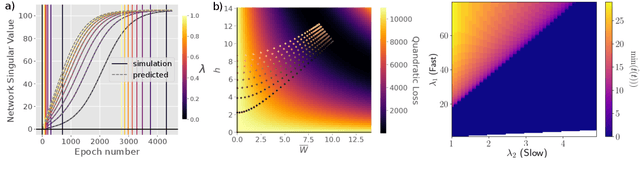

Prior work has demonstrated a consistent tendency in neural networks engaged in continual learning tasks, wherein intermediate task similarity results in the highest levels of catastrophic interference. This phenomenon is attributed to the network's tendency to reuse learned features across tasks. However, this explanation heavily relies on the premise that neuron specialisation occurs, i.e. the emergence of localised representations. Our investigation challenges the validity of this assumption. Using theoretical frameworks for the analysis of neural networks, we show a strong dependence of specialisation on the initial condition. More precisely, we show that weight imbalance and high weight entropy can favour specialised solutions. We then apply these insights in the context of continual learning, first showing the emergence of a monotonic relation between task-similarity and forgetting in non-specialised networks. {Finally, we show that specialization by weight imbalance is beneficial on the commonly employed elastic weight consolidation regularisation technique.
Optimal Protocols for Continual Learning via Statistical Physics and Control Theory
Sep 26, 2024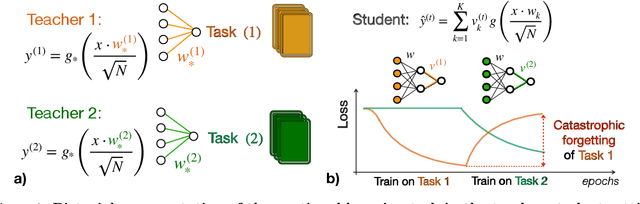


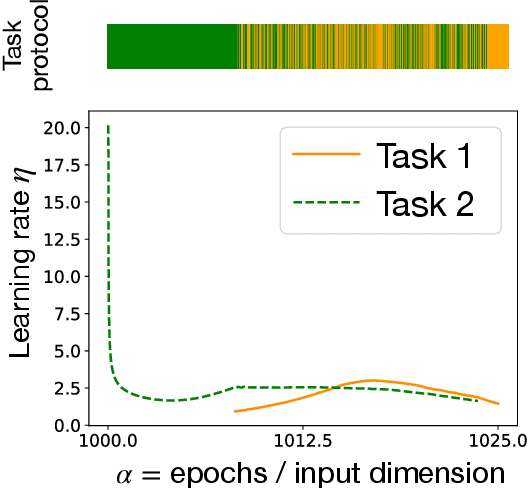
Artificial neural networks often struggle with catastrophic forgetting when learning multiple tasks sequentially, as training on new tasks degrades the performance on previously learned ones. Recent theoretical work has addressed this issue by analysing learning curves in synthetic frameworks under predefined training protocols. However, these protocols relied on heuristics and lacked a solid theoretical foundation assessing their optimality. In this paper, we fill this gap combining exact equations for training dynamics, derived using statistical physics techniques, with optimal control methods. We apply this approach to teacher-student models for continual learning and multi-task problems, obtaining a theory for task-selection protocols maximising performance while minimising forgetting. Our theoretical analysis offers non-trivial yet interpretable strategies for mitigating catastrophic forgetting, shedding light on how optimal learning protocols can modulate established effects, such as the influence of task similarity on forgetting. Finally, we validate our theoretical findings on real-world data.
Tilting the Odds at the Lottery: the Interplay of Overparameterisation and Curricula in Neural Networks
Jun 03, 2024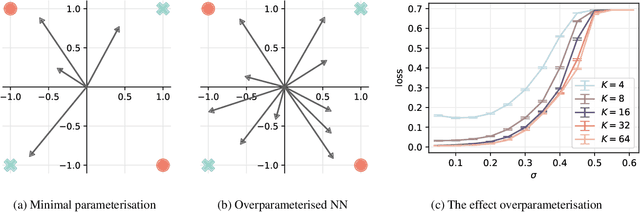
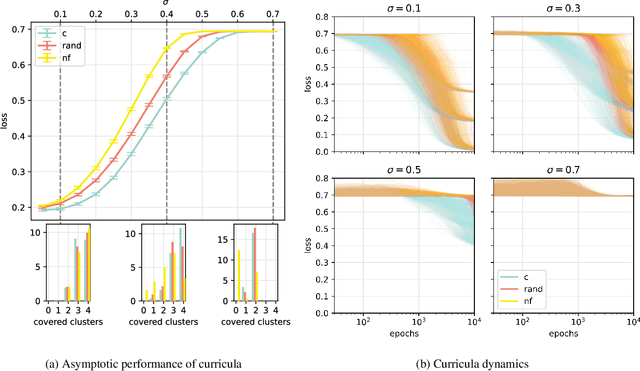
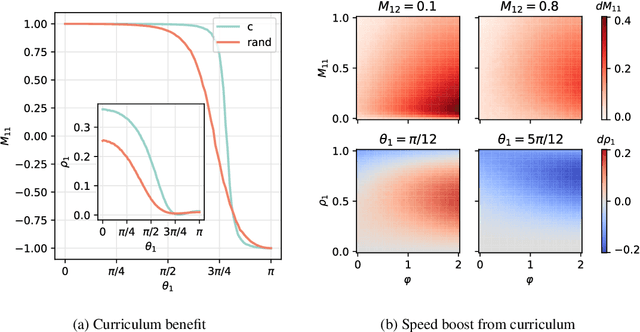
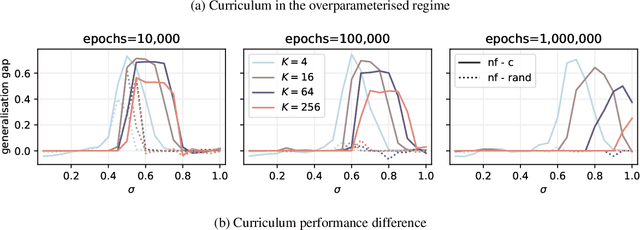
A wide range of empirical and theoretical works have shown that overparameterisation can amplify the performance of neural networks. According to the lottery ticket hypothesis, overparameterised networks have an increased chance of containing a sub-network that is well-initialised to solve the task at hand. A more parsimonious approach, inspired by animal learning, consists in guiding the learner towards solving the task by curating the order of the examples, i.e. providing a curriculum. However, this learning strategy seems to be hardly beneficial in deep learning applications. In this work, we undertake an analytical study that connects curriculum learning and overparameterisation. In particular, we investigate their interplay in the online learning setting for a 2-layer network in the XOR-like Gaussian Mixture problem. Our results show that a high degree of overparameterisation -- while simplifying the problem -- can limit the benefit from curricula, providing a theoretical account of the ineffectiveness of curricula in deep learning.
Bias in Motion: Theoretical Insights into the Dynamics of Bias in SGD Training
May 28, 2024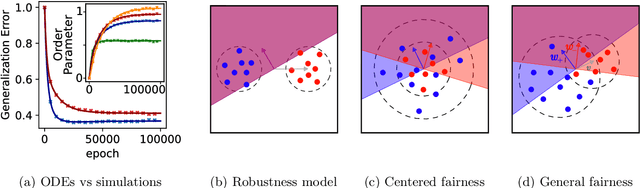
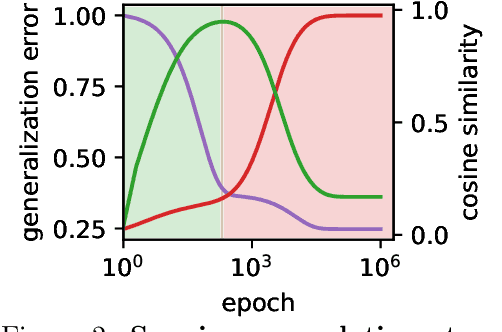
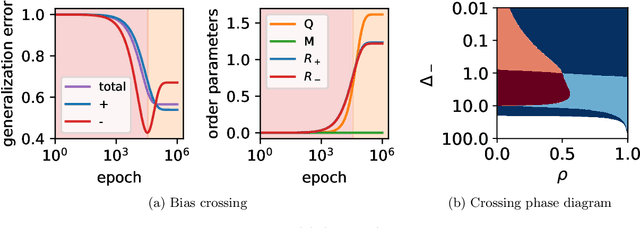
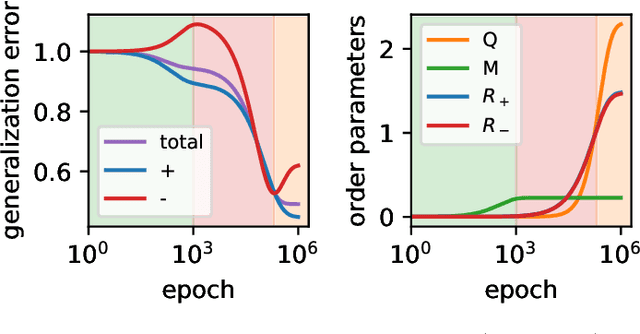
Machine learning systems often acquire biases by leveraging undesired features in the data, impacting accuracy variably across different sub-populations. Current understanding of bias formation mostly focuses on the initial and final stages of learning, leaving a gap in knowledge regarding the transient dynamics. To address this gap, this paper explores the evolution of bias in a teacher-student setup modeling different data sub-populations with a Gaussian-mixture model. We provide an analytical description of the stochastic gradient descent dynamics of a linear classifier in this setting, which we prove to be exact in high dimension. Notably, our analysis reveals how different properties of sub-populations influence bias at different timescales, showing a shifting preference of the classifier during training. Applying our findings to fairness and robustness, we delineate how and when heterogeneous data and spurious features can generate and amplify bias. We empirically validate our results in more complex scenarios by training deeper networks on synthetic and real datasets, including CIFAR10, MNIST, and CelebA.
The RL Perceptron: Generalisation Dynamics of Policy Learning in High Dimensions
Jun 27, 2023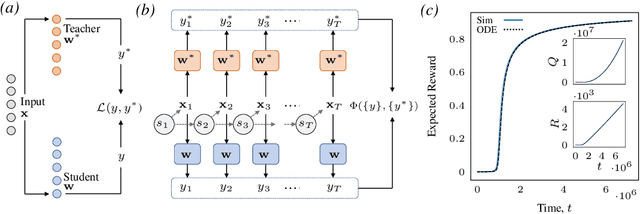
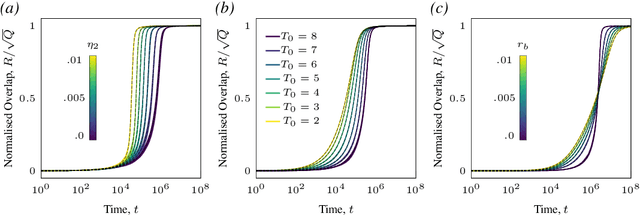
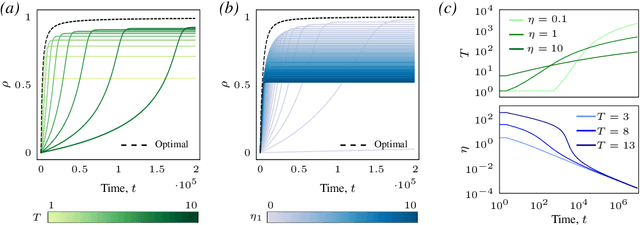
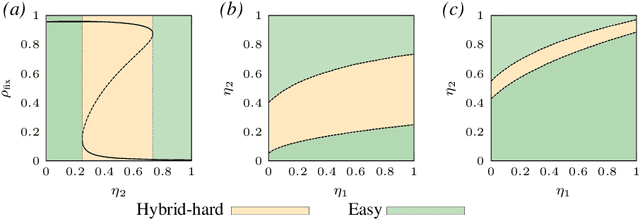
Reinforcement learning (RL) algorithms have proven transformative in a range of domains. To tackle real-world domains, these systems often use neural networks to learn policies directly from pixels or other high-dimensional sensory input. By contrast, much theory of RL has focused on discrete state spaces or worst-case analysis, and fundamental questions remain about the dynamics of policy learning in high-dimensional settings. Here, we propose a solvable high-dimensional model of RL that can capture a variety of learning protocols, and derive its typical dynamics as a set of closed-form ordinary differential equations (ODEs). We derive optimal schedules for the learning rates and task difficulty - analogous to annealing schemes and curricula during training in RL - and show that the model exhibits rich behaviour, including delayed learning under sparse rewards; a variety of learning regimes depending on reward baselines; and a speed-accuracy trade-off driven by reward stringency. Experiments on variants of the Procgen game "Bossfight" and Arcade Learning Environment game "Pong" also show such a speed-accuracy trade-off in practice. Together, these results take a step towards closing the gap between theory and practice in high-dimensional RL.
Optimal transfer protocol by incremental layer defrosting
Mar 02, 2023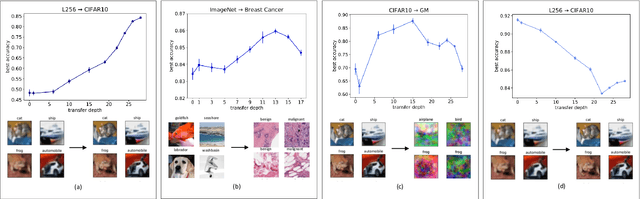
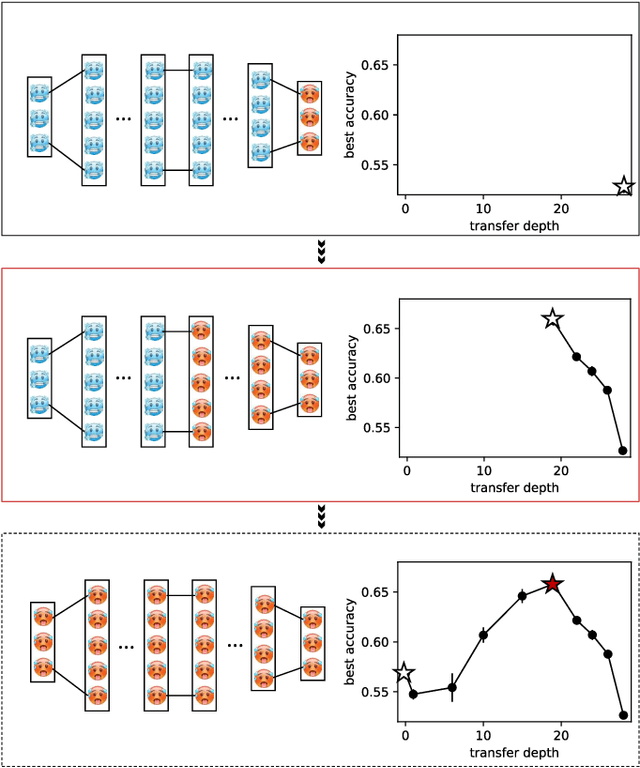
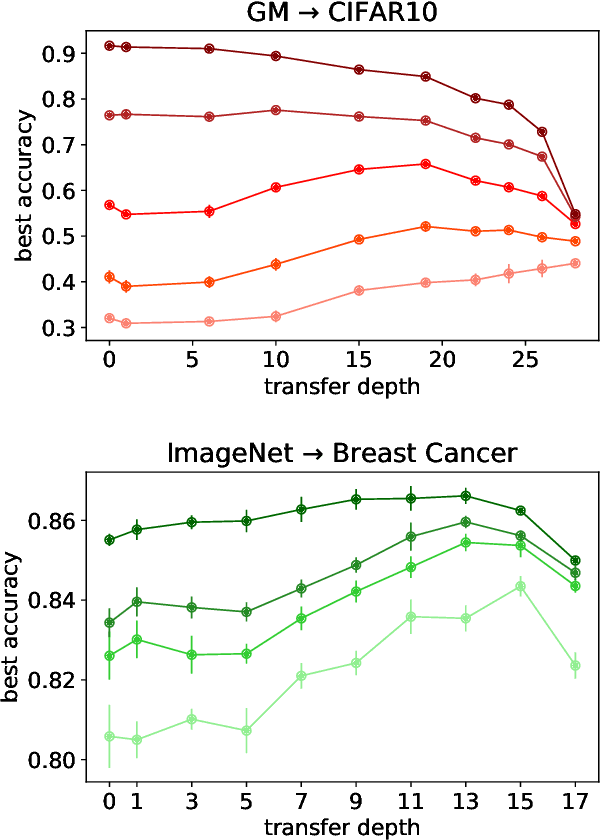

Transfer learning is a powerful tool enabling model training with limited amounts of data. This technique is particularly useful in real-world problems where data availability is often a serious limitation. The simplest transfer learning protocol is based on ``freezing" the feature-extractor layers of a network pre-trained on a data-rich source task, and then adapting only the last layers to a data-poor target task. This workflow is based on the assumption that the feature maps of the pre-trained model are qualitatively similar to the ones that would have been learned with enough data on the target task. In this work, we show that this protocol is often sub-optimal, and the largest performance gain may be achieved when smaller portions of the pre-trained network are kept frozen. In particular, we make use of a controlled framework to identify the optimal transfer depth, which turns out to depend non-trivially on the amount of available training data and on the degree of source-target task correlation. We then characterize transfer optimality by analyzing the internal representations of two networks trained from scratch on the source and the target task through multiple established similarity measures.
Inducing bias is simpler than you think
May 31, 2022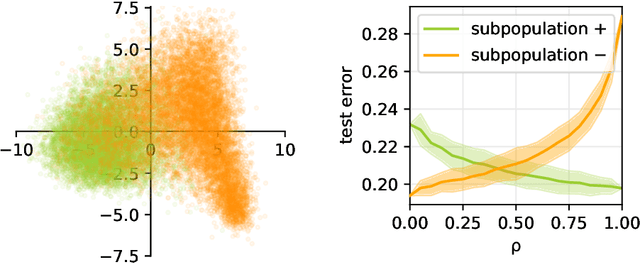
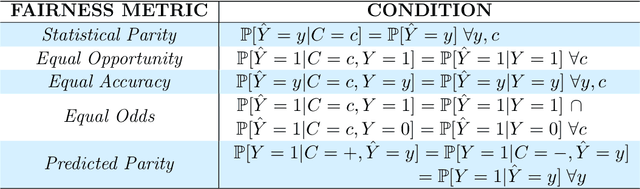
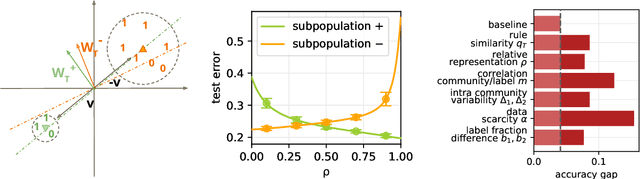
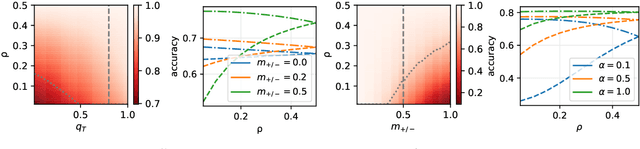
Machine learning may be oblivious to human bias but it is not immune to its perpetuation. Marginalisation and iniquitous group representation are often traceable in the very data used for training, and may be reflected or even enhanced by the learning models. To counter this, some of the model accuracy can be traded off for a secondary objective that helps prevent a specific type of bias. Multiple notions of fairness have been proposed to this end but recent studies show that some fairness criteria often stand in mutual competition. In the present work, we introduce a solvable high-dimensional model of data imbalance, where parametric control over the many bias-inducing factors allows for an extensive exploration of the bias inheritance mechanism. Through the tools of statistical physics, we analytically characterise the typical behaviour of learning models trained in our synthetic framework and find similar unfairness behaviours as those observed on more realistic data. However, we also identify a positive transfer effect between the different subpopulations within the data. This suggests that mixing data with different statistical properties could be helpful, provided the learning model is made aware of this structure. Finally, we analyse the issue of bias mitigation: by reweighing the various terms in the training loss, we indirectly minimise standard unfairness metrics and highlight their incompatibilities. Leveraging the insights on positive transfer, we also propose a theory-informed mitigation strategy, based on the introduction of coupled learning models. By allowing each model to specialise on a different community within the data, we find that multiple fairness criteria and high accuracy can be achieved simultaneously.