 Add to Chrome
 Add to Firefox
 Add to Edge
Nsanku: Evaluating Zero-Shot Translation Performance of LLMs for Ghanaian Languages
May 05, 2026
Large language models (LLMs) have demonstrated impressive multilingual capabilities for well-resourced languages, yet their performance on low-resource African languages remains poorly understood and largely unevaluated. This paper presents Nsanku, a systematic benchmark that evaluates the zero-shot machine translation performance of 19 open-weight and proprietary LLMs across 43 Ghanaian languages paired with English. Evaluation sentences were sourced from the YouVersion Bible platform, providing 300 sentence pairs per language. Two complementary automatic metrics are employed: Bilingual Evaluation Understudy (BLEU) and Character n-gram F-Score (chrF), alongside an average accuracy score and a cross-language consistency dimension. Nsanku represents the most comprehensive LLM translation evaluation for Ghanaian languages conducted to date. Results show that gemini-2.5-flash achieves the highest overall average score of 26.88 (BLEU: 24.60, chrF: 29.16), followed by claude-sonnet-4-5 at 24.87 (BLEU: 22.46, chrF: 27.28) and gpt-4.1 at 23.20 (BLEU: 21.15, chrF: 25.24). Among open-weight models, kimi-k2-instruct-0905 leads at an average score of 20.87. A critical finding from the consistency analysis is that no model and no language reached the Leaders quadrant of high performance and high consistency simultaneously, indicating that current LLMs are not yet reliably usable for Ghanaian language translation at scale. Siwu achieved the highest per-language average score at 25.73 while Nkonya scored lowest at 11.65. Nsanku establishes a publicly available, community-extensible evaluation infrastructure for African language NLP research.

AfriMTE and AfriCOMET: Empowering COMET to Embrace Under-resourced African Languages
Nov 16, 2023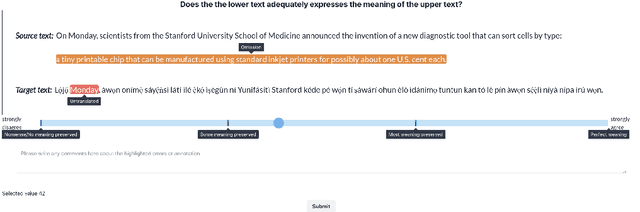
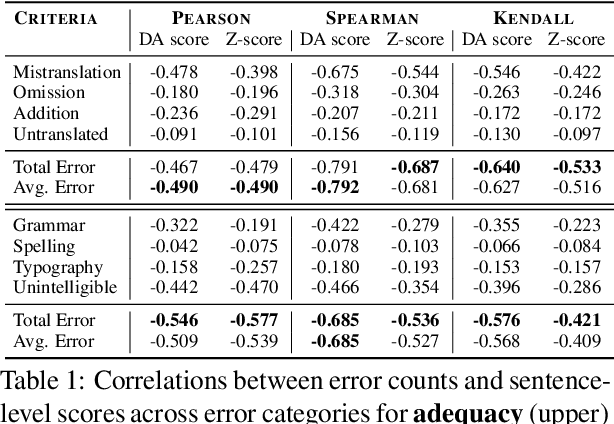
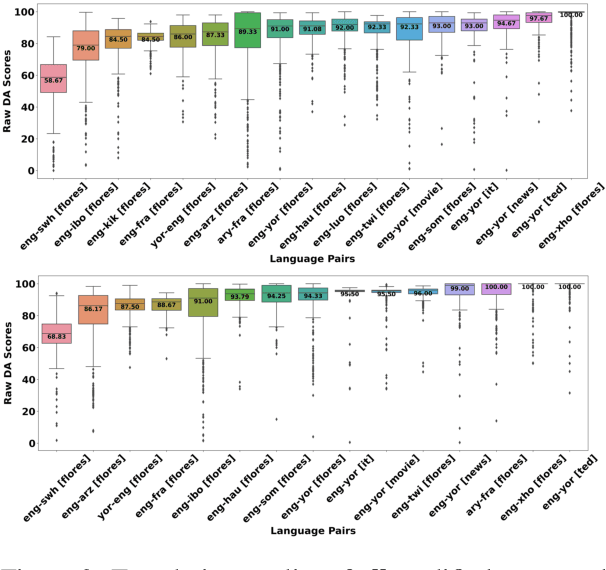
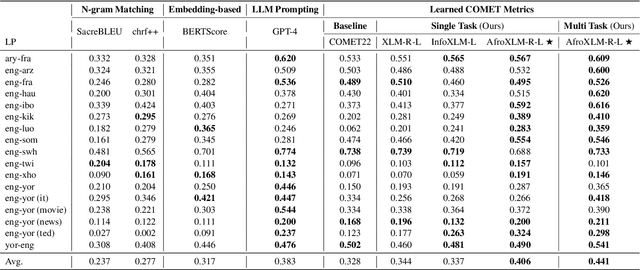
Despite the progress we have recorded in scaling multilingual machine translation (MT) models and evaluation data to several under-resourced African languages, it is difficult to measure accurately the progress we have made on these languages because evaluation is often performed on n-gram matching metrics like BLEU that often have worse correlation with human judgments. Embedding-based metrics such as COMET correlate better; however, lack of evaluation data with human ratings for under-resourced languages, complexity of annotation guidelines like Multidimensional Quality Metrics (MQM), and limited language coverage of multilingual encoders have hampered their applicability to African languages. In this paper, we address these challenges by creating high-quality human evaluation data with a simplified MQM guideline for error-span annotation and direct assessment (DA) scoring for 13 typologically diverse African languages. Furthermore, we develop AfriCOMET, a COMET evaluation metric for African languages by leveraging DA training data from high-resource languages and African-centric multilingual encoder (AfroXLM-Roberta) to create the state-of-the-art evaluation metric for African languages MT with respect to Spearman-rank correlation with human judgments (+0.406).