 Add to Chrome
 Add to Firefox
 Add to Edge
Fast Reconstruction of Motion-Corrupted Data with Mobile-GRAPPA: Motion and dB0 Inhomogeneity Correction Leveraging Efficient GRAPPA
Nov 09, 2025
Advanced motion navigations now enable rapid tracking of subject motion and dB0-induced phase, but accurately incorporating this high-temporal-resolution information into SENSE (Aligned-SENSE) is often computationally prohibitive. We propose "Mobile-GRAPPA", a k-space "cleaning" approach that uses local GRAPPA operators to remove motion and dB0 related corruption so that the resulting data can be reconstructed with standard SENSE. We efficiently train a family of k-space-position-specific Mobile-GRAPPA kernels via a lightweight multilayer perceptron (MLP) and apply them across k-space to generate clean data. In experiments on highly motion-corrupted 1-mm whole-brain GRE (Tacq = 10 min; 1,620 motion/dB0 trackings) and EPTI (Tacq = 2 min; 544 trackings), Mobile-GRAPPA enabled accurate reconstruction with negligible time penalty, whereas full Aligned-SENSE was impractical (reconstruction times > 10 h for GRE and > 10 days for EPTI). These results show that Mobile-GRAPPA incorporates detailed motion and dB0 tracking into SENSE with minimal computational overhead, enabling fast, high-quality reconstructions of challenging data.

Time-efficient, High Resolution 3T Whole Brain Quantitative Relaxometry using 3D-QALAS with Wave-CAIPI Readouts
Nov 08, 2022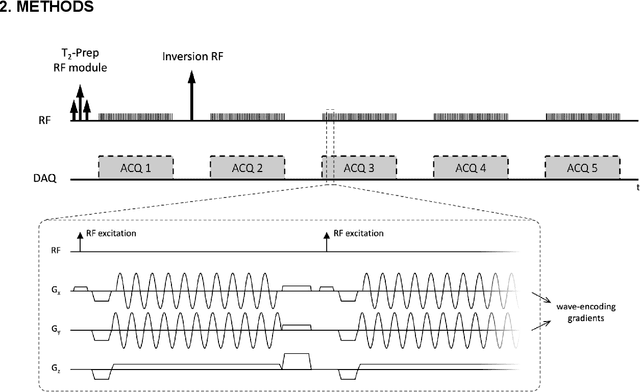
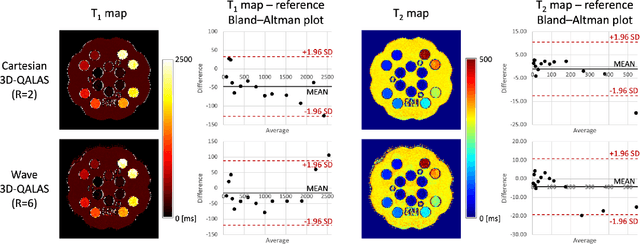
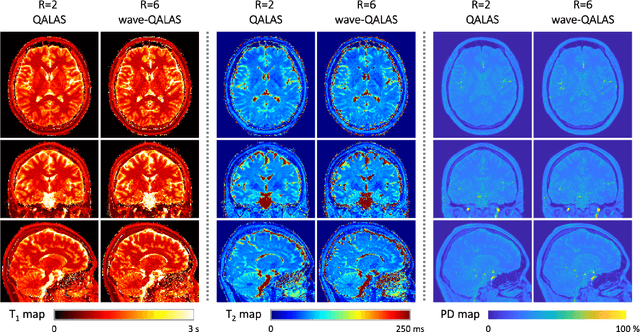
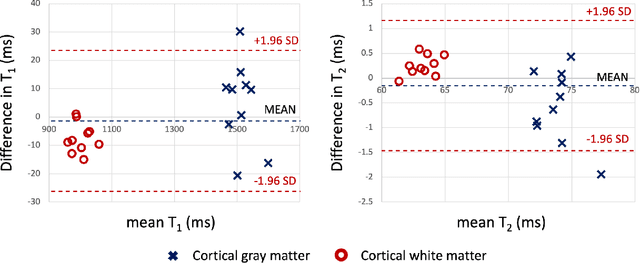
Purpose: Volumetric, high resolution, quantitative mapping of brain tissues relaxation properties is hindered by long acquisition times and SNR challenges. This study, for the first time, combines the time efficient wave-CAIPI readouts into the 3D-QALAS acquisition scheme, enabling full brain quantitative T1, T2 and PD maps at 1.15 isotropic voxels in only 3 minutes. Methods: Wave-CAIPI readouts were embedded in the standard 3d-QALAS encoding scheme, enabling full brain quantitative parameter maps (T1, T2 and PD) at acceleration factors of R=3x2 with minimum SNR loss due to g-factor penalties. The quantitative maps using the accelerated protocol were quantitatively compared against those obtained from conventional 3D-QALAS sequence using GRAPPA acceleration of R=2 in the ISMRM NIST phantom, and ten healthy volunteers. To show the feasibility of the proposed methods in clinical settings, the accelerated wave-CAIPI 3D-QALAS sequence was also employed in pediatric patients undergoing clinical MRI examinations. Results: When tested in both the ISMRM/NIST phantom and 7 healthy volunteers, the quantitative maps using the accelerated protocol showed excellent agreement against those obtained from conventional 3D-QALAS at R=2. Conclusion: 3D-QALAS enhanced with wave-CAIPI readouts enables time-efficient, full brain quantitative T1, T2 and PD mapping at 1.15 in 3 minutes at R=3x2 acceleration. When tested on the NIST phantom and 7 healthy volunteers, the quantitative maps obtained from the accelerated wave-CAIPI 3D-QALAS protocol showed very similar values to those obtained from the standard 3D-QALAS (R=2) protocol, alluding to the robustness and reliability of the proposed methods. This study also shows that the accelerated protocol can be effectively employed in pediatric patient populations, making high-quality high-resolution full brain quantitative imaging feasible in clinical settings.