 Add to Chrome
 Add to Firefox
 Add to Edge
On Pairwise Quantile Regression -- Statistical Guarantees and Applications
Jul 05, 2026
Quantile regression provides a powerful tool for summarizing the conditional distribution of a real valued random variable (r.v.) of interest $Y$ as a function of covariates $Z$ in cases where it shows a large dispersion with high probability, going beyond the situation where standard least square regression is informative/predictive. This article aims to extend this methodology to the pairwise case, when the variable to be explained takes the form of a similarity function between two independent observations, such as pixelated ID photos, as input data of biometric systems) and the explanatory variables take the form of a pair of covariates of the observations, such as the age or the hair color. We establish theoretical guarantees for solutions of this statistical learning problem, considered here as empirical minimizers of a pairwise version of the pinball loss. Leveraging sharp concentration results for $U$-processes, we prove generalization bounds and identify mild conditions under which fast learning rates can be achieved. Confirming the probabilistic analysis, experiments based on simulation data also provide solid empirical evidence of the validity of the methodology promoted here for pairwise quantile regression. Finally, its usefulness from an application perspective is demonstrated by a detailed study aimed at analyzing errors in similarity scoring for facial recognition.

Doing well with less! On Sampling Techniques for Empirical Pairwise Loss Estimation/Minimization
Jun 01, 2026Many machine learning problems, including similarity learning, ranking, and clustering, rely on empirical pairwise loss functions whose quadratic computational cost quickly becomes prohibitive at scale. We demonstrate how a frugal approach that retains only a fraction of the available information on pairs can achieve estimation or optimization performance comparable to that obtained by using all pairs, by leveraging survey sampling techniques. A central finding, supported by both theory and experiments, is that such sampling plans must target pairs directly rather than individual observations. In particular, for pairwise losses between high-dimensional vectors such as embeddings in vision or graph learning, assigning higher inclusion probabilities to informative pairs using suitable auxiliary information yields performance close to full pairwise evaluation, providing a principled and theoretically grounded trade-off between accuracy and computational cost.
On Gossip Algorithms for Machine Learning with Pairwise Objectives
Mar 25, 2026In the IoT era, information is more and more frequently picked up by connected smart sensors with increasing, though limited, storage, communication and computation abilities. Whether due to privacy constraints or to the structure of the distributed system, the development of statistical learning methods dedicated to data that are shared over a network is now a major issue. Gossip-based algorithms have been developed for the purpose of solving a wide variety of statistical learning tasks, ranging from data aggregation over sensor networks to decentralized multi-agent optimization. Whereas the vast majority of contributions consider situations where the function to be estimated or optimized is a basic average of individual observations, it is the goal of this article to investigate the case where the latter is of pairwise nature, taking the form of a U -statistic of degree two. Motivated by various problems such as similarity learning, ranking or clustering for instance, we revisit gossip algorithms specifically designed for pairwise objective functions and provide a comprehensive theoretical framework for their convergence. This analysis fills a gap in the literature by establishing conditions under which these methods succeed, and by identifying the graph properties that critically affect their efficiency. In particular, a refined analysis of the convergence upper and lower bounds is performed.
Active Bipartite Ranking with Smooth Posterior Distributions
Feb 27, 2026In this article, bipartite ranking, a statistical learning problem involved in many applications and widely studied in the passive context, is approached in a much more general \textit{active setting} than the discrete one previously considered in the literature. While the latter assumes that the conditional distribution is piece wise constant, the framework we develop permits in contrast to deal with continuous conditional distributions, provided that they fulfill a Hölder smoothness constraint. We first show that a naive approach based on discretisation at a uniform level, fixed \textit{a priori} and consisting in applying next the active strategy designed for the discrete setting generally fails. Instead, we propose a novel algorithm, referred to as smooth-rank and designed for the continuous setting, which aims to minimise the distance between the ROC curve of the estimated ranking rule and the optimal one w.r.t. the $\sup$ norm. We show that, for a fixed confidence level $ε>0$ and probability $δ\in (0,1)$, smooth-rank is PAC$(ε,δ)$. In addition, we provide a problem dependent upper bound on the expected sampling time of smooth-rank and establish a problem dependent lower bound on the expected sampling time of any PAC$(ε,δ)$ algorithm. Beyond the theoretical analysis carried out, numerical results are presented, providing solid empirical evidence of the performance of the algorithm proposed, which compares favorably with alternative approaches.
Decentralized Ranking Aggregation: Gossip Algorithms for Borda and Copeland Consensus
Feb 26, 2026The concept of ranking aggregation plays a central role in preference analysis, and numerous algorithms for calculating median rankings, often originating in social choice theory, have been documented in the literature, offering theoretical guarantees in a centralized setting, i.e., when all the ranking data to be aggregated can be brought together in a single computing unit. For many technologies (e.g. peer-to-peer networks, IoT, multi-agent systems), extending the ability to calculate consensus rankings with guarantees in a decentralized setting, i.e., when preference data is initially distributed across a communicating network, remains a major methodological challenge. Indeed, in recent years, the literature on decentralized computation has mainly focused on computing or optimizing statistics such as arithmetic means using gossip algorithms. The purpose of this article is precisely to study how to achieve reliable consensus on collective rankings using classical rules (e.g. Borda, Copeland) in a decentralized setting, thereby raising new questions, robustness to corrupted nodes, and scalability through reduced communication costs in particular. The approach proposed and analyzed here relies on random gossip communication, allowing autonomous agents to compute global ranking consensus using only local interactions, without coordination or central authority. We provide rigorous convergence guarantees, including explicit rate bounds, for the Borda and Copeland consensus methods. Beyond these rules, we also provide a decentralized implementation of consensus according to the median rank rule and local Kemenization. Extensive empirical evaluations on various network topologies and real and synthetic ranking datasets demonstrate that our algorithms converge quickly and reliably to the correct ranking aggregation.
Beyond Kemeny Medians: Consensus Ranking Distributions Definition, Properties and Statistical Learning
Feb 11, 2026In this article we develop a new method for summarizing a ranking distribution, \textit{i.e.} a probability distribution on the symmetric group $\mathfrak{S}_n$, beyond the classical theory of consensus and Kemeny medians. Based on the notion of \textit{local ranking median}, we introduce the concept of \textit{consensus ranking distribution} ($\crd$), a sparse mixture model of Dirac masses on $\mathfrak{S}_n$, in order to approximate a ranking distribution with small distortion from a mass transportation perspective. We prove that by choosing the popular Kendall $τ$ distance as the cost function, the optimal distortion can be expressed as a function of pairwise probabilities, paving the way for the development of efficient learning methods that do not suffer from the lack of vector space structure on $\mathfrak{S}_n$. In particular, we propose a top-down tree-structured statistical algorithm that allows for the progressive refinement of a CRD based on ranking data, from the Dirac mass at a Kemeny median at the root of the tree to the empirical ranking data distribution itself at the end of the tree's exhaustive growth. In addition to the theoretical arguments developed, the relevance of the algorithm is empirically supported by various numerical experiments.
Robust Distributed Learning under Resource Constraints: Decentralized Quantile Estimation via (Asynchronous) ADMM
Jan 28, 2026Specifications for decentralized learning on resource-constrained edge devices require algorithms that are communication-efficient, robust to data corruption, and lightweight in memory usage. While state-of-the-art gossip-based methods satisfy the first requirement, achieving robustness remains challenging. Asynchronous decentralized ADMM-based methods have been explored for estimating the median, a statistical centrality measure that is notoriously more robust than the mean. However, existing approaches require memory that scales with node degree, making them impractical when memory is limited. In this paper, we propose AsylADMM, a novel gossip algorithm for decentralized median and quantile estimation, primarily designed for asynchronous updates and requiring only two variables per node. We analyze a synchronous variant of AsylADMM to establish theoretical guarantees and empirically demonstrate fast convergence for the asynchronous algorithm. We then show that our algorithm enables quantile-based trimming, geometric median estimation, and depth-based trimming, with quantile-based trimming empirically outperforming existing rank-based methods. Finally, we provide a novel theoretical analysis of rank-based trimming via Markov chain theory.
TimeSAE: Sparse Decoding for Faithful Explanations of Black-Box Time Series Models
Jan 14, 2026As black box models and pretrained models gain traction in time series applications, understanding and explaining their predictions becomes increasingly vital, especially in high-stakes domains where interpretability and trust are essential. However, most of the existing methods involve only in-distribution explanation, and do not generalize outside the training support, which requires the learning capability of generalization. In this work, we aim to provide a framework to explain black-box models for time series data through the dual lenses of Sparse Autoencoders (SAEs) and causality. We show that many current explanation methods are sensitive to distributional shifts, limiting their effectiveness in real-world scenarios. Building on the concept of Sparse Autoencoder, we introduce TimeSAE, a framework for black-box model explanation. We conduct extensive evaluations of TimeSAE on both synthetic and real-world time series datasets, comparing it to leading baselines. The results, supported by both quantitative metrics and qualitative insights, show that TimeSAE provides more faithful and robust explanations. Our code is available in an easy-to-use library TimeSAE-Lib: https://anonymous.4open.science/w/TimeSAE-571D/.
Asynchronous Gossip Algorithms for Rank-Based Statistical Methods
Sep 09, 2025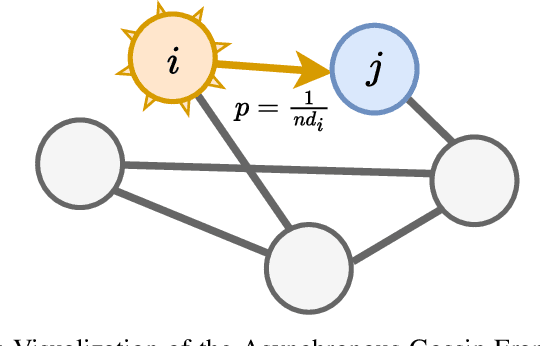
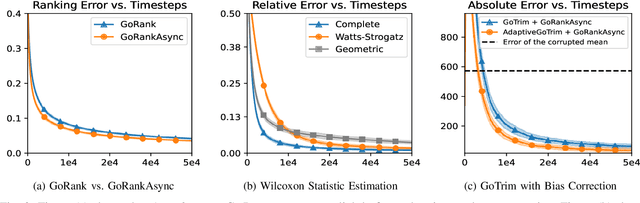
As decentralized AI and edge intelligence become increasingly prevalent, ensuring robustness and trustworthiness in such distributed settings has become a critical issue-especially in the presence of corrupted or adversarial data. Traditional decentralized algorithms are vulnerable to data contamination as they typically rely on simple statistics (e.g., means or sum), motivating the need for more robust statistics. In line with recent work on decentralized estimation of trimmed means and ranks, we develop gossip algorithms for computing a broad class of rank-based statistics, including L-statistics and rank statistics-both known for their robustness to outliers. We apply our method to perform robust distributed two-sample hypothesis testing, introducing the first gossip algorithm for Wilcoxon rank-sum tests. We provide rigorous convergence guarantees, including the first convergence rate bound for asynchronous gossip-based rank estimation. We empirically validate our theoretical results through experiments on diverse network topologies.
Robust Distributed Estimation: Extending Gossip Algorithms to Ranking and Trimmed Means
May 23, 2025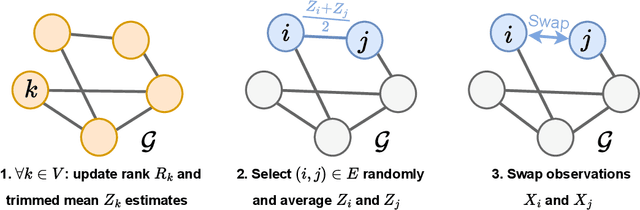
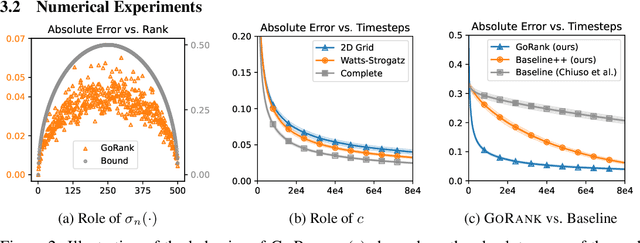
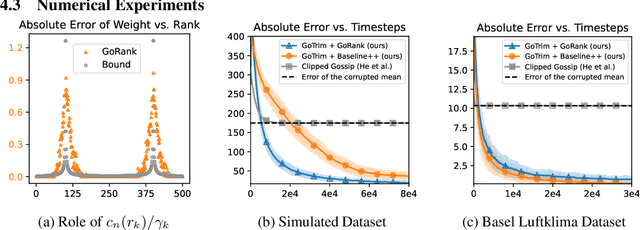
This paper addresses the problem of robust estimation in gossip algorithms over arbitrary communication graphs. Gossip algorithms are fully decentralized, relying only on local neighbor-to-neighbor communication, making them well-suited for situations where communication is constrained. A fundamental challenge in existing mean-based gossip algorithms is their vulnerability to malicious or corrupted nodes. In this paper, we show that an outlier-robust mean can be computed by globally estimating a robust statistic. More specifically, we propose a novel gossip algorithm for rank estimation, referred to as \textsc{GoRank}, and leverage it to design a gossip procedure dedicated to trimmed mean estimation, coined \textsc{GoTrim}. In addition to a detailed description of the proposed methods, a key contribution of our work is a precise convergence analysis: we establish an $\mathcal{O}(1/t)$ rate for rank estimation and an $\mathcal{O}(\log(t)/t)$ rate for trimmed mean estimation, where by $t$ is meant the number of iterations. Moreover, we provide a breakdown point analysis of \textsc{GoTrim}. We empirically validate our theoretical results through experiments on diverse network topologies, data distributions and contamination schemes.