 Add to Chrome
 Add to Firefox
 Add to Edge
A Bilateral Teleoperation Framework for Dexterous Manipulation
Jun 13, 2026
Dexterous teleoperation requires precise arm-hand coordination, low-latency feedback, and robust interaction in real-world contact-rich environments. This paper presents a modular bilateral teleoperation framework that integrates operator-side input interfaces with a robot-side dexterous hand and compliant robotic arm in a unified control architecture. The system supports position-based hand retargeting, differential arm control, multi-scale haptic feedback, and shared control for stable manipulation. We validate the framework through a real-world dexterous manipulation task, highlighting coordinated arm-hand control and contact-aware interaction. Beyond feasibility, we identify key design insights related to cross-embodiment mismatch, haptic feedback granularity, and shared control. The proposed platform provides a practical teleoperation system and a foundation for collecting high-quality demonstrations for future learning-from-demonstration research.

Personalized Gait Patterns During Exoskeleton-Aided Training May Have Minimal Effect on User Experience. Insights from a Pilot Study
Dec 19, 2025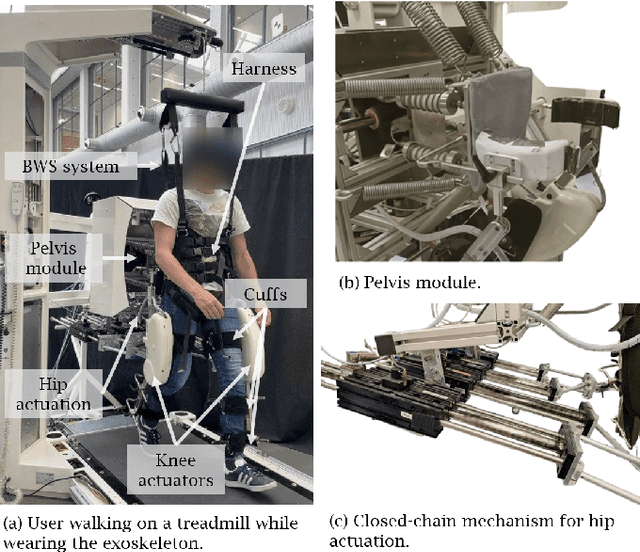
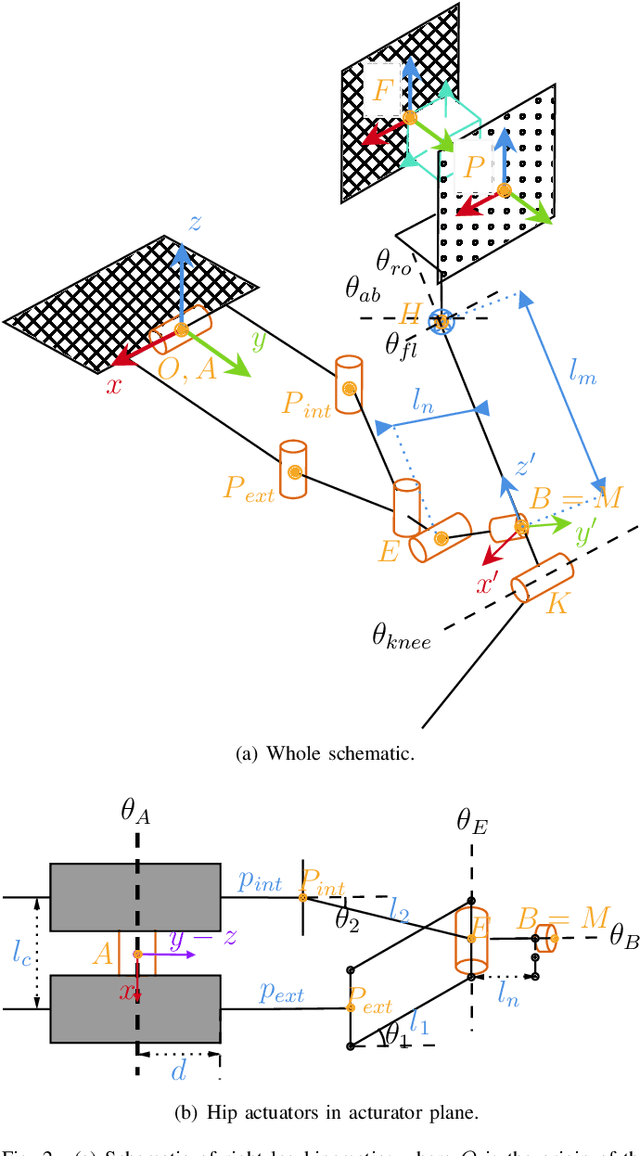
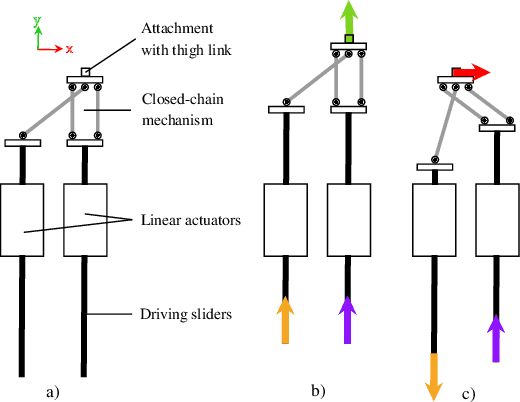
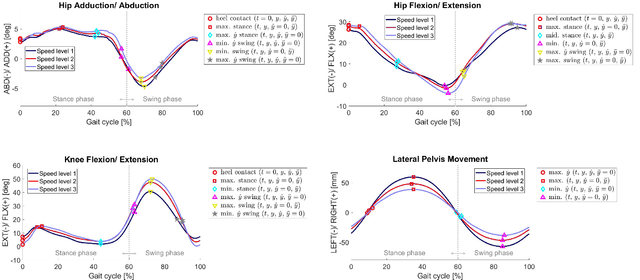
Robot-aided gait rehabilitation facilitates high-intensity and repeatable therapy. However, most exoskeletons rely on pre-recorded, non-personalized gait trajectories constrained to the sagittal plane, potentially limiting movement naturalness and user comfort. We present a data-driven gait personalization framework for an exoskeleton that supports multi-planar motion, including hip abduction/adduction and pelvic translation and rotation. Personalized trajectories to individual participants were generated using regression models trained on anthropometric, demographic, and walking speed data from a normative database. In a within-subject experiment involving ten unimpaired participants, these personalized trajectories were evaluated in regard to comfort, naturalness, and overall experience and compared against two standard patterns from the same database: one averaging all the trajectories, and one randomly selected. We did not find relevant differences across pattern conditions, despite all trajectories being executed with high accuracy thanks to a stiff position-derivative controller. We found, however, that pattern conditions in later trials were rated as more comfortable and natural than those in the first trial, suggesting that participants might have adapted to walking within the exoskeleton, regardless of the enforced gait pattern. Our findings highlight the importance of integrating subjective feedback when designing personalized gait controllers and accounting for user adaptation during experimentation.
Human-Exoskeleton Kinematic Calibration to Improve Hand Tracking for Dexterous Teleoperation
Jul 31, 2025Hand exoskeletons are critical tools for dexterous teleoperation and immersive manipulation interfaces, but achieving accurate hand tracking remains a challenge due to user-specific anatomical variability and donning inconsistencies. These issues lead to kinematic misalignments that degrade tracking performance and limit applicability in precision tasks. We propose a subject-specific calibration framework for exoskeleton-based hand tracking that uses redundant joint sensing and a residual-weighted optimization strategy to estimate virtual link parameters. Implemented on the Maestro exoskeleton, our method improves joint angle and fingertip position estimation across users with varying hand geometries. We introduce a data-driven approach to empirically tune cost function weights using motion capture ground truth, enabling more accurate and consistent calibration across participants. Quantitative results from seven subjects show substantial reductions in joint and fingertip tracking errors compared to uncalibrated and evenly weighted models. Qualitative visualizations using a Unity-based virtual hand further confirm improvements in motion fidelity. The proposed framework generalizes across exoskeleton designs with closed-loop kinematics and minimal sensing, and lays the foundation for high-fidelity teleoperation and learning-from-demonstration applications.
BiFlex: A Passive Bimodal Stiffness Flexible Wrist for Manipulation in Unstructured Environments
Apr 11, 2025Robotic manipulation in unstructured, humancentric environments poses a dual challenge: achieving the precision need for delicate free-space operation while ensuring safety during unexpected contact events. Traditional wrists struggle to balance these demands, often relying on complex control schemes or complicated mechanical designs to mitigate potential damage from force overload. In response, we present BiFlex, a flexible robotic wrist that uses a soft buckling honeycomb structure to provides a natural bimodal stiffness response. The higher stiffness mode enables precise household object manipulation, while the lower stiffness mode provides the compliance needed to adapt to external forces. We design BiFlex to maintain a fingertip deflection of less than 1 cm while supporting loads up to 500g and create a BiFlex wrist for many grippers, including Panda, Robotiq, and BaRiFlex. We validate BiFlex under several real-world experimental evaluations, including surface wiping, precise pick-and-place, and grasping under environmental constraints. We demonstrate that BiFlex simplifies control while maintaining precise object manipulation and enhanced safety in real-world applications.