 Add to Chrome
 Add to Firefox
 Add to Edge
TELLER: Dual-Path Iterative Preference Optimization for Table Entity Linking
Jul 29, 2026
Entity linking in tables matches short and ambiguous cell mentions to their corresponding knowledge-base entities. Existing approaches typically rely on data preprocessing pipelines that retain either compact or extensive table content as contextual evidence, and then formulate entity linking as a language generation task for instruction-tuned models; recent systems further incorporate explicit reasoning to disambiguate challenging mentions. However, their training supervision is usually static: fixed preference data cannot adapt to the residual errors of an evolving model, while variations in reasoning length can bias sequence-level preference learning. To address these limitations, we present TELLER: Table Entity Linking through Learning from Errors and Reasoning. We first retrieve and rank Wikidata candidates and retain reduced table evidence in the prompt. The direct-answer path applies iterative direct preference optimization and refreshes its preference data with residual errors from the updated model. The reasoning path uses filtered and compressed chain-of-thought rationales for supervised fine-tuning, followed by our iterative length-normalized regularized preference optimization. On the TableInstruct entity-linking subset, the direct-answer path improves accuracy from 94.35\% to 94.50\%; on the MammoTab V2 evaluation set, it improves accuracy from 87.59\% to 88.20\%. The reasoning path improves accuracy from 92.90\% to 92.95\% on TableInstruct and from 79.09\% to 81.85\% on MammoTab V2, while maintaining high rates of complete reasoning generation. These results show that iterative preference learning benefits both concise entity prediction and explicit reasoning.

THGFM: Dual-Branch Temporal Heterogeneous Graph Fusion Model
Jul 29, 2026Temporal heterogeneous graphs offer a natural abstraction for dynamic relational systems in which diverse node and relation types co-exist and evolve over time. Learning on such graphs requires jointly modeling cross-type structural heterogeneity and the temporal dynamics of interactions, yet existing methods still struggle to reconcile parameter-efficient cross-type transfer with relation-aware specialization, and typically inject time only as additive features outside the attention kernel. We propose \textbf{THGFM}, a web-scale temporal heterogeneous graph fusion model that addresses both limitations within a unified dual-path architecture. THGFM couples a \textit{Shared-Space Temporal Attention} branch for parameter-efficient cross-type transfer with a \textit{Relational Type-Partitioned Temporal Attention} branch for relation-aware specialization, and integrates them through \textit{Dual-Path Relational--Shared Fusion}, instantiated with \textit{Type-Conditioned Non-Competitive Gated Sum Fusion}: a adaptive mechanism that assigns independent, type-conditioned feature-wise gates to the shared and specialized branches, allowing both to be amplified or suppressed without zero-sum competition. To directly incorporate relative time into the attention score, THGFM further introduces \textit{Rotary Temporal Attention}, which rotates queries and keys by half-phases of relative time before matching. THGFM consistently outperforms baseline graph transformer models on academic graphs benchmarks, delivering a $+3.25\%$ six-task mean gain, with peak relative gains of $+12.37\%$ on OAG-CS PV, $+4.87\%$ on PF-$L_2$, and $+1.18\%$ on PF-$L_1$, and $+4.24\%$, $+3.73\%$, and $+4.61\%$ on OGBN-MAG, HTAG-ArXiv, and HTAG-DBLP, respectively.
What Does ODRL Mean? A Cross-Level Ontological Grounding of Permissions, Prohibitions, and Duties in UFO-L
Jun 23, 2026ODRL policy evaluators produce verdicts, but say nothing about the normative positions a policy brings into existence, the authority structures those positions presuppose, or who holds the power to declare a norm violated. We formulate the Cross-Level Design Principle: any normative language with violable, consequential norms requires both conduct-level positions (Permission, Duty, Right, No right) and competence-level positions (Power, Subjection, Immunity, Disability). Applying this to ODRL, we establish that prohibition is sanctioned (violation possible and consequential), that permission is underspecified across its behaviour parameter (open vs. closed world), and that the formal semantics covers achievement obligations only. We ground ODRL in UFO-L, mapping each activated rule to a simple legal relator and extending coverage from two to eight legal positions; violation-declaration authority, implicit in every existing evaluator, becomes an explicit Power-Subjection pair. All axioms are mechanically verified in Isabelle/HOL and across a 39-problem benchmark under Vampire, E, and Z3.
Unconsciously Forget: Mitigating Memorization; Without Knowing What is being Memorized
Dec 12, 2025Recent advances in generative models have demonstrated an exceptional ability to produce highly realistic images. However, previous studies show that generated images often resemble the training data, and this problem becomes more severe as the model size increases. Memorizing training data can lead to legal challenges, including copyright infringement, violations of portrait rights, and trademark violations. Existing approaches to mitigating memorization mainly focus on manipulating the denoising sampling process to steer image embeddings away from the memorized embedding space or employ unlearning methods that require training on datasets containing specific sets of memorized concepts. However, existing methods often incur substantial computational overhead during sampling, or focus narrowly on removing one or more groups of target concepts, imposing a significant limitation on their scalability. To understand and mitigate these problems, our work, UniForget, offers a new perspective on understanding the root cause of memorization. Our work demonstrates that specific parts of the model are responsible for copyrighted content generation. By applying model pruning, we can effectively suppress the probability of generating copyrighted content without targeting specific concepts while preserving the general generative capabilities of the model. Additionally, we show that our approach is both orthogonal and complementary to existing unlearning methods, thereby highlighting its potential to improve current unlearning and de-memorization techniques.
LogicAD: Explainable Anomaly Detection via VLM-based Text Feature Extraction
Jan 08, 2025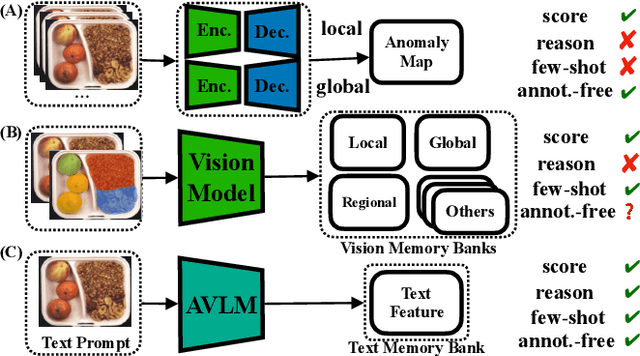
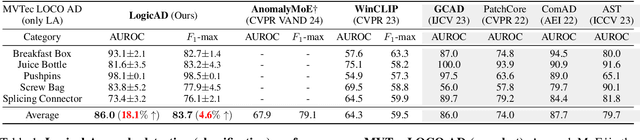
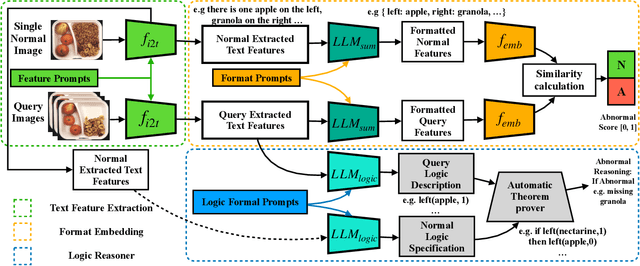
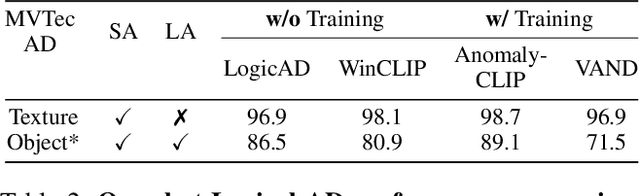
Logical image understanding involves interpreting and reasoning about the relationships and consistency within an image's visual content. This capability is essential in applications such as industrial inspection, where logical anomaly detection is critical for maintaining high-quality standards and minimizing costly recalls. Previous research in anomaly detection (AD) has relied on prior knowledge for designing algorithms, which often requires extensive manual annotations, significant computing power, and large amounts of data for training. Autoregressive, multimodal Vision Language Models (AVLMs) offer a promising alternative due to their exceptional performance in visual reasoning across various domains. Despite this, their application to logical AD remains unexplored. In this work, we investigate using AVLMs for logical AD and demonstrate that they are well-suited to the task. Combining AVLMs with format embedding and a logic reasoner, we achieve SOTA performance on public benchmarks, MVTec LOCO AD, with an AUROC of 86.0% and F1-max of 83.7%, along with explanations of anomalies. This significantly outperforms the existing SOTA method by a large margin.
Towards Enabling FAIR Dataspaces Using Large Language Models
Mar 18, 2024Dataspaces have recently gained adoption across various sectors, including traditionally less digitized domains such as culture. Leveraging Semantic Web technologies helps to make dataspaces FAIR, but their complexity poses a significant challenge to the adoption of dataspaces and increases their cost. The advent of Large Language Models (LLMs) raises the question of how these models can support the adoption of FAIR dataspaces. In this work, we demonstrate the potential of LLMs in dataspaces with a concrete example. We also derive a research agenda for exploring this emerging field.
From Large Language Models to Knowledge Graphs for Biomarker Discovery in Cancer
Oct 12, 2023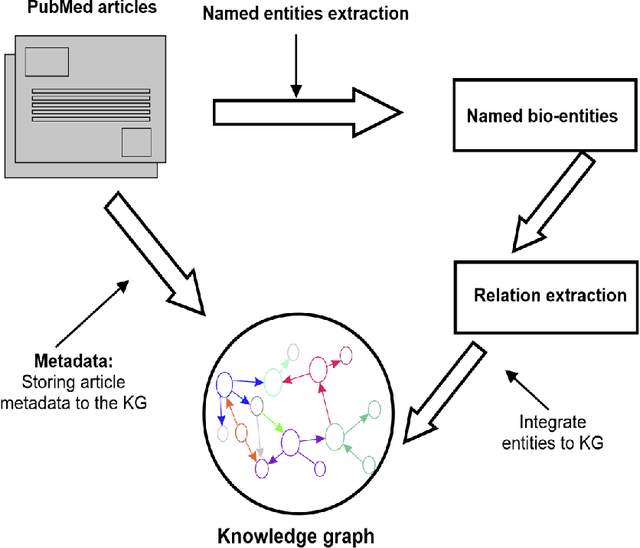
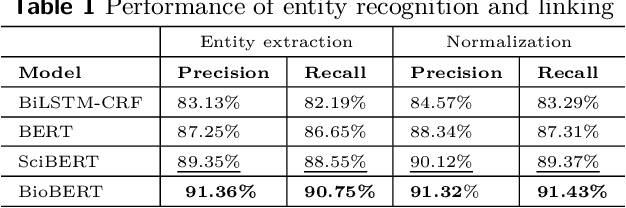
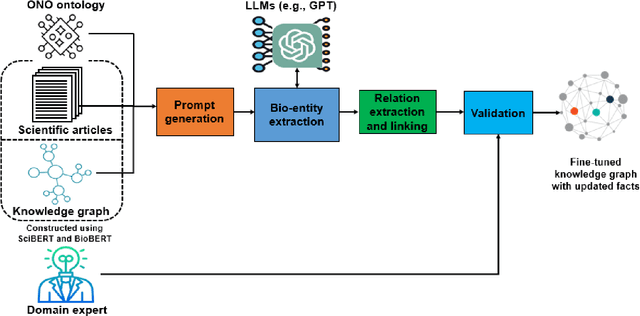
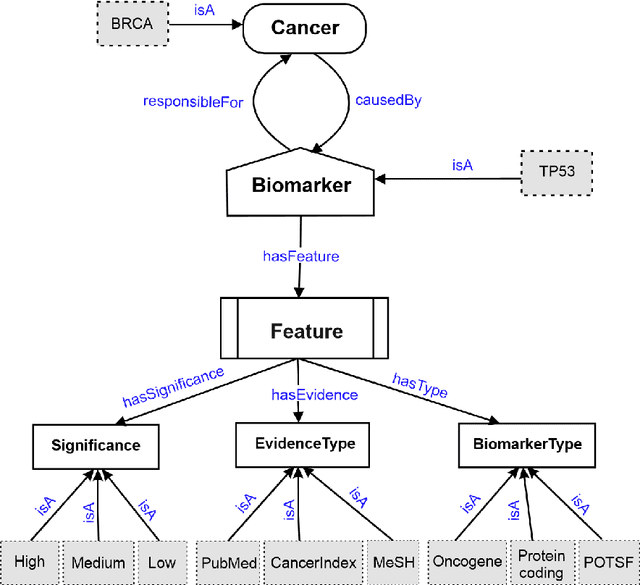
Domain experts often rely on up-to-date knowledge for apprehending and disseminating specific biological processes that help them design strategies to develop prevention and therapeutic decision-making. A challenging scenario for artificial intelligence (AI) is using biomedical data (e.g., texts, imaging, omics, and clinical) to provide diagnosis and treatment recommendations for cancerous conditions. Data and knowledge about cancer, drugs, genes, proteins, and their mechanism is spread across structured (knowledge bases (KBs)) and unstructured (e.g., scientific articles) sources. A large-scale knowledge graph (KG) can be constructed by integrating these data, followed by extracting facts about semantically interrelated entities and relations. Such KGs not only allow exploration and question answering (QA) but also allow domain experts to deduce new knowledge. However, exploring and querying large-scale KGs is tedious for non-domain users due to a lack of understanding of the underlying data assets and semantic technologies. In this paper, we develop a domain KG to leverage cancer-specific biomarker discovery and interactive QA. For this, a domain ontology called OncoNet Ontology (ONO) is developed to enable semantic reasoning for validating gene-disease relations. The KG is then enriched by harmonizing the ONO, controlled vocabularies, and additional biomedical concepts from scientific articles by employing BioBERT- and SciBERT-based information extraction (IE) methods. Further, since the biomedical domain is evolving, where new findings often replace old ones, without employing up-to-date findings, there is a high chance an AI system exhibits concept drift while providing diagnosis and treatment. Therefore, we finetuned the KG using large language models (LLMs) based on more recent articles and KBs that might not have been seen by the named entity recognition models.
A Biomedical Knowledge Graph for Biomarker Discovery in Cancer
Feb 23, 2023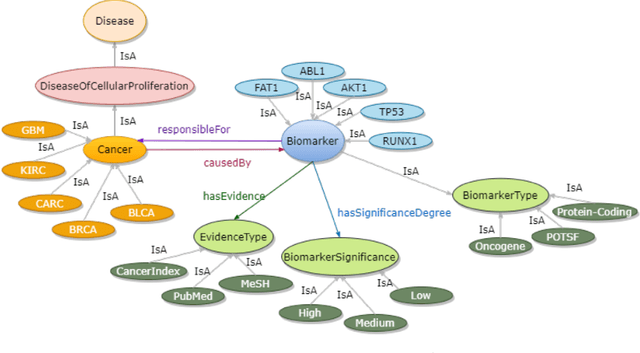
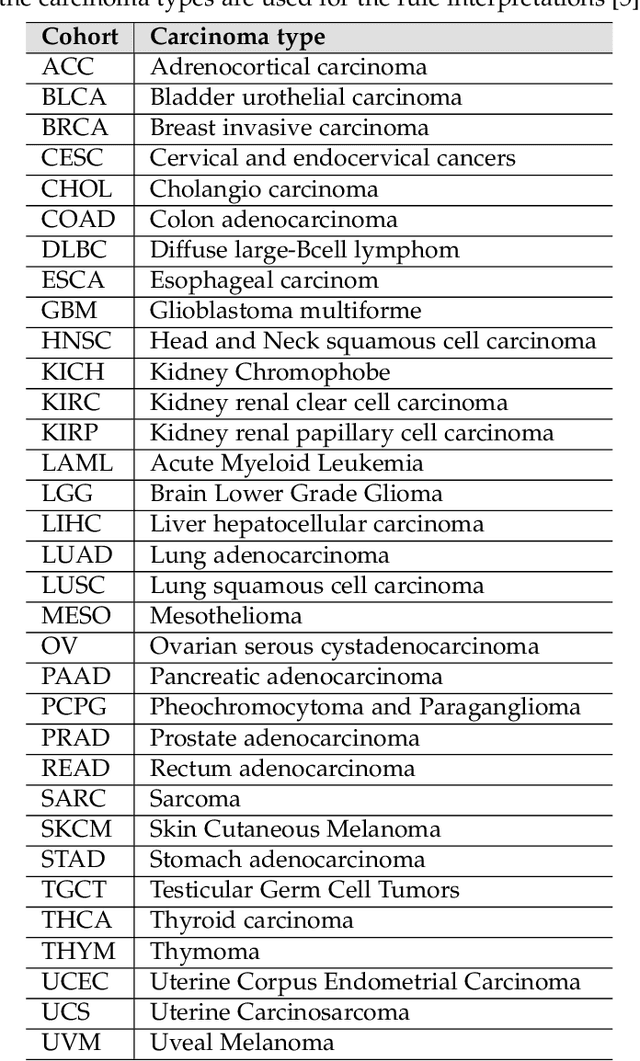
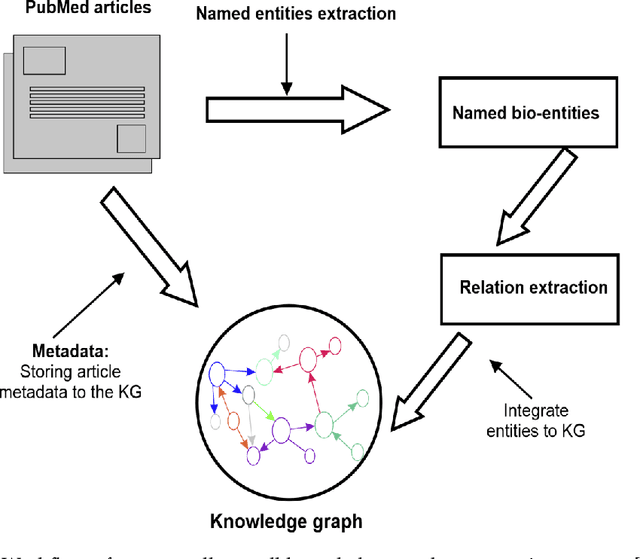
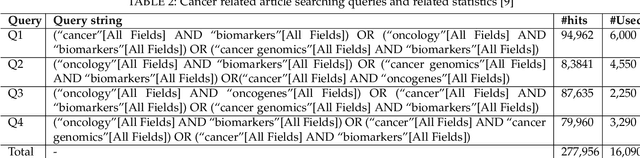
Structured and unstructured data and facts about drugs, genes, protein, viruses, and their mechanism are spread across a huge number of scientific articles. These articles are a large-scale knowledge source and can have a huge impact on disseminating knowledge about the mechanisms of certain biological processes. A domain-specific knowledge graph~(KG) is an explicit conceptualization of a specific subject-matter domain represented w.r.t semantically interrelated entities and relations. A KG can be constructed by integrating such facts and data and be used for data integration, exploration, and federated queries. However, exploration and querying large-scale KGs is tedious for certain groups of users due to a lack of knowledge about underlying data assets or semantic technologies. Such a KG will not only allow deducing new knowledge and question answering(QA) but also allows domain experts to explore. Since cross-disciplinary explanations are important for accurate diagnosis, it is important to query the KG to provide interactive explanations about learned biomarkers. Inspired by these, we construct a domain-specific KG, particularly for cancer-specific biomarker discovery. The KG is constructed by integrating cancer-related knowledge and facts from multiple sources. First, we construct a domain-specific ontology, which we call OncoNet Ontology (ONO). The ONO ontology is developed to enable semantic reasoning for verification of the predictions for relations between diseases and genes. The KG is then developed and enriched by harmonizing the ONO, additional metadata schemas, ontologies, controlled vocabularies, and additional concepts from external sources using a BERT-based information extraction method. BioBERT and SciBERT are finetuned with the selected articles crawled from PubMed. We listed down some queries and some examples of QA and deducing knowledge based on the KG.
Explainable AI for Bioinformatics: Methods, Tools, and Applications
Dec 25, 2022Artificial intelligence(AI) systems based on deep neural networks (DNNs) and machine learning (ML) algorithms are increasingly used to solve critical problems in bioinformatics, biomedical informatics, and precision medicine. However, complex DNN or ML models that are unavoidably opaque and perceived as black-box methods, may not be able to explain why and how they make certain decisions. Such black-box models are difficult to comprehend not only for targeted users and decision-makers but also for AI developers. Besides, in sensitive areas like healthcare, explainability and accountability are not only desirable properties of AI but also legal requirements -- especially when AI may have significant impacts on human lives. Explainable artificial intelligence (XAI) is an emerging field that aims to mitigate the opaqueness of black-box models and make it possible to interpret how AI systems make their decisions with transparency. An interpretable ML model can explain how it makes predictions and which factors affect the model's outcomes. The majority of state-of-the-art interpretable ML methods have been developed in a domain-agnostic way and originate from computer vision, automated reasoning, or even statistics. Many of these methods cannot be directly applied to bioinformatics problems, without prior customization, extension, and domain adoption. In this paper, we discuss the importance of explainability with a focus on bioinformatics. We analyse and comprehensively overview of model-specific and model-agnostic interpretable ML methods and tools. Via several case studies covering bioimaging, cancer genomics, and biomedical text mining, we show how bioinformatics research could benefit from XAI methods and how they could help improve decision fairness.
Question Answering Over Biological Knowledge Graph via Amazon Alexa
Oct 12, 2022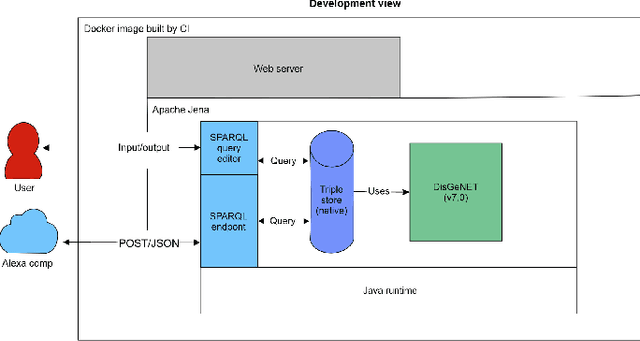
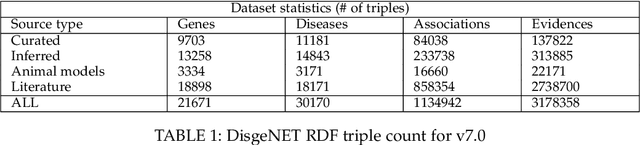
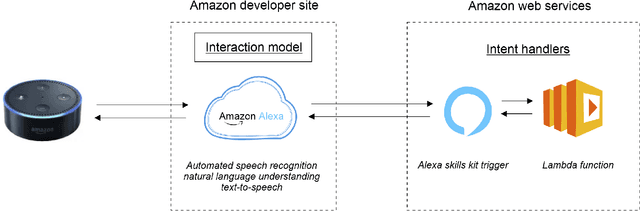
Structured and unstructured data and facts about drugs, genes, protein, viruses, and their mechanism are spread across a huge number of scientific articles. These articles are a large-scale knowledge source and can have a huge impact on disseminating knowledge about the mechanisms of certain biological processes. A knowledge graph (KG) can be constructed by integrating such facts and data and be used for data integration, exploration, and federated queries. However, exploration and querying large-scale KGs is tedious for certain groups of users due to a lack of knowledge about underlying data assets or semantic technologies. A question-answering (QA) system allows the answer of natural language questions over KGs automatically using triples contained in a KG. Recently, the use and adaption of digital assistants are getting wider owing to their capability at enabling users to voice commands to control smart systems or devices. This paper is about using Amazon Alexa's voice-enabled interface for QA over KGs. As a proof-of-concept, we use the well-known DisgeNET KG, which contains knowledge covering 1.13 million gene-disease associations between 21,671 genes and 30,170 diseases, disorders, and clinical or abnormal human phenotypes. Our study shows how Alex could be of help to find facts about certain biological entities from large-scale knowledge bases.