 Add to Chrome
 Add to Firefox
 Add to Edge
K-EXAONE 2.0 Technical Report
Aug 05, 2026
This technical report presents K-EXAONE 2.0, an open-weight multilingual foundation model developed by LG AI Research as a step in our effort toward global frontier-scale foundation models. Rather than training from scratch, we upcycle K-EXAONE and expand its architecture, yielding a Mixture-of-Experts (MoE) model with 750B total parameters and approximately 37B activated per token---more than three times the capacity of its predecessor. K-EXAONE 2.0 supports context lengths of up to 256K tokens and expands multilingual coverage from six to ten languages. Its training pipeline combines continual pre-training, difficulty-focused mid-training, and post-training to strengthen reasoning, agentic coding, multilingual capability, and safety grounded in Korean sociocultural contexts. Across nine evaluation categories selected to reflect the conditions of practical use, K-EXAONE 2.0 improves over K-EXAONE and remains competitive with open-weight models, showing its largest gains in agentic coding and long-context understanding and its clearest strengths in long-context retrieval and safety. Released under the Apache 2.0 license, K-EXAONE 2.0 enables the wider AI ecosystem to evaluate, deploy, adapt, and build upon it, while marking the beginning---rather than the endpoint---of our challenge toward the global frontier.

VinQA: Visual Elements Interleaved Long-form Answer Generation for Real-World Multimodal Document QA
Jun 15, 2026Real-world documents combine text with tables, charts, photographs, and diagrams arranged in diverse layouts, yet existing research on multimodal large language models (MLLMs) for document QA predominantly produces text-only responses, underutilizing these visual elements. We introduce VinQA, a dataset for long-form answer generation where cited visual elements are explicitly interleaved with their supporting text and grounded in relevant document pages. To support this task, we study two encoding methods for feeding raw document page images into an MLLM, along with their visual-element citation mechanisms: (1) Page Encoding, which directly encodes full-page images with bounding boxes of visual elements and treats these boxed regions as citable units; and (2) Modality Encoding, which parses each page to extract text and crop visual elements, encodes them separately, and uses these cropped elements as citable units. In our experiments, we propose M-GroSE, a multimodal evaluation framework extending GroUSE to assess answers along four dimensions: completeness, answer relevancy, faithfulness, and unanswerability. We additionally report Visual Source F1 to directly measure visual citation accuracy. Although proprietary frontier models still achieve the best overall scores on the VinQA test split, fine-tuning open Qwen2.5-VL models on the training split substantially improves their performance and narrows this gap. Modality Encoding is initially more robust for complex documents with long text, many visual elements, and diverse citation requirements. After training on VinQA, however, Page Encoding reaches a comparable level, competing effectively even without the explicit parsing used in Modality Encoding. Finally, Visual G-Eval, an MLLM-based judge, confirms that fine-tuned models insert visual elements at semantically appropriate positions with faithful supporting text.
ARHN: Answer-Centric Relabeling of Hard Negatives with Open-Source LLMs for Dense Retrieval
Apr 13, 2026Neural retrievers are often trained on large-scale triplet data comprising a query, a positive passage, and a set of hard negatives. In practice, hard-negative mining can introduce false negatives and other ambiguous negatives, including passages that are relevant or contain partial answers to the query. Such label noise yields inconsistent supervision and can degrade retrieval effectiveness. We propose ARHN (Answer-centric Relabeling of Hard Negatives), a two-stage framework that leverages open-source LLMs to refine hard negative samples using answer-centric relevance signals. In the first stage, for each query-passage pair, ARHN prompts the LLM to generate a passage-grounded answer snippet or to indicate that the passage does not support an answer. In the second stage, ARHN applies an LLM-based listwise ranking over the candidate set to order passages by direct answerability to the query. Passages ranked above the original positive are relabeled to additional positives. Among passages ranked below the positive, ARHN excludes any that contain an answer snippet from the negative set to avoid ambiguous supervision. We evaluated ARHN on the BEIR benchmark under three configurations: relabeling only, filtering only, and their combination. Across datasets, the combined strategy consistently improves over either step in isolation, indicating that jointly relabeling false negatives and filtering ambiguous negatives yields cleaner supervision for training neural retrieval models. By relying strictly on open-source models, ARHN establishes a cost-effective and scalable refinement pipeline suitable for large-scale training.
EXAONE 4.5 Technical Report
Apr 09, 2026This technical report introduces EXAONE 4.5, the first open-weight vision language model released by LG AI Research. EXAONE 4.5 is architected by integrating a dedicated visual encoder into the existing EXAONE 4.0 framework, enabling native multimodal pretraining over both visual and textual modalities. The model is trained on large-scale data with careful curation, particularly emphasizing document-centric corpora that align with LG's strategic application domains. This targeted data design enables substantial performance gains in document understanding and related tasks, while also delivering broad improvements across general language capabilities. EXAONE 4.5 extends context length up to 256K tokens, facilitating long-context reasoning and enterprise-scale use cases. Comparative evaluations demonstrate that EXAONE 4.5 achieves competitive performance in general benchmarks while outperforming state-of-the-art models of similar scale in document understanding and Korean contextual reasoning. As part of LG's ongoing effort toward practical industrial deployment, EXAONE 4.5 is designed to be continuously extended with additional domains and application scenarios to advance AI for a better life.
K-EXAONE Technical Report
Jan 05, 2026This technical report presents K-EXAONE, a large-scale multilingual language model developed by LG AI Research. K-EXAONE is built on a Mixture-of-Experts architecture with 236B total parameters, activating 23B parameters during inference. It supports a 256K-token context window and covers six languages: Korean, English, Spanish, German, Japanese, and Vietnamese. We evaluate K-EXAONE on a comprehensive benchmark suite spanning reasoning, agentic, general, Korean, and multilingual abilities. Across these evaluations, K-EXAONE demonstrates performance comparable to open-weight models of similar size. K-EXAONE, designed to advance AI for a better life, is positioned as a powerful proprietary AI foundation model for a wide range of industrial and research applications.
DEER: A Comprehensive and Reliable Benchmark for Deep-Research Expert Reports
Dec 19, 2025As large language models (LLMs) advance, deep research systems can generate expert-level reports via multi-step reasoning and evidence-based synthesis, but evaluating such reports remains challenging. Existing benchmarks often lack systematic criteria for expert reporting, evaluations that rely heavily on LLM judges can fail to capture issues that require expert judgment, and source verification typically covers only a limited subset of explicitly cited statements rather than report-wide factual reliability. We introduce DEER, a benchmark for evaluating expert-level deep research reports. DEER comprises 50 report-writing tasks spanning 13 domains and an expert-grounded evaluation taxonomy (7 dimensions, 25 sub-dimension) operationalized into 130 fine-grained rubric items. DEER further provides task-specific expert guidance to help LLM judges assess expert-level report quality more consistently. Complementing rubric-based assessment, we propose a document-level fact-checking architecture that extracts and verifies all claims across the entire report, including both cited and uncited ones, and quantifies external-evidence quality. DEER correlates closely with human expert judgments and yields interpretable diagnostics of system strengths and weaknesses.
EXAONE 4.0: Unified Large Language Models Integrating Non-reasoning and Reasoning Modes
Jul 15, 2025This technical report introduces EXAONE 4.0, which integrates a Non-reasoning mode and a Reasoning mode to achieve both the excellent usability of EXAONE 3.5 and the advanced reasoning abilities of EXAONE Deep. To pave the way for the agentic AI era, EXAONE 4.0 incorporates essential features such as agentic tool use, and its multilingual capabilities are extended to support Spanish in addition to English and Korean. The EXAONE 4.0 model series consists of two sizes: a mid-size 32B model optimized for high performance, and a small-size 1.2B model designed for on-device applications. The EXAONE 4.0 demonstrates superior performance compared to open-weight models in its class and remains competitive even against frontier-class models. The models are publicly available for research purposes and can be easily downloaded via https://huggingface.co/LGAI-EXAONE.
LG-ANNA-Embedding technical report
Jun 09, 2025This report presents a unified instruction-based framework for learning generalized text embeddings optimized for both information retrieval (IR) and non-IR tasks. Built upon a decoder-only large language model (Mistral-7B), our approach combines in-context learning, soft supervision, and adaptive hard-negative mining to generate context-aware embeddings without task-specific fine-tuning. Structured instructions and few-shot examples are used to guide the model across diverse tasks, enabling strong performance on classification, semantic similarity, clustering, and reranking benchmarks. To improve semantic discrimination, we employ a soft labeling framework where continuous relevance scores, distilled from a high-performance dense retriever and reranker, serve as fine-grained supervision signals. In addition, we introduce adaptive margin-based hard-negative mining, which filters out semantically ambiguous negatives based on their similarity to positive examples, thereby enhancing training stability and retrieval robustness. Our model is evaluated on the newly introduced MTEB (English, v2) benchmark, covering 41 tasks across seven categories. Results show that our method achieves strong generalization and ranks among the top-performing models by Borda score, outperforming several larger or fully fine-tuned baselines. These findings highlight the effectiveness of combining in-context prompting, soft supervision, and adaptive sampling for scalable, high-quality embedding generation.
EXAONE Deep: Reasoning Enhanced Language Models
Mar 16, 2025We present EXAONE Deep series, which exhibits superior capabilities in various reasoning tasks, including math and coding benchmarks. We train our models mainly on the reasoning-specialized dataset that incorporates long streams of thought processes. Evaluation results show that our smaller models, EXAONE Deep 2.4B and 7.8B, outperform other models of comparable size, while the largest model, EXAONE Deep 32B, demonstrates competitive performance against leading open-weight models. All EXAONE Deep models are openly available for research purposes and can be downloaded from https://huggingface.co/LGAI-EXAONE
KL Penalty Control via Perturbation for Direct Preference Optimization
Feb 18, 2025
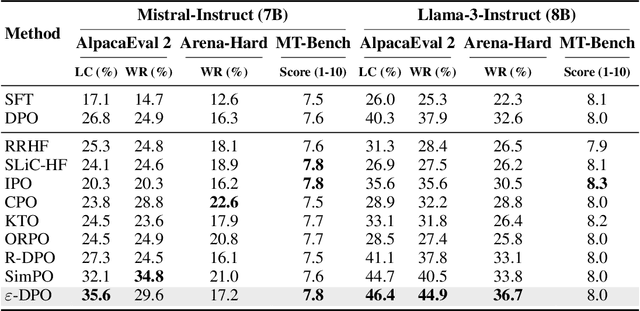
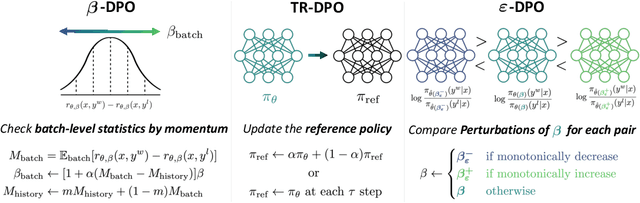
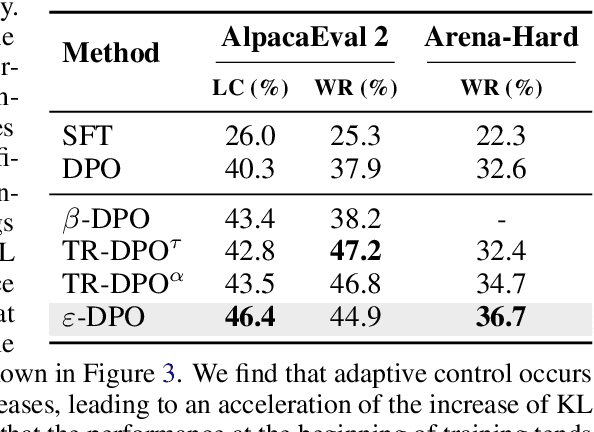
Direct Preference Optimization (DPO) demonstrates the advantage of aligning a large language model with human preference using only an offline dataset. However, DPO has the limitation that the KL penalty, which prevents excessive deviation from the reference model, is static throughout the training process. Several methods try to turn this static KL penalty into a dynamic one, but no approach can adaptively assign different KL penalties for each preference pair. In this paper, we propose $\varepsilon$-Direct Preference Optimization ($\varepsilon$-DPO), which allows adaptive control of the KL penalty strength $\beta$ for each preference pair. Specifically, $\varepsilon$-DPO adaptively controls $\beta$ for each preference pair based on the monotonicity of logits as a preference model under the perturbation of $\beta$ during training by simply reusing the logit of the current policy and the reference policy. Experimental results show that $\varepsilon$-DPO outperforms existing direct alignment algorithms and KL penalty relaxation methods on general chatbot benchmarks, highlighting the significance of adaptive KL penalty relaxation at the instance-level in DPO.