 Add to Chrome
 Add to Firefox
 Add to Edge
Scalable and Differentiable Point-Cloud Registration Using Maximum Mean Discrepancy
Jun 26, 2026
We present MMD-Reg, a novel correspondence-free approach to point-cloud registration that is differentiable and has linear computational complexity in the number of points. We model registration as a nonlinear least-squares problem based on the Maximum Mean Discrepancy, approximated using random Fourier features. The resulting objective can be solved efficiently with standard methods such as Levenberg-Marquardt, and the solution is differentiable via the implicit function theorem. This allows MMD-Reg to be used as a differentiable optimization layer within end-to-end trainable models, supporting registration under challenging conditions such as poor initial alignment and partial overlap. We demonstrate this Neural MMD-Reg formulation by integrating the layer with a set transformer, training the resulting model in supervised and unsupervised settings, and comparing its performance against recent learning-based methods. We also evaluate standalone MMD-Reg, comparing its accuracy and scalability against widely used non-learning-based registration methods.

Joint Inference of Multiple Label Types in Large Networks
Jan 30, 2014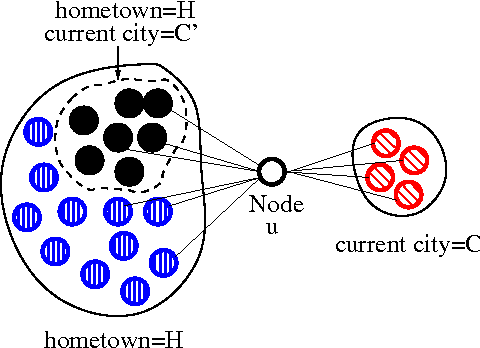
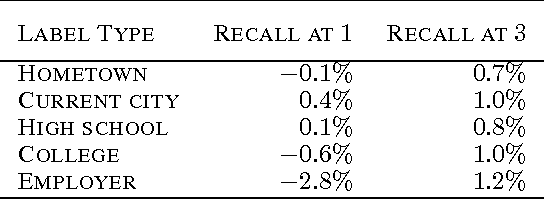
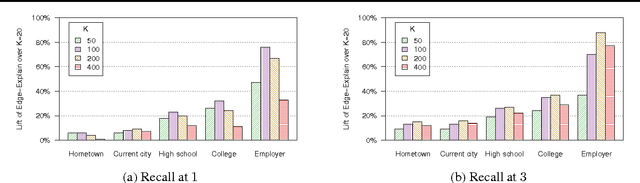
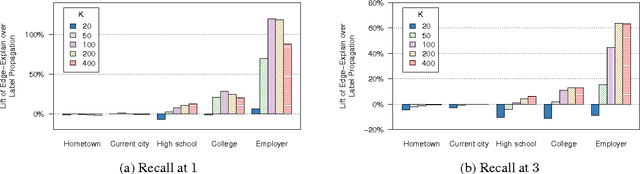
We tackle the problem of inferring node labels in a partially labeled graph where each node in the graph has multiple label types and each label type has a large number of possible labels. Our primary example, and the focus of this paper, is the joint inference of label types such as hometown, current city, and employers, for users connected by a social network. Standard label propagation fails to consider the properties of the label types and the interactions between them. Our proposed method, called EdgeExplain, explicitly models these, while still enabling scalable inference under a distributed message-passing architecture. On a billion-node subset of the Facebook social network, EdgeExplain significantly outperforms label propagation for several label types, with lifts of up to 120% for recall@1 and 60% for recall@3.